/filters:format(webp)/filters:quality(100)/prod01/channel_3/media/tcd/langs-lits-cultures/images/news-and-events/TCD-HonoraryDegrees2526-855X400px.png)
Corinna Salvadori Lonergan (Litt.D.)
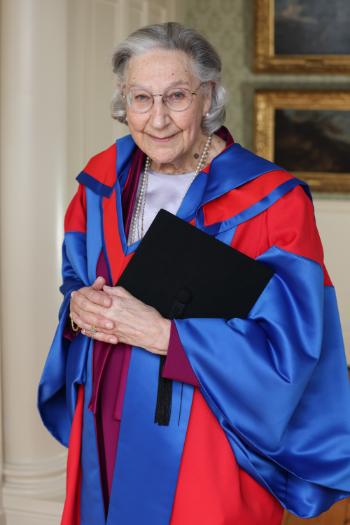 Corinna Salvadori Lonergan is the child of classical musicians who, after harsh wartime experiences, came from Florence to Dublin to play in the Radio Éireann Symphony Orchestra. Her Master’s thesis on Yeats and Castiglione was published as a monograph by Allen Figgis in 1965, while she was still in her twenties and it gave a taste of the passion, erudition and intellectual rigour that came to characterize her scholarship ever since. She was appointed to a lectureship in Trinity in 1961 as a Junior Lecturer. Until her “retirement” in 2001 she then led, with energy and integrity, and without sabbatical leave for some decades, a short-staffed and sometimes precarious department that, through thick and thin, made a strong contribution to Modern Languages. Her teaching commitments continued after “retirement”; for many years she has offered specialist options for Italianists as well as supervising postgraduate students on recently developed MPhil degrees. Students continue to praise her academic rigour, vast knowledge and warmth. Fittingly, when the Provost’s teaching awards were first introduced, she was given a lifetime award for her contribution to teaching. She has, for 65 years epitomised the teaching of Modern Languages in Trinity. She was instrumental in strengthening and developing the infrastructure of modern language study not just in these islands but also further afield. Indeed, the Society for Italian Studies awarded her life membership, in recognition of her outstanding presence within the discipline, and the International Association of Italian Professors (AIPI) appointed her Honorary President of the Association at the end of her presidency. Again fittingly, the Italian Government conferred her with the title of Commendatore in the “Ordine al Merito della Repubblica Italiana”, Italy’s most prestigious honour. Her research has been prolific focusing on Castiglione, Dante Alighieri and Lorenzo de’ Medici. The apparatus accompanying her seminal centenary edition of Lorenzo’s Selected writings (1992) includes over 100 pages of introductory analysis and annotation, together with lively English verse translations of poetry and drama. Other verse translations include Angelo Poliziano’s Orfeo (2013). Her first involvement in a Dante project dates from 1963; the latest is in press. She has published on the poetry of Michelangelo and Ariosto, and (from several angles) on the complex entanglements of Dante and Beckett. She is co-editor of Italian Culture: Interactions, Transpositions, Translations (2006), co-ordinating editor of the AIPI collection Insularità e cultura mediterranea nella lingua e nella letteratura italiana (645 pages, 2012) and co-editor of Medieval Studies, Translation, Creativity (2022). Beyond her extraordinary contribution to Modern Languages in Trinity College Corinna Lonergan has been and continues to be the epitome of what a ‘good citizen’ is in Trinity and, she is consequently a stellar representative of the discipline of Modern Languages. With boundless energy, she continues to teach, advise, organize events and propose new initiatives and through her grace and kindness she continues to inspire and mentor many, many young and emerging academics. She has been an inspiration and a role model for generations of, in particular, female students and colleagues and today embodies what is best about Trinity and its traditions.
Eda Sagarra (Litt.D.)
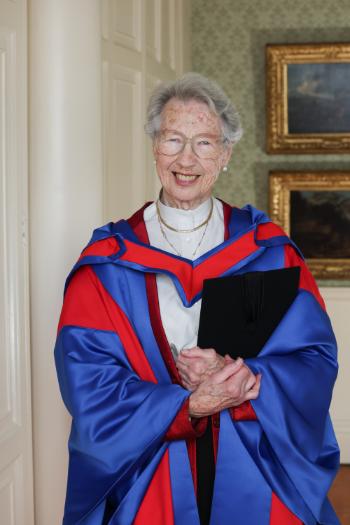 From 1975 until 1998 Eda Sagarra was the first female holder of the Chair of German (1776) at TCD. Her time as Chair of German and Head of Department was absolutely transformational for her discipline, for Modern Languages more broadly, and for the position of women in College and, more generally, in academia. In 1979 she became Dean for International Students and on becoming Registrar in 1981 she was the first woman in the history of the College to hold a statutory officership. From 2000 to 2008 she served as Pro-Chancellor of the University of Dublin. Beyond Trinity, she was Secretary of the Royal Irish Academy and after her retirement she was for five years the Founding Chair of the Irish Research Council of the Humanities and Social Sciences (IRCHSS) – a body whose existence owes a great deal to her vision and energy. In acknowledgment of her work, Research Ireland annually award the Eda Sagarra Medal of Excellence to the top-ranked PG researcher in the Humanities and Social Sciences. Her academic work has been extremely influential in German Studies. Ten volumes and over 120 peer reviewed articles and chapters in books are testament to her enormous erudition and boundless intellectual curiosity. Eda Sagarra is considered one of the founders of the social history of literature in German Studies. All of her monographs are magisterial, much quoted standard works. On the European front, she was a powerful advocate for the Humanities and an influential ambassador of Irish academia. She served on many influential commissions of the European Science Foundation and the Deutsche Forschungs Gemeinschaft and other institutions. Within Trinity, and with inexhaustible energy, enthusiasm and persuasive power she was the driving force between the design and implementation of multiple new degree courses such as European Studies, Business and a Language, Law and a Language and Computer Science, Linguistics and a Language, all with a mandatory year abroad, making maximum use of the opportunities the new Erasmus-programs offered. The high international reputation that Modern Languages at Trinity enjoy today has its foundation in the work of Eda Sagarra and her colleagues. For over 50 years she has been a much-admired inspirational role model for women in academia breaking multiple glass ceilings. As her 2022 memoir, Living with my Century, shows, she had to face many forms of gender-based discrimination, many subtle and some not so subtle, which today seem outrageous, but which she confronted with skill and aplomb. Her exceptional achievements have been recognized on many fronts: she is holder of the German Order of Merit, the Bundesverdienstkreuz, the Austrian Ehrenkreuz for Science and Art and she was awarded the Goethe Medal of the Goethe-Institut in 1990. In 1995 she was the recipient of the Grimm Preis for German Studies Abroad and was elected a Corresponding Member of the Austrian Academy of Sciences in 1996. In 2022 she was awarded the Fontane-Wissenschaftspreis for her academic work on the 19th century novelist Theodor Fontane.
Read more
Main image: Linguistics and language scholar David Little, Italian scholar Corinna Salvadori Lonergan, literary translator Hans-Christian Oeser and Eda Sagarra, Trinity's first female Chair of German, pictured with Chancellor Dr Mary McAleese and Provost Dr Linda Doyle after the ceremony.