Finding and Building a New Path to Purpose: An Alum Q&A with Seamus Burns
Stepping out of a career you’ve known for a decade is terrifying. For ten years, Séamus Burns worked as a primary school teacher. He loved his profession, but he kept seeing systemic, heavy challenges popping up in the education sector and felt entirely powerless to solve them.
Then, he discovered the Postgraduate Certificate in Innovation & Enterprise Development.
One year after graduating, Séamus has successfully transitioned his career, using the exact frameworks he learned in class to launch his own business, Well2Teach, dedicated to teacher well-being and burnout prevention. We sat down with him to talk about the grey areas of innovation, overcoming self-doubt, and why your future self will thank you for taking the leap.
Q: What was your professional background, and what made you decide to apply for this programme?
I’ve been a primary school teacher for the last ten years. Honestly, I was pretty stuck in the teacher mindset. I saw so many challenges popping up in education, and I knew something needed to be done, but I had absolutely no idea how to go about it. I was browsing Springboard courses, and this one immediately jumped out at me. From the moment I attended the open evening, I knew this was the exact toolkit I needed to tackle these problems. I haven't regretted it for a single second.
Q: What was the transition like from starting on the programme to progressing through the modules?
I remember that initial meeting as though it was yesterday! I had this massive wave of panic right after: “Oh my god, have I gotten myself in way too deep here?”. But as Module 1 progressed, I realised it wasn't a birth by fire at all. It was challenging in the absolute best way, but the teaching team eased us into the rhythm of things. Once I got used to how the frameworks worked, it became incredibly manageable and deeply rewarding.
Q: The learning approach relies heavily on group work with people from completely different backgrounds. What did you learn from that experience?
It was a massive eye-opener. In your own sector, it’s easy to suffer from what I call ‘main character syndrome’ – for example, thinking, “I work in education, so I know exactly what the education problem is and how to fix it.” But when you sit in a group with engineers, corporate managers, and creatives, they look at your problem from entirely different angles. It forces you to get out of your own head, empathise with different perspectives, and co-create a solution that actually works. We definitely ‘butt heads’ from time to time during our Zoom sessions, but always in a highly respectful, productive way. It taught me how to collaborate on a whole new level.
 Q: Was there a specific tool or assignment that completely shifted your mindset?
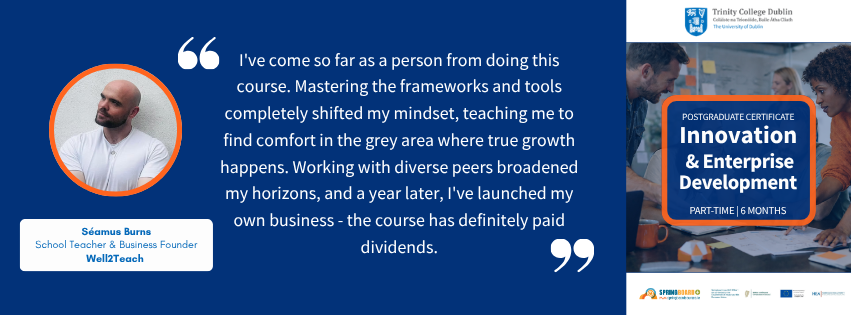
Without a doubt, the Design Thinking process and Empathy Mapping. Instead of guessing what teachers needed, the course taught me how to sit down, conduct structured stakeholder interviews, and map out their actual pain points. I spent six months doing deep research based on those exact tools before launching my business.
The other game-changer was the elevator pitch in Module 2. It’s highly challenging to distil your entire idea into just two minutes, but the presentation and leadership skills I mastered during that assignment are the exact ones I use today to build my community, lead conversations, and generate followers on social media.
Q: Many innovators struggle with imposter syndrome or over-thinking and over-analysing their work. Did you experience this?
Oh, absolutely. I suffered from major paralysis by analysis. During the elevator pitch module, I had this massive internal battle, catastrophising everything and thinking, “I don't believe in myself. This idea isn't good enough to put out there.”
But the beauty of this programme is the incredible psychological safety net the class and the instructors provide. You feel so safe to express half-baked ideas, get constructive feedback, and refine them. Once I pushed through that fear, that self-limiting mentality completely vanished. I don’t suffer from that self-doubt anymore.
Q: Where are you now, a year after graduating, and how has your life changed?
I've actually taken a break from substitute teaching to set up my own business helping teachers with well-being and burnout prevention. The response has been amazing. I have principals and teachers reaching out to me on social media and in schools asking for my opinion and guidance. The course didn’t just give me an academic qualification; it gave me the entrepreneurial tools and the personal confidence to build something from scratch.
Q: What would you say to someone who is currently looking at the application page but is hesitant to apply?
Just feel the fear and do it anyway! Put in the application and go for it. Yes, you will be challenged, and yes, you will have to confront some of your own self-beliefs. But I promise you, in the future, your future self will be looking back and thanking your past self for actually taking this step. You have absolutely nothing to lose and a whole new path to gain.