A Multi-dimensional Approach to Climate Crisis: An Alum Q&A with Pablo Celis
We spoke with Pablo Celis, an economist with a background in energy finance and technology, about how the Postgraduate Certificate in Climate Entrepreneurship helped him move from researching carbon footprints to developing his own energy efficiency venture, e-Spark.
Q: Pablo, what was your background, and what originally drew you to this climate programme?
"My background is in economics, energy finance, and technology. I had some experience in developing ideas and entrepreneurship, and I was already researching carbon footprints. When I saw the course, I wanted to become more serious about the topic of climate entrepreneurship. I wanted the tools to take my ideas and develop them into a real, structured project."
Q: Group work is a massive part of this course. What was your experience collaborating with people from so many different backgrounds?
"On the very first day, they put us in a group and said, 'Guys, come up with a problem based on your background and resolve it.' In my group, we had an electrical engineer, a teacher, a lawyer, a finance person, and myself in economics. None of us had formal climate science backgrounds, and we all had completely different professional views on how to solve a problem.
Our project looked at transport and energy. That is when you truly understand how important it is to have the view of the other person and bring them together. Working alone, it will never work. Having a multicultural, multi-professional group is the most important part of the learning."
Q: What was the standout tool or 'aha!' moment for you on the course?
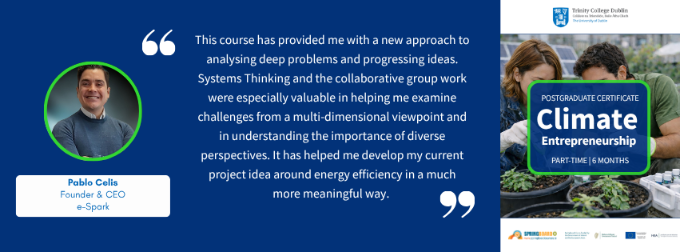
"For me, it was Systems Thinking. It gave me a much broader, global view to analyse a problem from multiple dimensions. Previously, I was mostly focused on Design Thinking, which is a much narrower view. Systems thinking changed my whole perspective. Plus, having about four industry specialists come in per module to share their deep knowledge and tips on entrepreneurship was incredibly valuable."
Q: How have you applied what you learned on the course to your career since graduating?
"It has had a massive, direct impact. My course project started with a funding method for EV chargers, solving the 'chicken and egg' problem of why there aren't enough chargers because there aren't enough electric cars.
But after the course, as I continued researching the EV charging sector, I realised that financing was not the core challenge, it was the "profitability". That led me to explore alternative revenue streams, including carbon credits, and later to regulatory frameworks such as RED III. Those discoveries significantly changed the direction of the business.
Today, e-Spark is developing compliance infrastructure that enables the creation, management and verification of environmental attributes and energy-efficiency related certificates under emerging European regulatory frameworks. The company has continued to evolve significantly beyond the original course project, and we are now exploring opportunities across several European markets, including Germany, Belgium, Norway and the UK. I even keep in touch with my tutor from the course when I need advice. It gave me the foundation to keep going deeper."
Want to Hear More About the Climate Entrepreneurship course experience?
You can watch back the Spotlight on Healthcare Innovation with Pablo, Jeanne le Corre, course coordinator and Dr Dan Rogers, Head of Education at Trinity Innovation & Enterprise - register here to access the Climate Entrepreneurship Spotlight Event recording.