
Building Your Toolkit, Voice & Mindset for Healthcare Innovation: An Alum Q&A with Belenda Ryan
Returning to the workforce after a five-year career break is a powerful transition, especially when stepping straight into a fast-paced, digital health environment. For Belenda Ryan, a nurse by background who had transitioned into healthcare management, her return to work with Care-Connect (part of Centric Health) represented an exciting new professional frontier.
Surrounded by forward-thinking teams developing digital chronic disease management services, Belenda immediately spotted an opportunity. Rather than just keeping pace, she wanted to master the modern language of digital service design, validate her extensive expertise, and build a robust, contemporary toolkit. This ambition led her straight to the Postgraduate Certificate in Healthcare Innovation.
We sat down with Belenda to hear how she used the programme to elevate her career, conquer classroom insecurities, and emerge as a champion of digital healthcare change.
Q: Belenda, thank you for sharing your story. What was your main motivation for enrolling in the course after your career break?
Honestly, after being out of the workforce for over five years, I felt a level of insecurity. I was in awe of how my new colleagues at Care Connect came up with these incredible digital healthcare pathways, and I wanted to understand that language. I didn’t join with the intention of starting my own business; I joined because I wanted to grow, rebuild my confidence, and understand the science behind design thinking.
Q: Coming back to an academic environment must have been daunting. How did you handle those initial insecurities?
It was tough at first, particularly regarding digital skills. While I’m digitally savvy, I’m not a digital native like some of the younger members of our cohort. But the support system was incredible.
Right at the start of the course, our study groups signed a ‘Group Contract’. It was our way of agreeing on how we’d communicate, what our values were, and how we'd support each other. It established immediately that everyone had an equal voice, regardless of whether you were a doctor, a nurse, or an administrator. If you got stuck on something, you’d just say it in our group, and someone would instantly step up to help.
Q: What was the classroom dynamic like with such a diverse mix of backgrounds?
It was fantastic! In my workplace, I tend to interact with the same group of colleagues every day. At Trinity, our group was a true mix - pharmacists, dentists, doctors, medtech specialists, physiotherapists, and nurses. Bouncing ideas off people with entirely different daily realities was highly beneficial. It was incredibly open, collaborative, and friendly. We still have a highly active class WhatsApp group today, years after graduating, where we share career updates, healthcare developments, and industry innovations.
Q: Is there a specific tool or framework from the course that you still use in your work at Care Connect?
Absolutely, several!
Empathy Mapping: We do a lot of work developing new services for chronic disease patients. Empathy mapping helps us look at a service not just from the patient's side, but through the eyes of the nurses and doctors who have to run it. It opens up conversations we wouldn't have had otherwise.
The Lean Canvas Model: When we are testing new service concepts, I still pull out those frameworks to determine our pathway forward.
The "Five Ws", the Why Framework: It’s a simple tool, but it's brilliant for getting to the root of an operational problem.
Having this toolkit has given me a level of credibility and professional backing when discussing service designs with senior clinical leads.
Q: If you had to summarise your single biggest takeaway from your experience of the programme, what would it be?
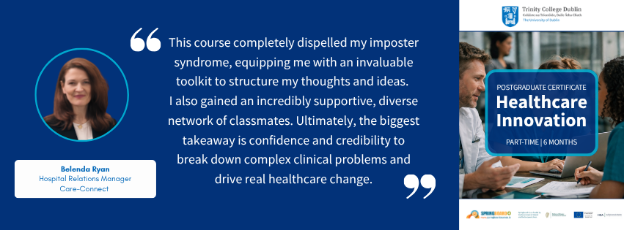
Without a doubt, it’s confidence. The course gives you the ability to break incredibly complex healthcare problems down into smaller, manageable aspects, build a story around them, and confidently pitch a pathway forward. It completely dispelled my imposter syndrome.
Q: What would you say to someone who is currently hesitating to apply because they are worried about the time commitment?
I won’t sugarcoat it - it does take dedication. You have to put in four to six hours of study a week, and there are times you’ll be staying up late after the children are in bed to finish an assignment.
But it is so incredibly worth it. If you’re interested in healthcare innovation, don’t be hesitant. The staff, the lecturers, and your peers are there to support you every step of the way. And trust me, attending that graduation ceremony at Trinity College is a fabulous day out that you will never forget!
Want to Hear More About the Healthcare Innovation course experience?
You can watch back the Spotlight on Healthcare Innovation with Belenda and Dr Alison Keogh, Assistant Professor in Healthcare Innovation at the School of Medicine - register here to access the recording.