/filters:format(webp)/filters:quality(100)/prod01/channel_3/media/tcd/dental/images/presenting-pic-3-1460X804.jpeg)
Congratulations to Nikolaos Synodinos, who presented his review of digital carbon calculators at the inaugural Collaboration of Sustainable Healthcare Research conference in Malmö earlier this month.
Health services around the world have committed to net zero — but before emissions can be cut, they must be measured. Most teams do this with a free online carbon calculator rather than commissioning a full environmental assessment.
However, until this study, these calculators had never been catalogued or checked for reliability.
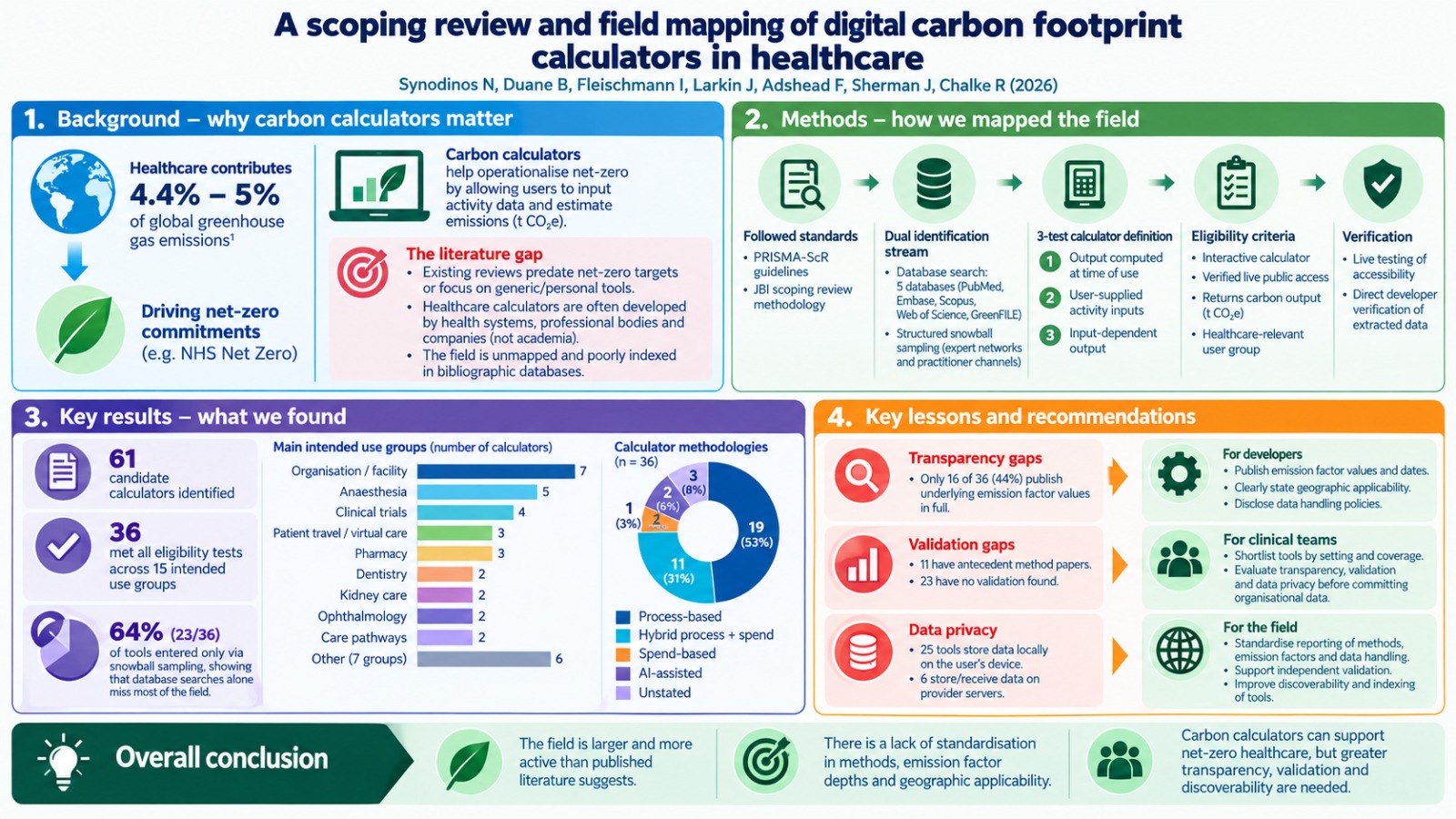
Working with colleagues in Ireland, the UK and the US, Nikolaos tracked down 61 carbon calculators built for healthcare, tested each one, and recorded what they measured and how.
Thirty-six were free, functioning and relevant to healthcare. Between them, they covered 15 areas of care, from a single anaesthetic technique to an entire health system.
Two findings stood out:
The first is how hard these tools are to find. Nearly two thirds - 23 of the 36 - could be found only by asking people working in the field. They never appeared in a search of the research databases where studies are normally catalogued. A clinician with just 20 minutes and a search engine would be unlikely to find most of what is available.
The second is how difficult it is to check the answers. Less than half of the tools publish the underlying figures used to turn activity into a carbon number, which makes it hard to verify results or compare calculators.
There was better news on privacy. Twenty-five of the 36 calculators retain information on a user's own computer, rather than sending it elsewhere.
The study, which was undertaken to inform the KitNewCare programme, is under peer review and was supervised by Prof Brett Duane.