
/filters:format(webp)/filters:quality(100)/prod01/channel_3/media/tcd/trinityhaus/images/Launch.jpg)
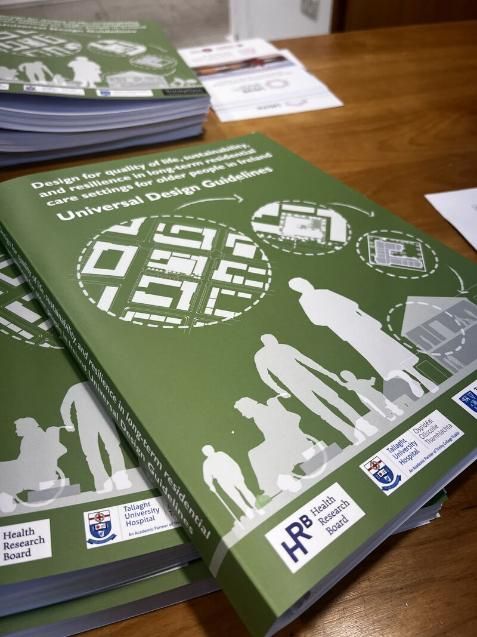 The diversity & changing nature of resident needs, health conditions, and dependencies, as well as the range of visitors & staff who typically occupy an LTRC setting, necessitate a welcoming and inclusive environment. The Universal Design approach provides the kind of accessible, safe, comfortable, & adaptable design required to support these diverse and evolving needs.
COVID-19 disproportionately affected older persons, particularly those living in LTRC settings. While the primary impacts of COVID-19 were illness and death, the secondary impacts of isolation, loneliness, lack of physical activities and social interaction that resulted from infection control measures were also devastating to people living in these settings. The design of LTRC must fully consider how a more resilient built environment can enhance infection control, while also maintain quality of life during a pandemic.
This resilience must also extend to the impacts of climate change including such hazards as storms, flooding, or heatwaves. Wider sustainability issues such as biodiversity are also critical, along with management & use of energy, not just in terms of climate change mitigation, but also in terms of adaptation & security of supply through economic or climate based disruptions.
Finally, continuing to live in your own home is a major part of ‘ageing in place’, but research tells us that ageing in place is also about a continuity of community, staying close to family, friends, and local services, and remaining in familiar environments where a person has a strong sense of place. In this understanding of ageing in place, it becomes vital to carefully consider the location & community integration of LTRC settings so that people can move to a local setting and maintain their sense of place.
These guidelines - Design for quality of life, sustainability, & resilience in LTRC - address the complex & interconnected issues and challenges described above through a LTRC Planning & Design Framework:
- Core design values: Quality of life & Quality of Experience; Inclusion through Universal Design; Sustainability & Resilience.
- Evidence based design across key spatial scales
- Key Design Considerations including overall UD Principles; Key LTRC design issues, & a range of sustainability, climate adaptation & resilience topics.
- Good practice exemplars & case studies used to illustrate the design guidance.
- Levels of Design to illustrate how important features can range from minor to major interventions.
- An Engagement & Co-creation Strategy to facilitate a collaborative approach to planning and design.
Funding and Support: These guidelines were completed as part of a research project funded by the Health Research Board, as part of their Investigator-Led Projects (2024). We are grateful for their support throughout the process and for funding this research.
Research Team (Principal Investigator, Co-Applicants, and Collaborators):
This HRB project was led by Trinity College Dublin (Principal Investigator Desmond O'Neill School of Medicine, Trinity College Dublin - Centre for Medical Gerontology, in collaboration with TrinityHaus Research Centre (Trinity College Dublin School of Engineering Tom Grey (Co-Applicant), Dimitra Xidous, and Jennifer O’Donoghue), and involves: Age Friendly Ireland (Co-Applicant – PPI), Age Action Ireland (Co-Applicant – PPI), Health Service Executive (Co-Applicant) and the Centre for Excellence in Universal Design (CEUD) (Co-Applicant). This project also included several collaborators - The London School of Economics and Political Science (LSE) (Collaborator); Nursing Homes Ireland (Collaborator) Care Champions (Collaborator-PPI), O'Connell Mahon Architects (Collaborator), Maastricht University (Collaborator) and Built Environment Consultant Bill Benbow (Collaborator); Ann Coyle (Collaborator).
Long-Term Residential Care Homes: We would like to thank the management in all 11 case studies for facilitating our research, without whom the research would not have been possible:
- Anam Cara Housing with Care, Fold Housing, Glasnevin Dublin 11, Dublin
- St Joseph’s Centre Shankill, Shankill, Dublin 18, Dublin
- Glenaulin Nursing Home, Chapelizod, Dublin 20, Dublin
- Peamount Healthcare, Newcastle, Co. Dublin
- Newtownpark House, Blackrock, Co. Dublin
- St Brendan's Community Nursing Unit, Loughrea, Co. Galway
- The Village Residence, Drogheda, Co. Louth
- Haven Bay Care Centre, Kinsale, Co. Cork,
- CareBright, Bruff, Co. Limerick
- St Brendan's High Support Unit, Mulranny, Co. Mayo
- Ballyshannon Community Hospital, Ballyshannon, Donegal
Residents, Families and Staff:
Finally, and most importantly, we would like to thank all the residents, their families and friends, and staff, who were kind enough to take the time to participate in the research, and who provided essential insight into their lived experience of residential long-term care.
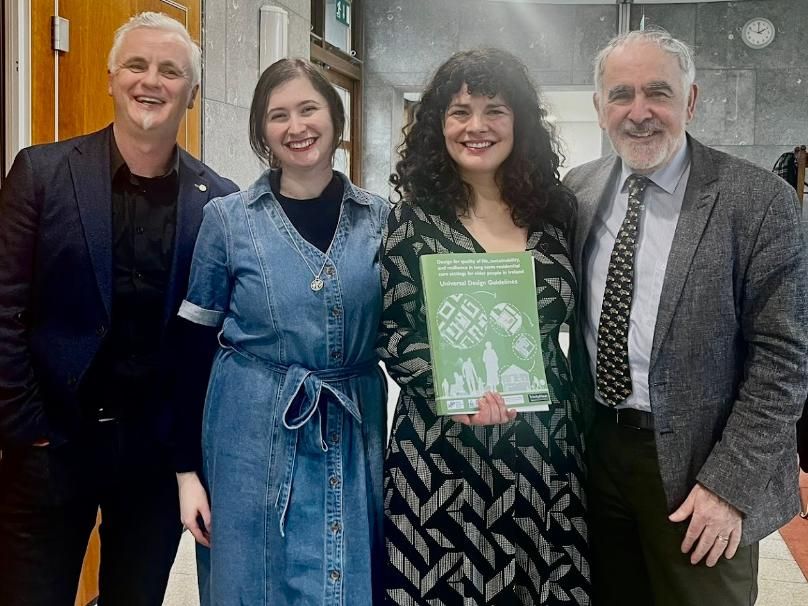
Left-to-Right: Thomas Grey (Research Fellow and Co-Principal Investigator); Jennifer O'Donoghue (Research Assistant); Dimitra Xidous (Research Fellow); and Professor Desmond O'Neill (Principal Investigator).