
The Powerful Art of Diverse Minds
What happens when you put a fashion designer specialising in sustainable Irish-made garments in the same room as a civil engineer who writes stories in his spare time?
We catch up with fashion designer Roisin Heffernan, founder of Irish womenswear brand So Roe Design, and practising civil engineer plus writer Cian Kelleher, to talk about stepping out of their comfort zones, building unexpected networks, and pitching their dreams thorugh the Postgraduate Certificate in Creative and Cultural Entrepreneurship.
Q: Firstly, by way of introduction, can you tell us what were you doing before this course and what made you take the leap?
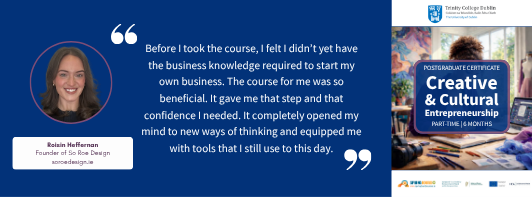
Roisin: I had just finished my undergraduate degree in fashion design. I knew how to design, but I had absolutely zero business experience or knowledge. I wanted to start my own business, but I lacked the confidence and the practical steps to make it happen. I needed a bridge that would combine design with business strategy.
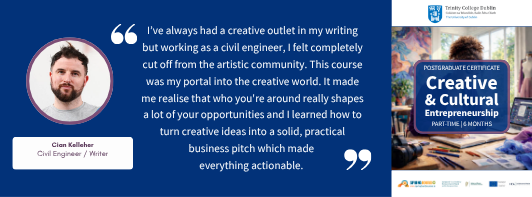
Cian: My background was completely different. I’m a civil engineer, and during the recession, I spent years working in very structured, isolated environments like coal mines in the Australian outback. But I’ve always had a creative outlet: writing. I kept journals full of stories and ideas, but living in such a technical world, I felt completely cut off from the artistic community. It felt like an alien world. When I saw this course, I realised that who you're around shapes your opportunities. It was my portal into the creative world.
Q: The cohort for this course is quite diverse. What was it like working with people from such different professional worlds?
Roisin: It was incredible and honestly eye-opening. Coming from an art college, everyone in my circle did fashion. Suddenly, I was in a room with musicians, filmmakers, textile designers, and engineers. One of my close friends in the course had worked in Enterprise Ireland for years and was a complete wealth of knowledge. Hearing how other people solved problems completely opened my mind to new ways of thinking that I still use in my business today.
Cian: It made me realise how insular my previous circles had been. I remember a Saturday workshop in our first module where we did relaxation exercises to unlock our creativity. One member of my group, a brilliant music teacher, was asked to describe what she noticed in the room. While I looked at physical objects, she processed the entire world through what she heard. It was a profound, lightbulb moment for me as a writer. People don’t just have different opinions; they actually process reality differently on a functional level.
Q: Was there a specific project or exercise in the course that completely changed how you work?
Roisin: Yes! In one exercise, we pulled roles out of a hat, and I pulled the "CEO" card. I had to lead my group, even though many of them had decades more professional experience than I did. I was so reserved back then, but having to step up and own that leadership role changed how I saw myself.
On a practical level, our business model project was huge for me. I put everything into it to test my brand, So Roe Design. That project led to me developing a "monthly drop" release structure. I literally still use that exact business model for my company today, and it works incredibly well.
Cian: For me, it was learning how to communicate value. We were taught how to condense our creative ideas into a solid, practical business pitch. It made everything actionable. Honestly, it bled into my everyday life. I can now pitch my partner on which restaurant we should go to on Friday night using a miniature elevator pitch! We were also introduced to digital editing and storytelling tools that I now use to package and share my stories on YouTube.
Q: Public speaking and pitching are major hurdles for creatives. How did you handle the final 60-second elevator pitch?
Roisin: I was absolutely terrified of public speaking. Because of COVID-19, I’d missed out on doing presentations during my undergrad, so the idea of pitching in front of a class made me want to run away. I almost considered skipping it and losing the marks, but I wanted that distinction! I forced myself out of my comfort zone, stood up, and did it. Once it was over, the fear completely vanished. It gave me the confidence to pitch my business to anyone, anywhere.
Cian: I completely agree. It is incredibly tough. You're standing in front of 60 people, including industry panels who deal with local authority grants. You might be going up right after someone who absolutely nailed their pitch to roaring applause, thinking, ‘Oh my god, how do I follow that?’ But there is no better training ground for the real world. Doing it, coming through it, and having your classmates clap and cheer you on is an absolutely fabulous experience.
Q: If someone is reading this and hesitating to apply, what would you say to them?
Roisin: I go around and recommend this course to literally everybody! I am actually on holidays in the south of France right now, and I made sure to jump onto this call because I wanted to tell everyone how life-changing this program is. If you are hesitating, make a pros and cons list, consider the time commitment, and then just do it. The support from Jeanne and the team is phenomenal.
Cian: Anything of real value in life comes with a bit of nerves. I was incredibly anxious on my first day, but this course was honestly way more fun and deeply enjoyable than any academic course I’ve ever done. You will walk into a room and instantly make connections with people who can help you publish books, produce plays, or launch brands. Don't let fear hold you back.