
Emergence, Resilience, and Vulnerability of Booterstown Spit as Urban Coastal Infrastructure
Project name: Emergence, Resilience, and Vulnerability of Booterstown Spit as Urban Coastal Infrastructure
PI : Prof. Iris Moeller
Research team (name the individual researchers and their level, e.g. undergrad, MSc, PhD, post-doc)
Prof. Quentin Crowley, Dr. Steve Waldren, Dr. Erica Terese Krueger, Abigail Roberts, Conor Fitzpatrick
Funders: European Union projects REWRITE (REWilding and Restoration of InterTidal sediment Ecosystems for carbon sequestration, climate adaptation and biodiversity support) - Grant Agreement no. 101081357 and NATURESCAPES (Investigating nature-based solutions from a landscape perspective) - Grant Agreement no. 101084341
Project dates ; 2024 – 2027
Summary
Booterstown Spit (south Dublin Bay, Ireland) has emerged over the past 25 years as a dynamic coastal landform of increasing environmental and societal importance within a highly urbanised setting. Using aerial imagery, topographic surveys, sediment analysis, hydrodynamic data, and water quality monitoring, these studies document the spit’s evolution from a small sand bar in the late 1990s into a recurved vegetated spit by 2025. Growth is primarily driven by northward longshore sediment transport under southeasterly wave forcing, while vegetation colonisation promotes dune stability and the development of salt marsh, lagoon, and seagrass habitats. Together, these interconnected systems function as a nature-based solution that dissipates wave energy, stores sediment, enhances biodiversity, and protects critical urban infrastructure in south Dublin Bay. Storm monitoring between 2024 and 2026 demonstrates both resilience and vulnerability within the system. Repeated overwash events and storm clustering expanded washover fans, limited vegetation recovery, and increased susceptibility to breaching, highlighting the importance of cumulative storm impacts in shaping long-term coastal change. Water quality analysis further identified elevated nutrient concentrations in nearby stream outflows, raising concerns for the health and stability of pioneer salt marsh vegetation. The findings emphasise the need for long-term, high-resolution monitoring and adaptive coastal management that recognises Booterstown Spit as living infrastructure. Future research will focus on nutrient dynamics, vegetation resilience, sediment transport pathways, and citizen science monitoring initiatives such as CoastSnap Dublin Bay to support climate adaptation planning and coastal resilience in Dublin Bay.
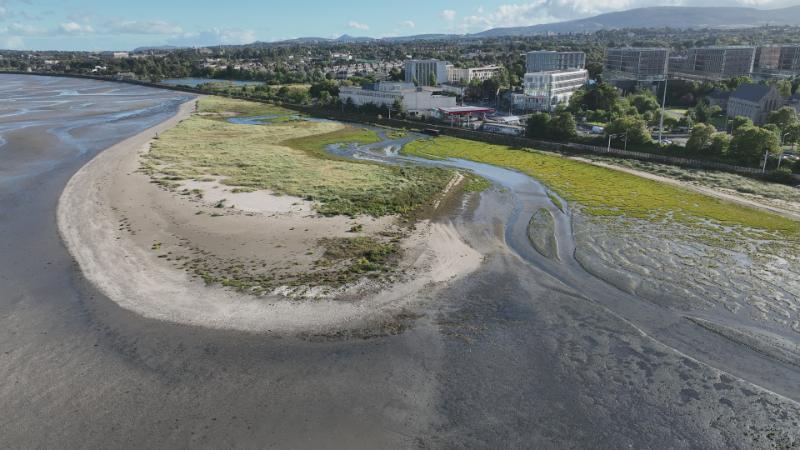
Image caption: Oblique aerial view of Booterstown spit.