
Some people believe true sustainability is letting a seagull recycle your lunch straight from your hand. While our local gulls certainly appreciate the gesture, it turns out they can make an even bigger contribution to the environment. The term seagull is misleading as most gull species are not truly sea based and many spend substantial periods inland. This is particularly true during the breeding season in May and June when some gulls choose to nest on our roof tops and chimney stacks.
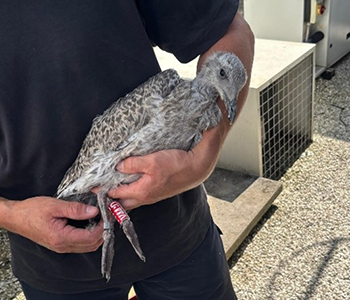 Estates and Facilities was delighted to take part in a colour-ringing study of urban herring gulls last week, alongside our service partner Integrated Wildlife Management Services (IWMS). IWMS are part of a group called The Irish Midlands Ringing Group (IMRG) who are licensed by the National Parks and Wildlife Service (NPWS) to carry out gull ringing.
The Herring Gull is the most numerous urban gull in Ireland and this species is “Red Listed” by Bird-Watch Ireland. The IMRG started this study in 2017 and to date have tagged over 2,000 gulls. Last week several Trinity gulls were fitted with coloured red leg bands, allowing researchers to identify individual birds and build a detailed picture of their movements, behaviours and habitats.
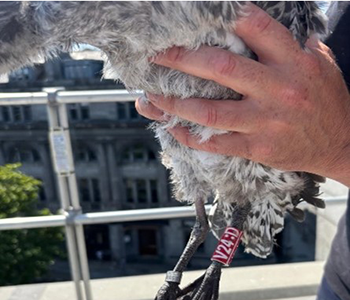 At first glance, putting a tiny bracelet on a seagull might not sound like a sustainability initiative. In reality, gull-ringing is a valuable conservation tool. By tracking where birds travel, how successfully they breed and how they interact with urban environments, researchers can better understand what is driving seabird population changes and how people and wildlife can coexist more successfully.
The information gathered helps inform conservation efforts, supports biodiversity and contributes to evidence-based environmental management in cities such as Dublin. In short, our gulls are helping to answer some important questions about urban ecology—and all without filling in a single survey.
And speaking of travel, previous ringing projects have already delivered some fascinating insights. One Trinity Lesser black-backed Gull (GY 73328) originally tagged in 2023 was later recorded on Agadir Beach in Morocco in 2026 about 2,500km away as the ‘Gull’ flies giving a whole new meaning to the term long-haul flight.
We’ll be sure to share any more exciting adventures from Trinity’s globe-trotting gulls. Until then, if a seagull seems unusually interested in your lunch, just remember—it might be conducting important field research.
If you have a sighting of ringed seagull you can log the details at Birdwatch Ireland.