
The Waldock Lab
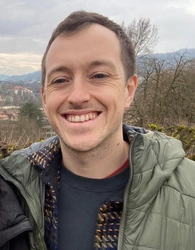
I am an ecologist interested in understanding global change impacts on species and communities. My research forms a bridge between biogeographical theory and local predictions of biodiversity under global environmental change. I develop new concepts and methods that help quantify the geographical structure of species niches and distributions (Waldock et al. 2024) and apply these to inform systematic conservation planning of aquatic biodiversity. In this context, I have experience at the science-policy interface, incorporating biodiversity models into spatial planning (LANAT-3 project link).
I work primarily on aquatic ecosystems with a recent focus on freshwater fish that form an exceptional system of study: a particularly imperilled and extraordinarily diverse group acting as key protagonists in the relationship between nature and people. I use statistical and mechanistic macroecological approaches, combining large-scale insights with field campaigns using electrofishing and eDNA metabarcoding. In understanding the connections between global society and biodiversity change, I draw on perspectives from political ecology and ecological economics — fields adjacent to my ecological training — to spotlight the underlying drivers of biodiversity loss. This interdisciplinary perspective drives my work toward transformative change — fostering just and decolonial people-nature relationships as the foundation of a sustainable society (Waldock et al. 2026).
Research interests
Sensitivity of ecological assemblages to global change
I am interested in developing projects that explain the drivers of spatial variation in the inherent sensitivity of communities to global environmental change. This work aims to examine the role of biogeographical processes — such as community niche structure, dispersal barriers, and spatial diversification — in explaining how biodiversity change unfolds. By taking an integrative view across ecological, evolutionary, and geographical processes, I aim to identify hotspots of ecological sensitivity and understand how this sensitivity drives biodiversity change at a local scale.
Biodiversity dynamics under climate change incorporating spatio-temporal variability at multiple scales
This work aims to understand how multi-dimensional environmental changes interact with the adaptive dynamics of ecological communities. I ask how climate-driven biodiversity change is amplified or dampened due to interactions between ecological and evolutionary processes (e.g., dispersal, adaptation, niche filtering – see Keggin et al. 2026). Rivers are a fascinating model system, characterised by a highly hierarchical and non-linear nature in combination with the high dimensionality of variables driving
environmental and biodiversity dynamics. This work combines eco-evolutionary simulations with deep learning and causal AI to disentangle the interactions and feedback among processes that contribute to climate-driven biodiversity change, from populations to ecosystems.
Robust conservation and restoration planning under bioclimatic uncertainty
The impact of climate change on ecosystems carries significant, and often underappreciated, uncertainties. For example, we do not know exactly how much greenhouse gas the world will emit, we have a poor understanding of species' exact geographic distributions, and we face modelling errors that compound overall uncertainty in our expectations of climate-driven biodiversity change. While we cannot be certain how biodiversity will change, we are certain of the need to act. I develop conservation and restoration prioritisations that are robust under multiple forms of uncertainty, especially when these uncertainties are impossible to reduce in the timeframes that decision making demands. Here I combine species distribution models, climate-driven shifts in species distributions, alongside the need for restoration, to identify spatial planning solutions that are robust under these multiple forms of uncertainty.
Tele-coupling of biodiversity loss and ecosystem restoration in a globalized economy
There is increasing attention on ecosystem restoration efforts which require significant land and natural resources – for example, the recent EU Nature Restoration Law mandates restoration of 20% of EU land and sea areas by 2030. Yet, this environmental space currently serves economic purposes - food production, industrial activities and waste management – which may be geographically displaced to non-EU countries. Furthermore, high-consumption lifestyles in the EU generate ecosystem degradation through large embodied-water footprints of products and supply chains acting beyond EU borders. I am interested in examining, particularly in the context of freshwater conservation and restoration, the coupled geographical relationships between restoration, consumption, and biodiversity gradients. These linkages may produce counter-intuitive net outcomes — namely, continued biodiversity loss at a global scale despite local restoration gains. Such inequities must be critically examined to ensure long-term and deeper forms of sustainability in nature conservation initiatives.