

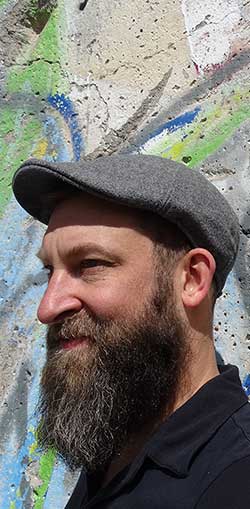
Dr Immo Warntjes
Ussher Associate Professor in Early Medieval Irish History
After graduating in History and Mathematics from the University of Göttingen (Germany) and a PhD from the University of Galway (Ireland), I held lectureships in Medieval History at the University of Greifswald (Germany) for 5 years and at Queen’s University Belfast (UK) for 3 years before joining Trinity College Dublin in 2016.
Research Interests
My research interests cover the entire Middle Ages, from early medieval Irish politics to late medieval burial practices. In early medieval Irish history, my current focus lies on the cult of St Patrick. Specifically, in collaboration with the Irish Department of Foreign Affairs and the Berlin-Brandenburgische Akademie der Wissenschaften, we are restoring a pioneering and monumental study of St Patrick and the origins and development of his legend by Heinrich Zimmer, completed in 1894, badly damaged in a fire in his house in 1903, and never published.
My principal area of research is early and high medieval scientific thought, c. 400–1100. With the Fall of Rome, Greek lost its currency as the principal learned language, leading to the rise of Latin Europe. Education and knowledge production moved from secular institutions to monasteries and cathedral schools. A new, decidedly Christian curriculum was designed, in which calendrical science / computus (to navigate the liturgical calendar depend on Easter and to understand God’s work as manifested in the cosmos) played a central part. Irish scholars were at the forefront of this development. I am working through a research plan of some 30 articles (some 20 are published to date) to understand the Irish contribution to early medieval calendrical science, 600–900. I have also edited and translated one of its key texts, the Munich Computus (718/9), at monograph length, and I am in the process of publishing a translation of the oldest textbook on the reckoning of time, the Computus Einsidlensis (c. 700), in collaboration with Tobit Loevenich. I am also finalizing a book on Iberian computus (c. 500–750) in collaboration with the late Alden Mosshammer,and am planning a book on the Frankish tradition (c. 690–800).
Between 2018 and 2023, I ran the Irish Research Council Laureate Project IFCE – The Irish Foundation of Carolingian Europe: the Case of Calendrical Science. We have created an interactive database for all manuscripts containing computus before 900, with cross-references to a description of key texts (https://computus.huma-num.fr/). We have also developed a new method for cataloguing computistical ‘objects’, which will be published in Speculum shortly. As background to this, I am currently working on a short history of the Easter controversy from Christ to Charlemagne.
I am also interested in the process of the adoption of Greek and Arabic science at the dawn of the so-called Renaissance of the 12th century. Commissioned by the Monumenta Germaniae Historica, I took over and finalized a project started by the late Arno Borst of making accessible the writings on time-reckoning by one of the foremost 11th-century scientists, Hermann the Lame of Reichenau (†1054).
In recent years, my interest has moved more strongly towards book culture, manuscript studies, the transmission of texts, and the more fundamental question of what really constitutes a ‘text’ in the early medieval period. I am part of the Trinity Research Doctoral Award interdisciplinary project Wandering Books (2024–2028) studying the movement of early medieval books. First fruits will be published shortly in a collected volume on one of the most important Irish books of the 9th century, the so-called Karlsruhe Bede. I am preparing, in collaboration with Jacopo Bisagni, a study of placing Abbo of Fleury (†1004) more firmly at the centre rather than the beginning of the transmission of specific calendrical ideas. I am also intending to write a book on the early medieval annalistic tradition in the margin of Easter tables.
Service to Discipline:
I am co-editor of:- Peritia: the Journal of the Medieval Academy of Ireland
- Knowledge, Scholarship, and Science in the Middle Ages
Select Publications
Books
- with Arno Borst, Hermann der Lahme: Schriften zur Zeitrechnung, mit Vorläufern und Bearbeitern (Wiesbaden 2026).
- The Munich Computus: text & translation. Irish computistics between Isidore of Seville and the Venerable Bede and its reception in Carolingian times (Stuttgart 2010).
Edited Volumes
- Immo Warntjes, Tobit Loevenich, & Dáibhí Ó Cróinín (eds.), Pre-Carolingian Latin computus and its regional contexts: texts, tables, and debates (Turnhout 2023).
- Immo Warntjes & Dáibhí Ó Cróinín (eds.), Late Antique calendrical thought and its reception in the early Middle Ages (Turnhout 2017).
- Pádraic Moran & Immo Warntjes (eds.), Early medieval Ireland and Europe: chronology, contacts, scholarship (Turnhout 2015).
- Karl-Heinz Spieß & Immo Warntjes (eds.), Death at Court (Wiesbaden 2012).
- Immo Warntjes & Dáibhí Ó Cróinín (eds.), The Easter Controversy of Late Antiquity and the Early Middle Ages (Turnhout 2011).
- Immo Warntjes & Dáibhí Ó Cróinín (eds.), Computus and its cultural context in the Latin West, AD 300–1200 (Turnhout 2010).
Articles
-
Early and High Medieval Scientific Thought:
- ‘Reichenauer Wissensnetzwerke im Spiegel zeitrechnerischer Schriften und Kodizes’, in Welterbe des Mittelalters – 1300 Jahre Klosterinsel Reichenau (Karlsruhe 2024), 72–85.
- ‘The computistica of the Antiphonary of León in context’, in Thomas Deswarte (ed.), Les folios introductifs de l’Antiphonaire de León (Archivo de la Catedral de León, ms. 8, fol. 1-27): Étude et edition (Turnhout 2024), 221–90.
- together with Thomas Deswarte & Alfred Lohr, ‘Édition des folios 1–28’, in Thomas Deswarte (ed.), Les folios introductifs de l’Antiphonaire de León (Archivo de la Catedral de León, ms. 8, fol. 1-27): Étude et edition (Turnhout 2024), 309–455.
- ‘A Visigothic Computus of AD 722 (Leiden, Universiteitsbibliotheek, VMI 11, 26r–27r)’, in Immo Warntjes, Tobit Loevenich & Dáibhí Ó Cróinín (eds.), Pre-Carolingian Latin computus and its regional contexts (Turnhout 2023), 141–57.
- ‘The lost fragment of Claudius of Turin’s Chronicle rediscovered, and the relation between Paris BnF Lat. 5001 and Lat. 7400B’, Filologia Mediolatina 27 (2020), 383–92.
- ‘The mechanics of lunar calendars and the modes of calculating Easter, AD 400–1100: context and perspectives’, in Fondazione Centro italiano di studi sull’alto medioevo, La conoscenza scientifica nell’alto medioevo (Spoleto 2020), 273–310.
- ‘AD 672 – the apex of apocalyptical thought in the early medieval Latin West?’, in Veronika Wieser et al. (eds.), Cultures of eschatology, 2 vols. (Berlin 2020), ii 642–73.
- ‘Isidore of Seville and the formation of medieval computus’, in Andrew Fear & Jamie Wood (eds.), A companion to Isidore of Seville (Leiden 2020), 457–523.
- ‘The final countdown and the reform of the liturgical calendar in the early Middle Ages’, in Matthew Gabriel & James T. Palmer (eds.), Apocalypse and reform from Late Antiquity to the Middle Ages (New York 2019), 51–75.
- ‘The continuation of the Alexandrian Easter table in seventh-century Iberia and its transmission to ninth-century Francia (Isidore, Etymologiae 6.17)’, Revue d'histoire des textes n. s. 13 (2018), 185–94.
- ‘Introduction: state of research on late antique and early medieval computus’, in Immo Warntjes & Dáibhí Ó Cróinín (eds.), Late Antique calendrical thought and its reception in the early Middle Ages (Turnhout 2017), 1–42.
- ‘Hermann der Lahme und die Zeitrechnung. Bedeutung seiner Computistica und Forschungsperspektiven’, in Felix Heinzer & Thomas Zotz (eds.), Hermannus Contractus: Reichenauer Mönch und Universalgelehrter des 11. Jh. (Stuttgart 2016), 285–321.
- ‘Computus’, in Victor J. Katz et al. (eds.), Sourcebook in the mathematics of Medieval Europe and North Africa (Princeton 2016), 29–36.
- ‘Köln als naturwissenschaftliches Zentrum in der Karolingerzeit: Die frühmittelalterliche Kölner Schule und der Beginn der fränkischen Komputistik’, in Heinz Finger & Harald Horst (eds.), Mittelalterliche Handschriften der Kölner Dombibliothek. Viertes Symposion der Diözesan- und Dombibliothek Köln zu den Dom-Manuskripten (26. bis 27. November 2010) (Köln 2012), 41–96.
- ‘The argumenta of Dionysius Exiguus and their early recensions’, in Immo Warntjes & Dáibhí Ó Cróinín (eds.), Computus and its cultural context in the Latin West, AD 300–1200 (Turnhout 2010), 40–111.
-
Irish Calendrical Science, 600–900:
- ‘The formation of medieval time-reckoning as a scientific discipline of Christian learning in seventh-century Ireland’, in Fondazione Centro italiano di studi sull’alto medioevo (ed.), Il tempo nell’alto medioevo (Spoleto 2024), 69–107.
- ‘Computus Einsidlensis’, in Lucia Castaldi, La trasmissione dei testi latini del Medioevo / Medieval Latin texts and their transmission (Florence 2023), 119–25.
- ‘Computus Monacensis (Munich Computus)’, in Lucia Castaldi, La trasmissione dei testi latini del Medioevo / Medieval Latin texts and their transmission (Florence 2023), 126–32.
- ‘De ratione conputandi’, in Lucia Castaldi, La trasmissione dei testi latini del Medioevo / Medieval Latin texts and their transmission (Florence 2023), 133–41.
- together with Tobit Loevenich: ‘Theodore of Tarsus and the study of computus at the Canterbury School’, Anglo-Saxon England 50 (2021), 29–59.
- ‘The origin(s) of the medieval calendar tradition in the Latin West’, in Sacha Stern, Calendars in the making: the origins of calendars from the Roman Empire to the Later Middle Ages (Leiden 2021), 129–87.
- ‘Computus as scientific thought in Ireland and the early medieval West’, in Roy Flechner & Sven Meeder (eds.), The Irish in early medieval Europe: identity, culture and religion (New York 2016), 285–321.
- ‘An Irish eclipse prediction of AD 754: the earliest in the Latin West’, Peritia 24–25 (2013–2014), 108–15.
- ‘Seventh-century Ireland: the cradle of medieval science?’, in Mary Kelly & Charles Doherty (eds.), Music and the stars. Mathematics in medieval Ireland (Dublin 2013), 44–72.
- ‘The Computus Cottonianus of AD 689: a computistical formulary written for Willibrord’s Frisian mission’, in Immo Warntjes & Dáibhí Ó Cróinín (eds.), The Easter Controversy of Late Antiquity and the Early Middle Ages (Turnhout 2011), 173–212.
- ‘Irische Komputistik zwischen Isidor von Sevilla und Beda Venerabilis: Ursprung, karolingische Rezeption und Forschungsperspektiven’, Viator 42 multilingual (2011), 1–32.
- ‘A newly discovered prologue of AD 699 to the Easter table of Victorius of Aquitaine in an unknown Sirmond manuscript’, Peritia 21 (2010), 254–83.
- ‘The Munich Computus and the 84 (14)-year Easter reckoning’, Proceedings of the Royal Irish Academy 107C (2007), 31–85.
- ‘A newly discovered Irish Computus: Computus Einsidlensis’, Peritia 19–20 (2005–6), 61–4.
- Early Medieval Irish History:
- ‘Augustine vs Wodan: Notker Labeo, Wednesday, and Irish intellectual influence at St Gall in the early Middle Ages’, Frühmittelalterliche Studien 59 (2025), 39–70.
- ‘Pope Vitalian’s Letter to King Oswiu of Northumbria and the beginning of Armagh’s claim to primacy over the Irish churches’, Revue Bénédictine 134 (2024), 1–39.
- ‘Historische und historiographische Episkopalisierungsversuche des frühmittelalterlichen Irlands’, in Andreas Bihrer & Hedwig Röckelein, Die ‘Episkopalisierung der Kirche’ im europäischen Vergleich (Berlin 2022), 165–222.
- ‘Victorius vs Dionysius: the Irish Easter controversy of AD 689’, in Pádraic Moran & Immo Warntjes (eds.), Early medieval Ireland and Europe: chronology, contacts, scholarship (Turnhout 2015), 40–96.
- ‘The role of the church in early Irish regnal succession – The case of Iona’, in L’Irlanda e gli Irlandesi nell’alto medioevo (Settimana di Studio del Centro italiano di studi sull’alto medioevo, LVII) (Spoleto 2010), 155–213.
- ‘Regnal succession in early medieval Ireland’, Journal of Medieval History 30 (2004), 377–410.
- ‘The alternation of the kingship of Tara 734–944’, Peritia 17 (2003), 394–432.
- The Use of the Vernacular in the Early Middle Ages:
- ‘Die Verwendung der Volkssprache in frühmittelalterlichen Klosterschulen’, in Christoph Fasbender & Gesine Mierke (eds.), Wissenspaläste. Räume des Wissens in der Vormoderne (Würzburg 2013), 153–83.
- ‘The earliest occurrence of Old English gerīm and its Anglo-Irish computistical context’, Anglia 127 (2009), 91–105.
- together with Jacopo Bisagni: ‘The early Old Irish material in the newly discovered Computus Einsidlensis (ca. AD 700)’, Ériu 58 (2008), 77–105.
- together with Jacopo Bisagni: ‘Latin and Old Irish in the Munich Computus: A reassessment and further evidence’, Ériu 57 (2007), 1–33.
- Central and Late Medieval Burial Practices:
- ‘Programmatic double burial (body and heart) of the European high nobility, c.1200-1400. Its origin, geography, and functions’, in Karl-Heinz Spieß & Immo Warntjes (eds.), Death at Court (Wiesbaden 2012), 197–259.
Teaching
I am dedicated teacher, with a teaching degree from Germany (1. Staatsexamen) and and a master in third level education from Queen’s University Belfast (UK). Before joining Trinity, I taught at the University of Greifswald (Germany) for 5 years and at Queen’s Belfast for 3 years, covering Frankish, English, Norman, Irish, and German history throughout the medieval period, but also chronology, palaeography, and Medieval Latin. Presently, I am teaching HIU12022 Early Christian Ireland, HIU33106 The Invention of England: Bede’s Ecclesiastical History of the English (?) People of 731, a new module on The Age of Charlemagne: the Carolingians and the Formation of Medieval Europe, and HI7175 Medieval Latin. I welcome PhD projects on all aspects of early and high medieval Europe (c.AD 400–1200).
PhD Projects:
- Completed:
- 2020: John Tighe: Kin Relations, socio-economic Change and Settlement Patters in the Diocese of Tuam, c.AD 400–1000
- 2021: Catherine Bromhead: Legitimisation of Sacral Kingship in Early Medieval Ireland and England, 6th to mid-8th Centuries AD
-
2021: Michel Summer: Beyond Mission: Willibrord as a Political Actor between Early Medieval Ireland, Britain and Merovingian Francia (690–739)
https://www.liverpooluniversitypress.co.uk/doi/book/10.3828/9781835534182 - 2022: Carlo Cedro: Letter-Writing in Seventh-Century Europe: the Case of Columbanus’s Epistulae
- 2022: Donncdha Carroll: Carolingian Perceptions of the Irish
- 2022: Tobit Loevenich: The Computus Einsidlensis: First Edition and Translation with Introductory Commentary (Pelkhovenpreis 2024)
- 2023: Christian Schweizer: Dicuil’s De cursu solis lunaeque: Translation and Commentary (Johann-Kaspar-Zeuss-Prize 2024 of the Societas Celtologia European)
- 2025: Jeremy Korth: Magic in Literature and Law: Depictions of Magic in the Christian Elite Latin Writing Culture of the Insular World before c.800
- Current:
- Mathew Clear: Early Medieval Reform between Royal Power and Ecclesiastical Networks: the introduction of the Dionysiac Easter Reckoning in Western Europe, 6th-8th Centuries
- Peter Fraunhofer: The Reichenau Group: a Case Study of Irish Script on the Continent
- Jiachun Xu: Time and Creation in the Early Medieval Latin West: the Augustinian Legacy and Insular Innovations
- Patrick Byrne: Paradise on the Waves: the Land of Promise in Medieval Irish Thought
- Beatrice Pilutti: Irish Intellectual Influence in Early Medieval Bavaria: the Textual Evidence
- Jiaxin Li: The Agency and Perception of Nature in Ireland and Northumbria, c. 635-735.
Mentored Projects:
2021-2023: Dr Philipp Nothaft: Transformations of Latin Astronomy, 1000–1250 (Marie-Curie Individual Fellowship)
https://brill.com/display/title/63539
https://jps.library.utoronto.ca/index.php/aestimatio/article/view/39086
https://journals.uco.es/index.php/mediterranea/article/view/15281
https://journals.uco.es/mediterranea/article/view/13608
https://jps.library.utoronto.ca/index.php/aestimatio/article/view/44061
https://brill.com/view/journals/esm/28/6/article-p659_3.xml
https://www.journals.uchicago.edu/doi/abs/10.1086/725388
2022-: Dr Nicole Volmering: Early Irish Hands: the Development of Writing in Early Ireland (Science Foundation Ireland / Irish Research Council Pathway Award)
https://earlyirishhands.ie/
Dr Warntjes on the TCD Research Support System
Contact Details
Room 3148
Department of History
Trinity College
Dublin 2.
Telephone: +353 1 896 1160
Fax: +353 1 896 3995
Email: iwarntje@tcd.ie