
/filters:format(webp)/filters:quality(100)/prod01/channel_3/media/Image.jpg)
Recognition of Prior Learning
Here at Trinity, we are committed to enabling lifelong learning and to supporting students to fulfil their academic potential.
Information for Staff members - Student information on RPL can be found here.
Context
Recognition of Prior Learning (RPL) forms a critical component of EU policy in relation to widening participation to higher education and in supporting lifelong learning. Trinity College Dublin, the University of Dublin, herein referred to as Trinity, is committed to ensuring that its RPL policy is compatible with its policies on access and progression and that it meets current good practice in the field. Trinity is a participating member of the National RPL in Higher Education project (2020-2025), working towards integrating RPL as an integral part of Ireland’s higher education system.
Purpose
The purpose of this policy is to ensure that the assessment of prior learning is facilitated and approached in an equitable, transparent and consistent manner, whilst ensuring that decisions on recognition of prior learning uphold the ethos of a Trinity Education and the academic integrity of a programme of study.
Benefits
The Recognition of Prior Learning (RPL) is a key component of lifelong learning, both in Ireland and internationally. RPL is beneficial for learners, higher education institutions and employers alike. By making visible the valuable skills and learning that people have acquired through work or other life experiences, RPL can enhance a person’s self-esteem and well-being. For higher education institutions, RPL is a critical component of lifelong learning and widening participation as it can make programmes more accessible to learners who may not meet minimum entry requirements but have, for example, relevant prior informal or non-formal learning. It can also expedite a learner’s progress through a programme, for example through advanced entry or exemptions (Pilot Framework for RPL in Higher Education, 2022).
Scope
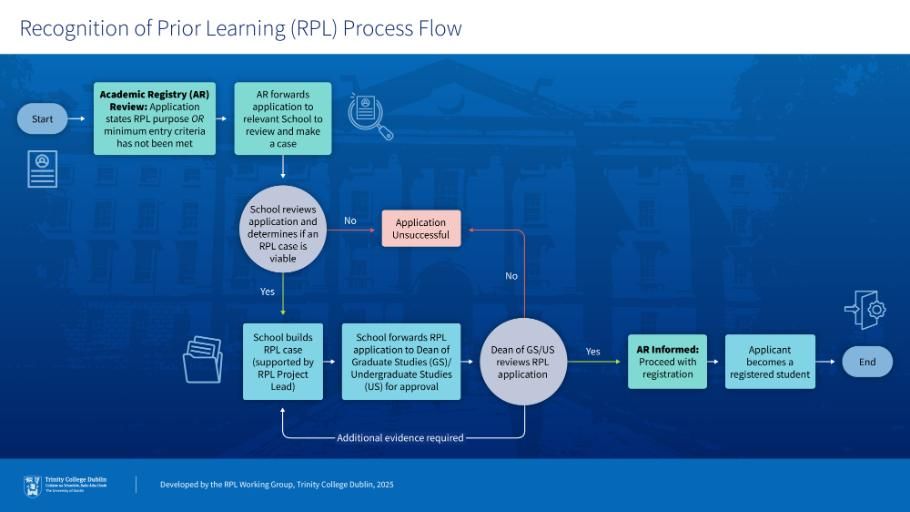
This policy applies to prospective undergraduate and postgraduate applicants seeking to gain admission or advanced entry to Trinity on the basis of prior learning. It also applies to currently registered students who wish to apply for exemption from core modules already completed elsewhere.
/filters:quality(100)/prod01/channel_3/media/enterprise-engagement.jpg)
/filters:quality(100)/prod01/channel_3/media/Trinity-History---Long-Room.jpg)
/filters:quality(100)/prod01/channel_3/media/east-theatre-tcd.jpg)
/filters:quality(100)/prod01/channel_3/media/MTL3.jpg)