/filters:format(webp)/filters:quality(100)/prod01/channel_3/media/tcd/careers/images/Standalone-banner---large-1150X450-NEW.jpg)
How Map My Future can help your career planning
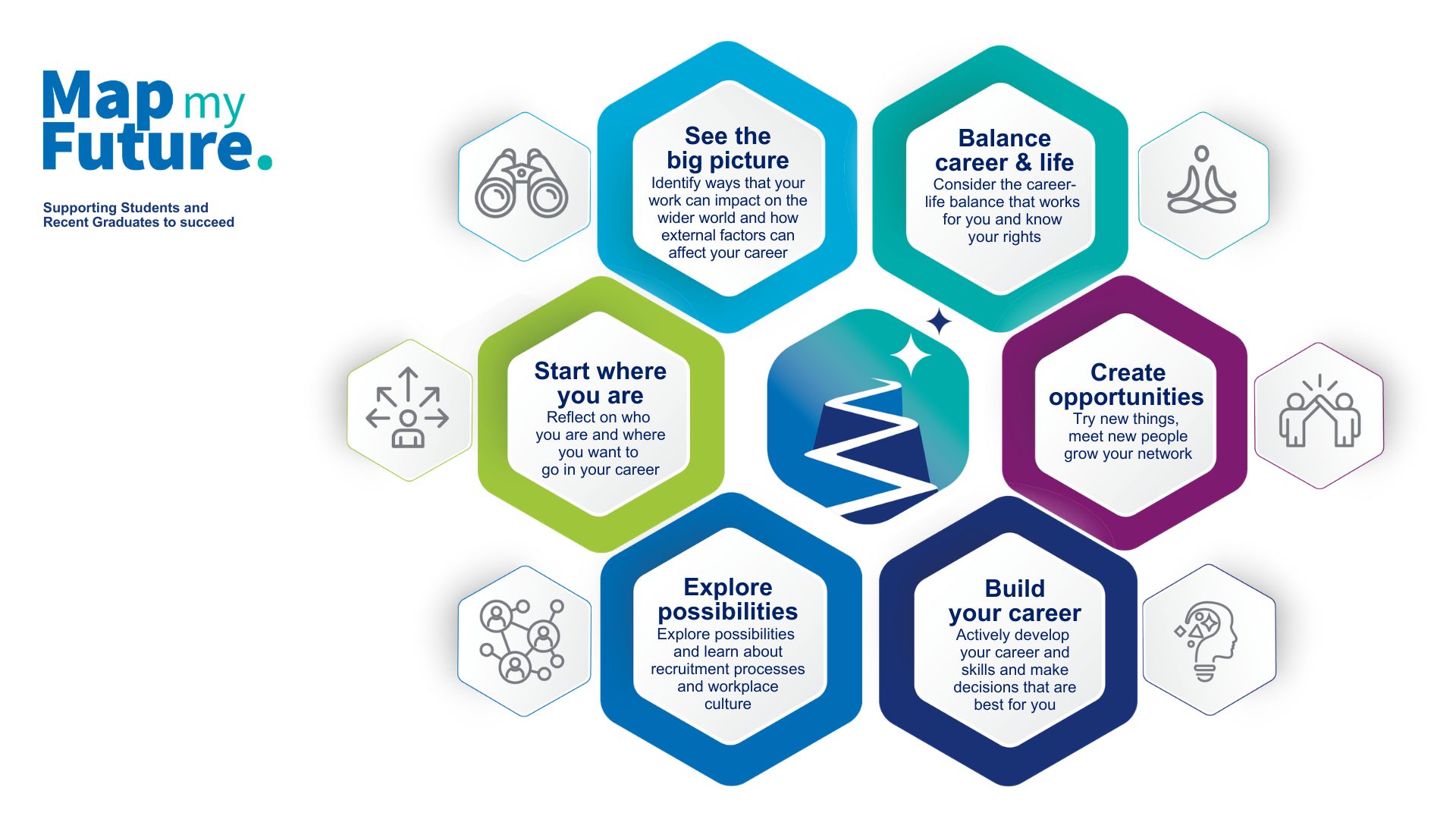
Ready to figure out your future career options but don't know where to start? Career development can be complex, so the Map My Future framework is here to help. Simply reflect on where you are currently and choose from one of the six pillars below to begin mapping your future.
/filters:quality(100)/prod01/channel_3/media/tcd/careers/images/Map-My-Future-tool.png)
Explore the Map My Future tool
Ready to figure out your next steps after Trinity? Map My Future is here to help. Our new interactive tool integrates the 6 pillars of career learning to apply them to your current career needs. Click the button below to head over to Blackboard to leverage our tool.
Start Where You Are
Start where you are: How it works
'Start where you are' is all about reflecting on who you are and where you want to go in your career. This includes your strengths and interests, possibly related to your course or other activities. It’s also reflecting on your identity and values and identifying an approach to career planning that works for you. Explore our resources in the section below.
We have reflection questions to guide you through the below resources.
Identify and recognise how your Strengths, Skills, Personality and Experiences contribute to your career:
- Watch this video on 'Flow'
- Listen to what alumni have to say on the Trinity Graduate Stories podcast
- For more learning in relation to your skills in relation to your career, consider participating in our Career Skills Award
Evaluate the concept of career and identify different approaches to apply to your career:
- Book a 1-1 appointment with your career consultant via MyCareer
- Watch this short video on Design Thinking Approach to career Planning
Reflect on the impact of your beliefs, identity and values in relation to your career:
- Explore our 'Uncovering Your Career Identity' exercise
- Leverage the 'Profiling for Success' Suite. The Values Based indicator tool is most applicable for this area of career exploration.
- Choose from an extensive collection of short videos which highlights reflections on values, identity, beliefs and career
Record and reflect on your experiences, achievements and learning:
- Complete the Action Planning Reflection Exercise.
- Chat with a Trinity graduate by requesting to join the Trinity Alumni Mentoring LinkedIn group
See The Big Picture
See the big picture: How it works
'See the big picture' looks at the wider world around us and how it can impact on your career, and the kind of impact you would like to make on the world through your own career. Things like technology, culture, society, politics, the economy or the climate and biodiversity crisis might be important to you and may impact your career and in turn your future career choices.
Climate and the biodiversity crisis
- Your Guide to Greenwashing: Created by Trinity student Natalie, this guide helps you spot the red flags of greenwashing.
- The Green Skills Report: Green skills are now core business skills. LinkedIn’s report shows how fast demand is growing — and that green-skilled candidates are hired well above the average rate.
- Project Drawdown: is a solutions-focused resource: a ranked roadmap of the most effective climate solutions, with a “Drawdown-aligned jobs” framing that helps you see where you could contribute.
Technology and the future of work
- AI and the Future of Work Guide: Artificial intelligence is transforming how businesses operate and how people do their jobs. Our guide helps you navigate GenAI and its potential implications for your career.
- WEF Future of Jobs Report 2025: Looks at how technology, the green transition, and geoeconomic shifts will reshape work to 2030. Includes an interactive data explorer so you can drill into specific sectors.
Making an impact
- 80,000 Hours: You have about 80,000 hours in your career: 40 hours a week, 48 weeks a year, for 40 years. This free online guide explores what makes for a fulfilling career, especially if you want to have a positive impact on the world.
- Talk it through: Book a chat with your Careers Consultant on MyCareer about the impact you’d like to make and how it might shape your career choices.
Balance Career And Life
Balance career and life: How it works
'Balance career and life' is all about exploring and experimenting with the kind of career-life balance you want. You could do this through taking part in student societies, part-time or voluntary work or award programmes such as the Career Skills Award. This area also covers supporting your wellbeing and knowing your rights in the workplace and broader society.
To explore and reflect on career-life balance, here are some suggestions and resources:
- Learn about how graduates approach balance in their careers through connecting with them on LinkedIn and through listening to our Graduate Stories Podcast.
- Reflect and Develop Your Skills
- Reflect on your skills, for example, using a skills audit tool. Think about how you want to build skills going forward and how you can prioritise your career-life balance.
- Participate in the Trinity Careers Skills Award, which gives you the opportunity to engage with a variety of employers and organisations across sectors.
- Explore our student careers portal, MyCareer:
- Register for alumni events and employer career fairs
- View job vacancies
- Discuss this theme further with your careers consultant. Book an appointment at a time that suits you.
- Consider applying for a Trinity Employability bursary.
- Read about initiatives at Healthy Trinity. You can also access the Healthy Trinity Online Tool, which aims to help you focus on the importance of maintaining work-life balance throughout your degree and into your career.
- Read about key initiatives at Trinity EDI office.
- Have you experienced a setback and feel out of balance? Read our Guide to Learning From Setbacks to gain helpful perspective and to explore how other Trinity students have navigated their setbacks.
- Question for reflection: Consider any work-based learning experiences you have completed, for example internships, part-time jobs, projects, voluntary work or entrepreneurial activities. What kind of ‘balance’ would you like to have in the context of your working life? What steps could you take to achieve this?
Create Opportunities
Create opportunities: How it works
'Create opportunities' challenges you to give things a go, get out there and meet people who may be able to assist you on your career journey. Whether it’s attending one of our mentoring events or pitching an idea for a start-up to a friend, the aim is to understand the important role connections play in career development.
- Create and build your career ideas and connections by participating in our Career Connections events
- Build a strong personal and professional network to help you explore career ideas and options with the 'Identifying Your Network' resource workbook
- Attend a Careers fair: Explore industries, ask meaningful questions and build valuable connections. Use our handy Careers Fair Preparation Worksheet to make the most of your time at the Trinity Careers Fairs
- Connect with Trinity Alumni through our LinkedIn page
- You can also watch this this video to help you explore connecting with a broad range of Alumni in career areas that interest you: Master LinkedIn: Connect with Trinity Alumni & Gain Career Insights
- Need help with Your LinkedIn profile? Book a spot in one of our our CV Review sessions and bring your draft profile for discussion via MyCareer
- Optimise your applications. Read 'Using ChatGPT and Other Generative AI for your Job Search'
- Explore student entrepreneurship and how you can turn your ideas, interests and skills into opportunities.
- Never underestimate the power of volunteering as an opportunity to build skills, discover what you enjoy and try things out in a real-world setting. Read our short resource on where you can get started in volunteering.
Build Your Career
Build Your Career: How it works
Under the Map My Future framework, the 'Build Your Career ' theme is all about learning how to make the best career decisions for you and developing your career skills so that you are more prepared for the future. It encourages students to actively develop skills, reflect on their progress, and prepare for transitions, both expected and unexpected.
Build Your Career in ways that suit you. Here are some suggestions and resources:
- The Proactively Manage Change and Transition guide is especially useful to help you create a playbook for change including addressing any sticking points holding you back
- Reflect and Develop Your Skills:
- Reflect on your skills, for example, using a skills audit tool
- Develop your skills through the Trinity Careers Skills Award, work experience or an internship, volunteering and/or living abroad, connecting with Trinity alumni, LinkedIn Learning
- For support with decision making read through the career decision-making guide with helpful case studies and guidance or watch this short video on decision making
- Learn from graduates, how they progress their careers through connecting with them on LinkedIn and through Graduate Stories Podcast
- Explore our student careers portal, MyCareer:
- Register for our career fairs
- View job vacancies
- Discuss this theme further with your careers consultant. Book an appointment
Explore Possibilities
Explore Possibilities: How it works
Under the Map My Future framework, the 'Explore possibilities' theme is all about seeing what is out there, what opportunities you can avail of, and if certain options could have a potential future. It's about doing all the research so that you are as prepared as you can be when it comes to applying or performing at interview. In this video, Natalie explores the resources our team have built to help your journey.
Explore Possibilities Resources
- Our reflections questions will help explore your possibilities
- Hear about employment opportunities by taking part in our Career Skills Award
- Explore our student careers portal, MyCareer:
- Register for our career fairs
- View job vacancies
- Attend a CV/Cover Letter/LinkedIn Profile Review, check out upcoming availability
- Discuss this theme further with your careers consultant. Book an appointment
- Explore career paths through career conversations with alumni by connecting with them on LinkedIn. Check out “Create opportunities” above to learn more about how to network.
- Hear about career paths on our Graduate Stories Podcast
- Check out our Sector-Specific Jobs Guide
- Read our Guide To Career Decision Making
- Explore our Your Guide To Making Great Applications
- Read our Your Guide To Interviewing
- Explore this online resource on what you can do with your degree