

Overlooked histories, marginalised voices and contemporary social issues sit at the heart of the Uncomfortable Dublin Walking Tour, a collaborative project involving researchers from across Trinity College Dublin. Drawing on academic research, community engagement and local knowledge, the tour encourages participants to look beyond familiar narratives of the city and consider the forces that have shaped Dublin past and present. In the interview below, Dr Joe Whelan discusses how the initiative came together and the ideas that underpin it.
Click here for video interview
What is the Uncomfortable Dublin Walking Tour?
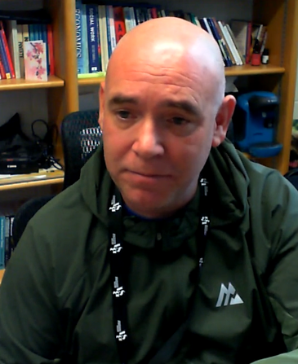
Dr Joe Whelan: The idea behind the Uncomfortable Dublin Walking Tour was to give people an opportunity to see a different side of Dublin, to hear stories that are perhaps not always heard, and to encounter perspectives that are often absent from conventional accounts of the city.
 How did the idea for the tour originate?
The Uncomfortable Dublin Walking Tour grew out of a collaboration between myself in the School of Social Work and Social Policy, Dr Caitlin White in the School of Education, Dr Patrick Walsh in the School of History, and Karen Hall, who interned on the project.
The inspiration came from Uncomfortable Oxford, a social enterprise that runs tours in Oxford, York and Cambridge. Caitlin had encountered the project and was struck by the idea of developing something similar in Dublin. That became the starting point for the tour.
What is covered on the tour?
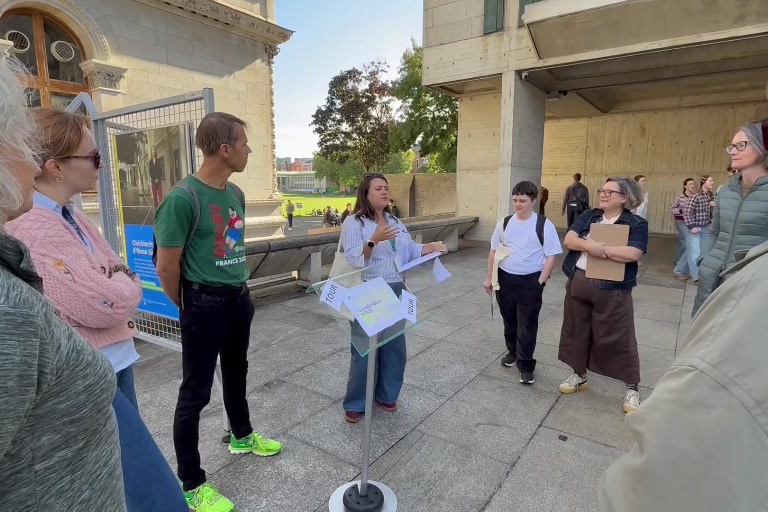
I do not want to give away too much because I would like people to experience it for themselves, but the tour begins at the Eavan Boland Library in Trinity College Dublin. We discuss the renaming of the library, Trinity's place in the city, and some of the narratives that are not always included in typical tours.
The route then moves towards Merrion Square, exploring the history of the city and its public spaces, before making its way along the quays and through the Docklands. It finishes at the Famine Memorial and the Poverty Stone on Custom House Quay.
Throughout the tour, participants encounter alternative or subaltern histories. Many of the stories featured emerged from collaborative workshops with people who live in these areas and shared local knowledge that may not appear in more conventional historical accounts.
What kinds of themes does the tour explore?
The tour is called Uncomfortable Dublin for a reason. Participants encounter subjects that are not always comfortable to discuss but are important parts of the city's story.
Themes include poverty, slavery, colonialism, migration and other challenging aspects of Dublin's history and present. These are topics that have helped shape the city but can often remain hidden from view.
Do you think mainstream accounts of Dublin's history overlook important stories?
Traditional tourist walking tours perform a particular function and often provide an orthodox or established account of the city's history. That is not to say they ignore difficult topics altogether, but that is not usually their primary focus.
The Uncomfortable Dublin Walking Tour takes a different approach. It deliberately visits places associated with difficult histories, seeks out hidden stories, and foregrounds voices that have not always been heard. In doing so, it challenges some of the narratives that dominate popular understandings of Dublin's past.
How does the tour connect to your research and your work in the School of Social Work and Social Policy?
The tour reflects a sociological perspective. Participants are encouraged to use their sociological imagination, connecting the conditions we see in Dublin today with the historical forces that helped produce them.
In that sense, it is not purely a historical tour. It looks to the past to help explain the present and encourages participants to think critically about the future of the city and how it might develop.
My own research is rooted in sociology, and that perspective informs many aspects of the tour. For that reason, it has relevance not only for students of history, but also for students of social policy, social work, sociology, education, public health and other fields.
How has the project been funded?
The tour and the research underpinning it grew out of interdisciplinary seed funding provided through the Faculty of Arts, Humanities and Social Sciences at Trinity College Dublin.
The purpose of the funding was to support collaboration across disciplines. It enabled colleagues from social work and social policy, education, and history to bring together different forms of expertise and work collectively on the development of the project.
When does the tour run and how can people get involved?
The tour has already run a number of times and was included as part of the Dublin Festival of History.
The plan is for it to continue on a monthly basis. Dr Caitlin White, in her role as Historian-in-Residence with Dublin City Council, intends to run the tour at least once a month during her tenure.
Anyone interested in participating can search for the Uncomfortable Dublin Walking Tour online and follow the project's Eventbrite page to stay informed about upcoming dates.