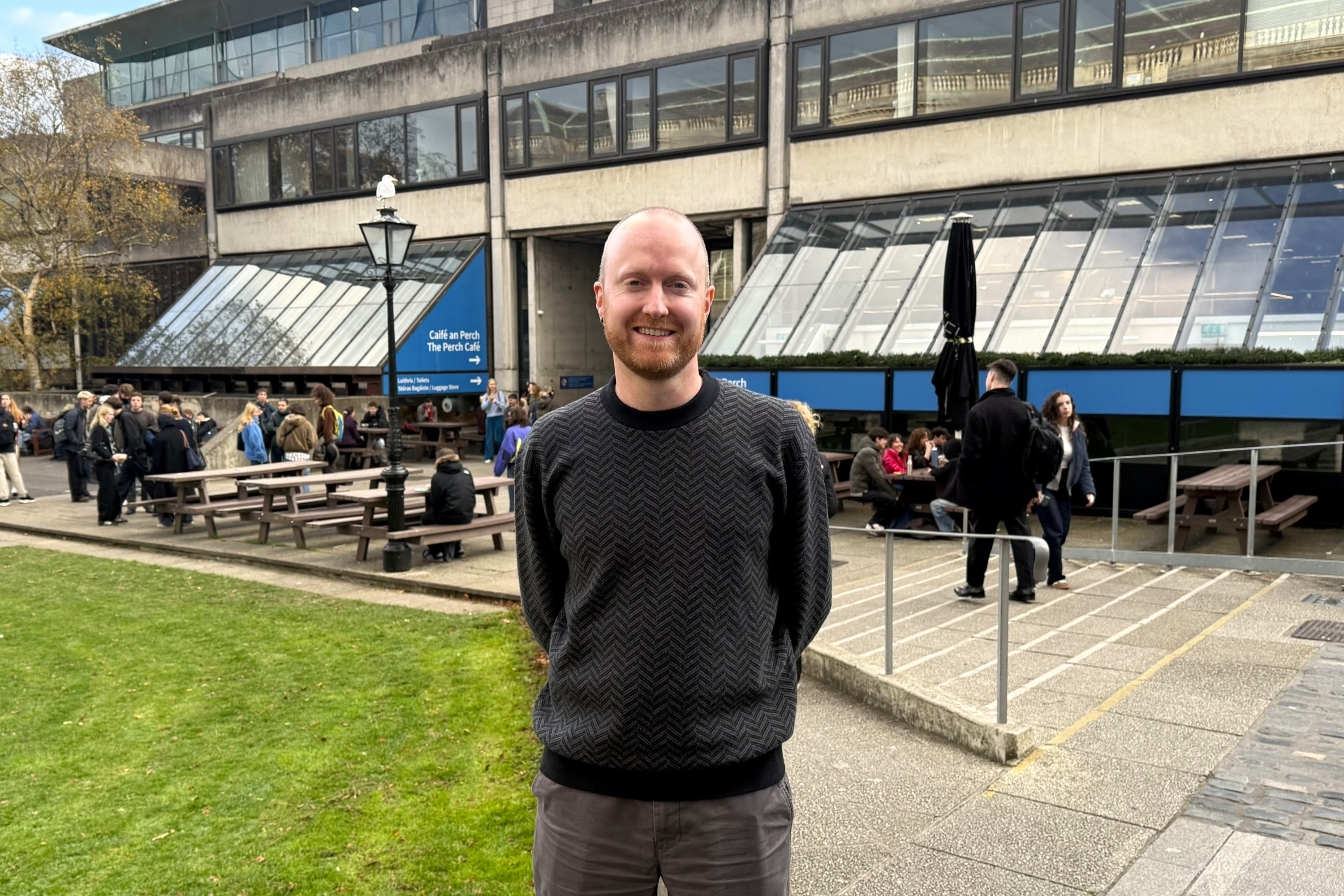
This academic year, Kevin Ryan joined the School of Social Work & Social Policy as Trinity's first Social Work Clinical Tutor. A graduate of the School's Master in Social Work (MSW) programme, Ryan spoke about developing a new model of practice education, expanding placement capacity, and strengthening the connection between social work education and frontline practice.
Trinity SWSP: What is a Clinical Social Work Tutor?
Kevin Ryan: Clinical tutors are common in medicine, nursing and other allied health professions, but social work has traditionally relied on practice teachers and external college tutors. The role is about bringing practice-based education directly into the placement setting and adding an extra layer of support for both students and practice teachers.
This is a new and novel development in social work in Ireland. The role was trialled between Trinity College Dublin and St James's Hospital in 2023, followed by an evaluation and a further trial before becoming a full-time permanent position.
What makes the role different from existing practice education models?
The key difference is having an on-site educational and support presence.
It's about taking social work theory, skills and interventions and narrowing them down to the needs of an acute hospital setting. Students still have their practice teacher and their external tutor, but I provide a complementary educational layer through skills workshops, peer support structures and practice-based learning opportunities. I’m also able to address concerns around interventions directly as they arise on-site.
During the trial phases, both students and practice teachers felt that students progressed more quickly and developed a stronger skill set. Practice teachers also felt that the clinical tutor role reduced some of the additional workload and potential challenges of placement teaching.
What challenge is the initiative trying to address?
The role was really conceptualised around sustainably increasing placement numbers.
In the context of a national drive to train more health and social care professionals with increases in university course intake, we also need to increase placement opportunities to fulfil CORU registration requirements. Finding placements is a continual challenge across health and social care professions. The core function of the role is to build a sustainable placement platform and demonstrate that, if we add additional support structures, we can increase placement capacity in a way that supports practice educators and placement sites.
How was the role funded?
Initially, the role was funded through the HSE's Health and Social Care Professionals Office, which provided seed funding for the pilot and its independent evaluation.
Following the success of the trials, permanent funding for the role was incorporated into Trinity's expansion plans through Higher Education Authority funding.
Why was St James's Hospital chosen as the partner site?
St James's is one of the largest hospitals in the country and Trinity's affiliated teaching hospital, so there's already a very strong and longstanding relationship in student education.
It's also home to the largest medical social work department in the country, which gives greater capacity to build a large cohort of practice teachers. Because there are students from so many disciplines on site, it's also a very strong environment for interprofessional education.
Is there a research element to the role?
There is. It's still early days, but I'm already involved in planning research around interprofessional education and the experiences of students and practice teachers.
I'd also like to see the role act as a bridge between the social work department in St James's and staff in Trinity, promoting and supporting collaborative research across a range of specialist services.
Tell us about your professional background.
I qualified from Trinity's MSW programme in 2017. After a short time elsewhere, I joined St James's Hospital and have worked there ever since across a variety of medical social work settings.
I've supervised social work students, coordinated placements, and worked closely with Trinity's practice education team. That experience gave me a good understanding of both the opportunities and challenges involved in supporting students and practice teachers.
How did the MSW programme shape your career?
I found it to be a very strong academic course with hugely experienced, dedicated and enthusiastic educators.
It gave me a very strong grounding in the theoretical and intervention aspects of social work, but what is really strong about social work education is the placement structure. It's the combination of the academic and the practical, and being supported to apply what you learn in real-world settings.
I can't speak highly enough about it. It was a very beneficial experience and I'm very glad I chose Trinity.
Did you always plan to become a social worker?
It was my goal all along, but it took a very long diversion.
When I left school, I intended to study social work and even applied for the undergraduate programme in Trinity. Life took me in a different direction for a few years, but I eventually came back, completed the Higher Diploma in Social Policy and then progressed into the MSW programme.
I always wanted to do it. Certain life factors just had to align.
What's it like returning to Trinity as a staff member?
The staff have been really welcoming and it's a very nice department to slot into. I've worked with many of the staff through my role in St James's over a number of years, so I'm not coming entirely into the unknown.
As I’m developing this new role, I’m giving it room to breathe and grow, seeing what works and being responsive to students and teachers.