/filters:format(webp)/filters:quality(100)/prod01/channel_3/media/tcd/ttmi/images/industry.jpg)
A key focus for TTMI is developing a strong programme for industry engagement to support advances in medical research that will directly benefit patients. Such a coherent and consolidated approach, fortified by a strong clinical research infrastructure, ensures an efficient pathway for bridging basic biomedical discovery research with improvements in clinical medicine.
/filters:quality(100)/prod01/channel_3/media/tcd/ttmi/images/industry/engagement.jpg)
/filters:quality(100)/prod01/channel_3/media/tcd/ttmi/images/industry/casestudy.jpg)
/filters:quality(100)/prod01/channel_3/media/tcd/ttmi/images/industry/opportunities.jpg)
/filters:quality(100)/prod01/channel_3/media/tcd/ttmi/images/industry/platform.jpg)
Industry Engagement
A synergistic relationship between TTMI, SJH and industry is key to ensuring the continued development and commercialisation of new healthcare therapeutics and innovations. TTMI and SJH are committed to a clinically oriented solutions approach to research that will drive improvements in patient outcomes. Hence, we welcome opportunities to foster industry collaborations to expedite healthcare research, while concurrently facilitating access to leading scientific and medical talent. As exemplified in the case studies below, TTMI has a wealth of experience in developing enterprise collaborations and is therefore well placed to advise on and capitalise on various national and international support initiatives. The scope of enterprise involvement can take many forms, and the following is a summary of past engagements:
- Equipment and Core Facility Access
- Collaborative Research — Consultancy
- Licensing Agreements
- Contract Research / Innovation Vouchers
- Innovation Partnerships
- Horizon 2020
Discover Our Research Experts
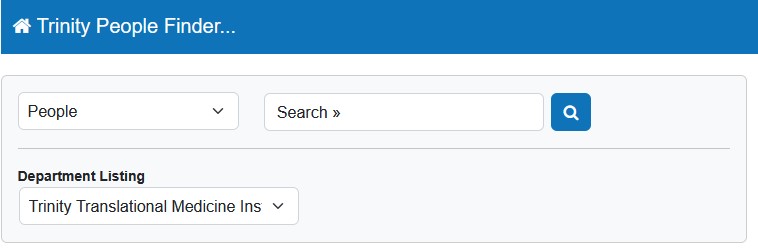
Explore the research expertise within the Trinity Translational Medicine Institute (TTMI) and connect with potential research or industry collaborators.
Use the button below to access our People Finder tool. From there, you can search using the drop-down menu by:
- Department
- Job Title
- Name
- Research Tag
- Telephone Extension
To find TTMI staff, simply select “Trinity Translational Medicine Institute” from the Department drop-down menu on PeopleFinder. (See example below.)
Opportunities
Development of a semi-conductor sequencing-based panel for genotyping of colon and lung cancer by the Onconetwork consortium.
Prof. Orla Sheils
Prof. Orla Sheils has been working as a founder member of the OncoNetwork Consortium in collaboration with ThermoFisher to develop and validate the CE-IVD Oncomine Solid Tumor DNA and Solid Tumour Fusion Transcript kits which enable highly accurate and reliable multiplexed sequencing of formalin-fixed, paraffin embedded (FFPE) tumour samples with the quality and performance needed for the clinical laboratory.
Promising new small molecule drugs for treating gastrointestinal cancer
Prof. Jacintha O’Sullivan
A drug discovery program led by Professor Jacintha O’Sullivan in TTMI in collaboration with Dr. Breandán Kennedy in UCD has identified and patented a small molecule drug Quininib with potent anti-angiogenic activity. Patent: Quininib is the subject of the patent. Anti-angiogenic compounds, WO 2012/095836, granted Dec 2014.
Human Pulmonary Immunology
Prof. Joseph Keane
Our track record in developing new paradigms of host defence has allowed us to screen numerous novel therapeutic approaches – with potential to drive innate and cell-mediated responses to support diseased patients with immune defects and lung disease. Our collaboration with the RCSI has led to the development of novel inhaled micro-particle approaches to lung-directed therapy.
Saving newborns with neonatal sepsis. European researchers developed a sample-to-result automated system for detecting blood pathogens in infants at the point of care.
Prof. Orla Sheils
The EU-funded ASCMICROPLAT (Fast automated multiplex analysis of neonatal sepsis markers on a centrifugal microfluidic platform) project addressed this issue through the development of a novel diagnostic platform capable of performing rapid diagnosis of neonatal sepsis. Briefly, the device allows detection of a biologically relevant panel of neonatal sepsis pathogens and sepsis biomarkers from paediatric serum samples within four hours.
Interrogating T cell migration – a High Content Analysis approach.
Prof. Aideen Long
Prof. Long and her research team have utilised siRNA and pharmacological libraries in combination with high content analysis (HCA) to identify novel signalling pathways or enzymes involved in T cell migration. Image-based HCA is a technology that is ideal for the analysis of complex cellular phenotypes, as the automated image acquisition permits large cell populations to be rapidly analysed on a large scale.
Trinity Health Kidney Centre – Unlocking the potential of patient registries and biobanks.
Prof. Mark Little
This highly successful endeavour has exclusive access to longitudinal data and samples from many well -phenotyped patients through the Irish Rare Kidney Disease Registry and Biobank, and the material available has led to the development of exciting new biomarkers of kidney disease. Such an approach has led to the publication last year in the Journal of the American Society of Nephrology by the group of a unique urine test that will help clinicians manage difficult-to-treat kidney vasculitis. The group have shown that soluble CD163, as measured in urine of patients, correlates well with the level of inflammation caused in active renal vasculitis and displays excellent biomarker characteristics.
Understanding the genetic etiology of mental disorders.
Prof. Aiden Corvin
Using methods based on genome-wide association study (GWAS) arrays, we have identified common and rare genetic variants that contribute to schizophrenia risk in the Irish population. We have also made a substantial contribution to international efforts, which have now identified more than 150 common risk loci for these conditions.
From bench to bedside. Key enabling technologies at TTMI.
Prof. Yuri Volkov and Prof. Adriele Prina-Mello
Prof. Yuri Volkov and Prof. Adriele Prina-Mello (TTMI Nanomedicine and Key Enabling Technologies group) are developing platforms in diagnostic, treatment and theranostic applications and have licensed several technologies to industry.
Screening Platforms
Genomics core facilities – TrinSeq - Dr Elaine Kenny
The facility supports diverse projects from determining organisms that define soil composition (metagenomics) or cause disease (e.g. food-borne pathogens), to identifying ancient human DNA, to finding genetic mutations in living people that contribute to conditions as disparate as autism, arthritis and cancer.
High Content Analysis approach - Prof Aideen Long
Image-based HCA is a technology that is ideal for the analysis of complex cellular phenotypes, as the automated image acquisition permits large cell populations to be rapidly analysed on a large scale.
Flow Cytometry - Dr Eamon Breen
Flow cytometry revolutionised the area of cell research, coming from humble beginnings of being able to measure 2 intrinsic parameters in the 1950s to modern-day cytometers that can now analyse two intrinsic parameters alongside 32 extrinsic parameters. The current facility can analyse 9 parameters at ~5000 cells per second, and shortly, a machine will be in place that can analyse 16+ parameters and speeds of up to 70000 cells per second.