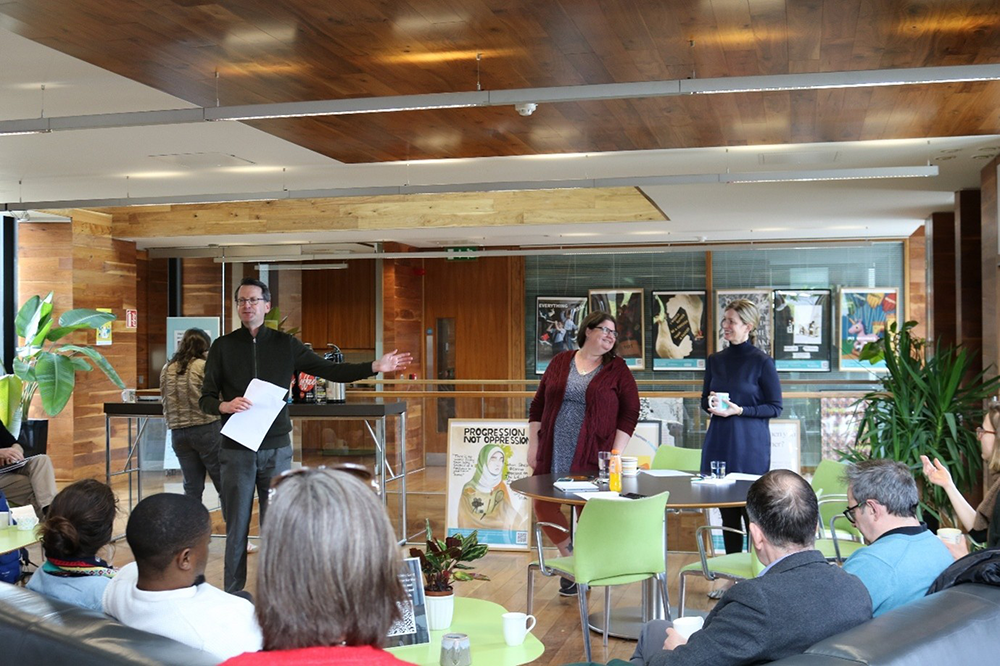
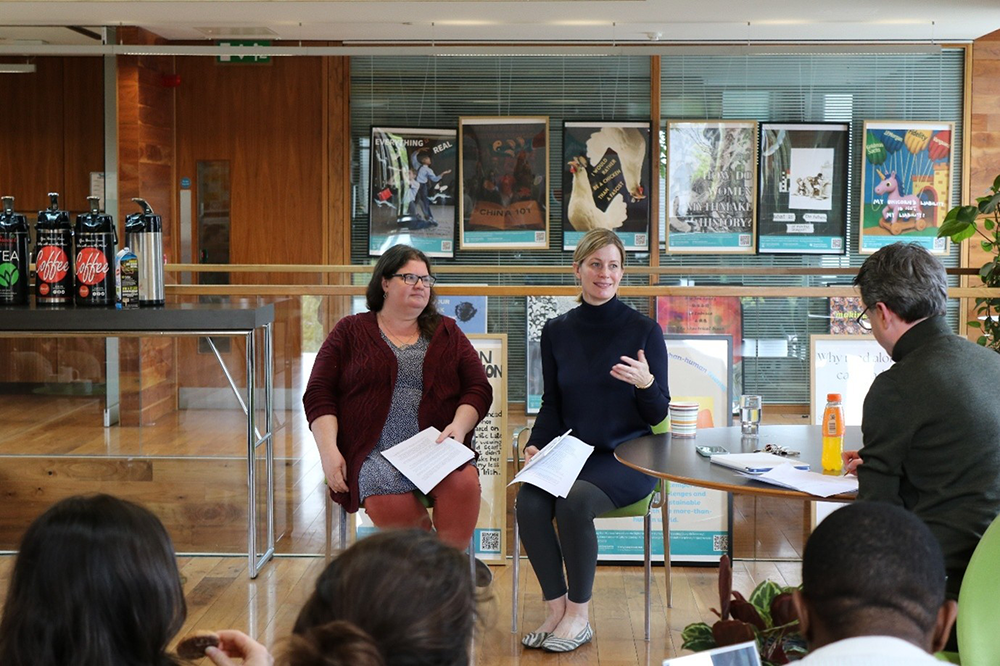
Hosting a special ‘pop-up coffee conversation’ on ‘The Ethics of AI in Higher Education’, Kelly A. Clancy joined visiting fellow Christiana Zenner at the Trinity Long Room Hub to discuss the AI landscape in public schools and higher education in the United States and Ireland.
“The default assumption in the United States is that the technology of AI should be in every classroom”, Professor Zenner said, as she argued “there are genuine reasons to pause before widespread – and uncritical – adoption of AI tools.”
Joining her in conversation, Dr. Clancy argued that as parents try to teach their kids about the concept of consent, we are seeing AI appear on a whole host of platforms that we as users didn’t agree to. This “trojan horse” effect of this technology has resulted in “no consensual framework for AI and higher education.”
This is the second conversation the two colleagues and friends have hosted in recent months, the first taking place at New York’s Society for Ethical Culture in January. Noting “how AI started coming into public schools in New York” without any “consultation” or “consent”, Dr. Clancy highlighted how the municipality of New York has now become the first city to call for a pause of AI in public schools.
With emerging research around “cognitive flatlining” and “cognitive foreclosure” from the neuroscience community, Dr. Clancy, a political scientist and leading expert on AI and educational policy, spoke about the impact all of this might have on sustaining democracy: “Cognitive flatlining is precisely the type of thing that puts democracy at risk.” Dr. Clancy is the author of Democracy: A Love Letter and a Guide for Everyone Fighting to Save It, published in 2024.
She is also the founder of Parents for AI Caution in Educational Spaces (PACES).
From Fordham University, Christiana Zenner is Professor of Theology, Science and Ethics. One of her two forthcoming books, Building a Moral Economy: Water for All (November 2026) engages the eco-social aspects of AI use and data centers, among other topics. Before that, her book Beyond Laudato Si’: Ecotheology, Equitable Futures, and the Papal Turn to the Earth will be published in June. Dr. Zenner is currently a Visiting Research Fellow at the Trinity Long Room Hub in association with Dr Jacob Erickson, of Trinity’s School of Religion, Theology and Peace Studies. Speaking about the work she is doing on her fellowship project ‘Waters, Sediments, and Entangled Anthropocene Ethics’, she will give a lecture on the 6 May 2026 ‘Un-knowing Water: Science, Values, and Ethical Futures for the World's Most Vital Substance’.
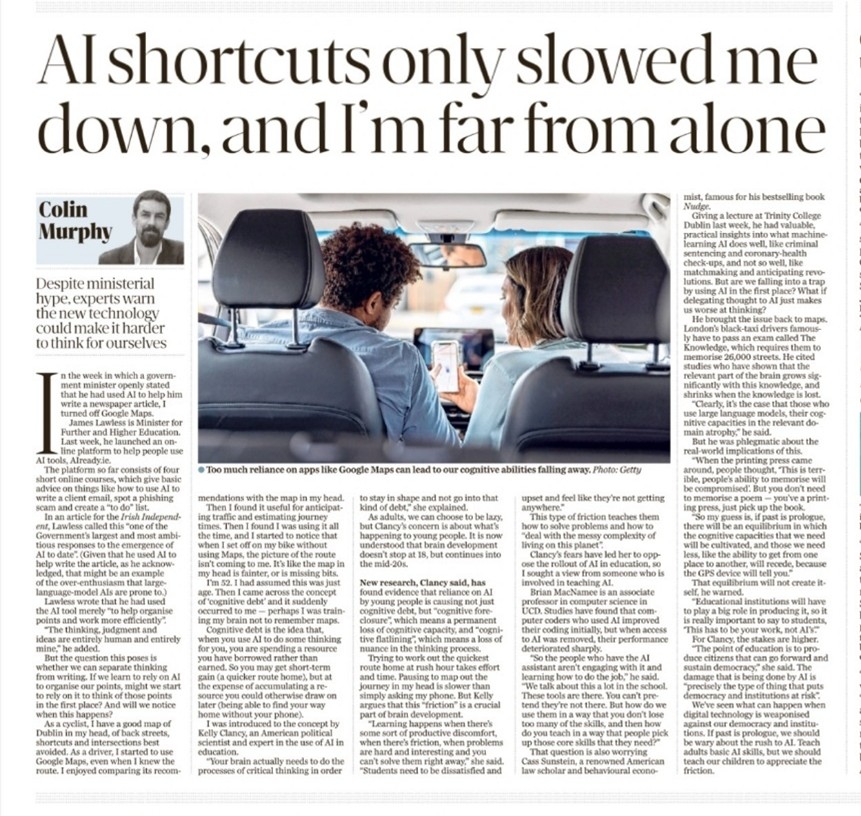
Following the discussion on AI and education, Dr. Clancy’s expertise was referenced by Colin Murphy, Rooney Writer Fellow at the Trinity Long Room Hub, in his recent Sunday Independent article ‘AI shortcuts only slowed me down, and I’m far from alone.’ In it he argues “despite Ministerial hype, experts warn the new technology could make it harder to think for ourselves.”
The event preceded another discussion on AI and education hosted by the Senior Fellows at Trinity College Dublin on the 22 April, where Jennifer Edmond, Professor in Digital Humanities, and many other speakers including Abeba Birhane, Trinity AI Accountability Lab, Ian Robertson, Trinity School of Psychology, and Fintan O’Toole of the Irish Times, explored how artificial intelligence is reshaping the concept of a university. That event was followed a few days later by a talk and seminar hosted by the School of Law, featuring Harvard Law professor Cass Sunstein to discuss his recent book, Imperfect Oracle: What AI Can and Cannot Do.
To find about more upcoming events on these important topics, sign up to the Trinity Long Room Hub newsletter here.