
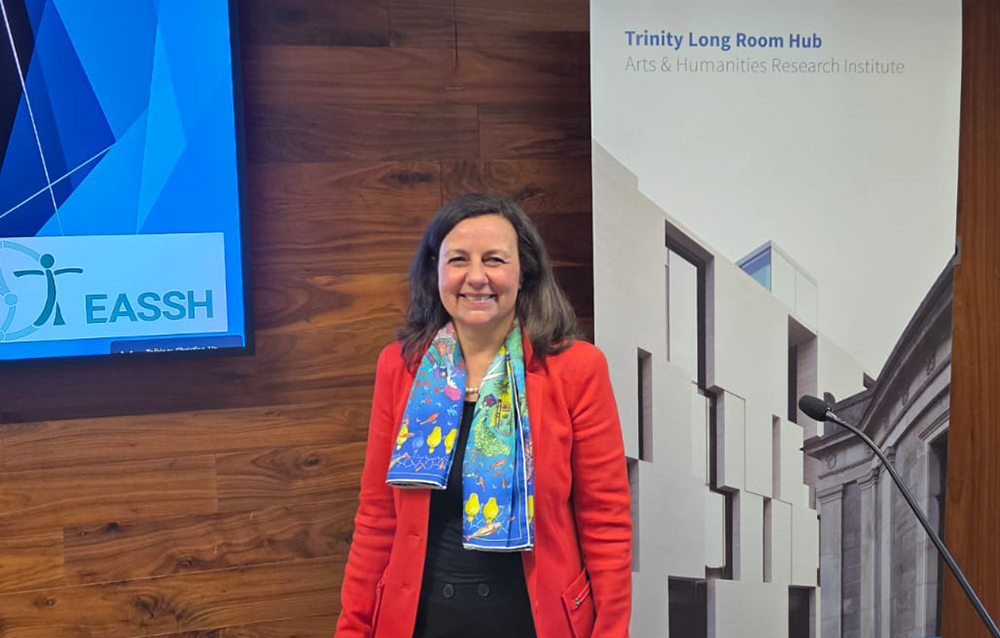
Gabi Lombardo is the Director of the European Alliance for Social Sciences and Humanities (EASSH), one of the largest advocacy and science policy organizations in Europe. Speaking at the Trinity Long Room Hub on 14 April 2026, she urged researchers to engage with the upcoming Irish Presidency of the Council of the European Union around the final negotiations for the next Horizon Europe Framework Programme (2028-2034), also known as FP10.
The public event ‘Designing a new Framework Programme: The role of the research community’ was organised by Dr Balázs Apor, Associate Professor in European Studies at Trinity College Dublin and Vice-chair of the Coimbra Group's Social Sciences and Humanities Working Group in association with the Trinity Long Room Hub and Trinity Global.
During her talk, the EASSH director criticised the narrow focus on economic output and tech-driven competitiveness in the next Framework Programme Structure, with the new inclusion of the European Competitiveness Fund. The big winner is “innovation”, Lombardo said while also highlighting a new focus on security and defence. She outlined how the new Framework will be based on four pillars with a proposed €175 billion budget.
Horizon Europe Framework Programme (2028-2034)
- Pillar I: Excellent Science
- Pillar II: Competitiveness and Society
- Pillar III: Innovation
- Pillar IV: European Research Area
“Society is for society”
Under Pillar II, in the new proposal, ‘Society’ will now include ‘global societal challenges’, ‘EU missions’, and a ‘new European Bauhaus facility.’
Lombardo reaffirmed EASSH’s stance in their recent position paper from September 2025, that there should be a separate policy window called Society with ringfenced funding dedicated to bottom-up research and the societal framing of the global challenges. The position paper calls on all European Union legislators to reinforce the commitment to a strengthening of research on Society under this pillar with a proposed budget of €7.6 billion.
To support this, she said that Social Science and Humanities researchers should put on a united front during the negotiations to get behind the new thematic areas that EASSH is proposing to ensure that ‘Society’ in FP10 is dedicated to research on society.
Proposed Thematic areas for SSH research:
- Democracy
- Education
- Europe in the 2040 world
- Culture and Knowledge
- Healthy and productive societies
She also outlined some key EASSH advocacy points for FP10, which include:
- Keep FP10 independent
- European Research Council (ERC), Marie Skłodowska-Curie Actions (MSCA): keep independent and well resourced
- Keep society for societal research questions (not generic societal challenges)
- Include Culture and Art research. Include education research
- The strategic importance of SSH and their transversal role
- Interdisciplinary and SSH integration across all policy windows, not just the society part
- Importance of having SSH expertise in evaluation committees and an experts-led programme design
- The necessity of a structural programmatic approach, considering SSH perspectives from the conception of work programmes.
The keynote talk by Gabi Lombardo was followed by a panel discussion moderated by Patrick Geoghegan, Professor in History and Director of Trinity Long Room Hub (Trinity College Dublin). Speakers included Ilaria Poggiolini, Professor of International History and Chair of the Coimbra SSH Working Group (University of Pavia); Pekka Räsänen, Professor of Economic Sociology (University of Turku); Maureen Burgess, Research Programme Officer, Trinity Long Room Hub; and Dr Gráinne Walshe, Assistant Director at Taighde Éireann – Research Ireland.
Dr Walshe also argued for the need to be “aware and wary” around the new direction of how societal research is framed under the FP10.
In terms of the impact of research, Dr Walshe outlined the importance of research stories and communicating big successes to university leadership and to Research Ireland.
We need to come with “a clear message”, Maureen Burgess said of Arts and Humanities research, when it comes to speaking with policy makers – something that is hard to do when there is such a diverse range of research topics and a multiplicity of voices.
Lombardo also spoke about communicating research to different stakeholders and audiences: “Politicians don’t really care about what research we’re doing, they want to know who benefits from it. We know that our research is for the wellbeing of society but we also need to convince other people.”
The director of EASSH also discussed Ireland’s EU presidency beginning in July 2026, outlining how it will be pivotal for final negotiations around the Framework Programme and asking for a strong voice from Irish researchers during this process. She outlined a number of ways researchers could get involved:
- Contribute to EASSH Mission to consolidate the funding for SSH in the next FP
- Mobilise your university to meet Ministry of Science/Min of Finance
- Become an expert reviewer for EU programmes. Click here for more info.
- Disseminate the position paper and engage with dean of your faculty, your rector, VP for research
- Identify research priorities with your community for a coherent programme design
- Engage with science policy debate: it matters!
Listen to Gabi Lombardo's talk here:
Gabi Lombardo (PhD LSE), is Director of the European Alliance for SSH one of the largest advocacy and science policy organizations in Europe. EASSH advocates for an evidence-based approach to policy-making, and researchers’ inclusion in funding design. High-level experience in science policy research and implementation working in international organisations like London School of Economics, European Research Council and Science Europe. She is a member of the CoARA Steering Board and other organisations’ steering boards. She’s an evaluator for the EU, World Bank, and COST. Gabi received the Young Academy of Europe Prize in 2018.