
Across Trinity, schools, researchers, staff and students are exploring Ireland’s EU Presidency, in their own ways, through events, research, teaching, discussion and collaboration. This page will be updated throughout the Presidency as new activities and stories emerge.
Why FP10 Matters
Provost Dr Linda Doyle highlights why Europe's next research and innovation programme, FP10, is so important. Negotiations on EU's long-term budget will ship investment in research, education and innovation for years to come. A strong FP10 will help tackle challenges such as climate change and AI, strengthen Europe's competitiveness and support international collaboration.
Trinity Long Room Hub: Ideas and Conversations for Europe
The Trinity Long Room Hub is bringing people together to explore the ideas, questions and challenges shaping Europe. Historians, researchers, policymakers and international voices are gathering to explore Europe’s opportunities and challenges from the future of European cooperation and the lessons of previous Presidencies to security, geopolitics and Ireland’s place in a changing world.
Visit the Hub, join the conversation and discover the research behind the debate.
Watch
Exploring Europe’s changing security landscape and the challenges facing Ireland.
Listen
Looking at the relationship between Ireland and Denmark, and what Ireland can learn from Denmark's approach to the Presidency.
Listen
Reflecting on Ireland's previous Presidency and the opportunities and challenges ahead.
The School of Social Sciences and Philosophy explores Ireland as EU President
Is Curiosity the Key to European Cooperation?
Dr Farbod Akhlaghi, Department of Philosophy, explores what it really takes for European nations to work together. Drawing on philosophy, he argues that genuine cooperation depends on a kind of curiosity that goes deeper than simply wanting to know.
Do you know who's lobbying the EU?
Professor Raj Chari, Department of Political Science, pulls back the curtain on one of Brussels' least visible forces. From corporate giants to NGOs, lobbying shapes EU policy long before it reaches a vote, and Ireland's presidency offers a rare chance to ask how transparent that process really is.
What is the future of trade for the EU?
Professor Marvin Suesse, Department of Economics, looks at the forces reshaping Europe's trading relationships, from shifting alliances to new economic pressures. As Ireland takes the chair, trade policy is one of the biggest tests of what the EU can still agree on.
Can Ireland Keep AI Under Control?
Professor Taha Yasseri, Department of Sociology, makes the case for why Ireland is uniquely positioned to steer Europe's approach to AI regulation. With the technology evolving faster than the law, this is one of the defining questions of the presidency.
Listening beneath the waves: Trinity research explores new ways to strengthen maritime security
What if the fibre-optic cables carrying Europe’s data could also help us understand what is happening in the waters around us?
Professor in Computer Science and Statistics, Marco Ruffini and Associate Professor in Vibrations, Acoustics and Dynamics, John Kennedy are the Principal Investigators of the Sea Scan project. They are using existing subsea cables as a network of underwater acoustic sensors. Their Sea-Scan project uses AI to detect and identify vessels, including those that are not transmitting traditional AIS signals.
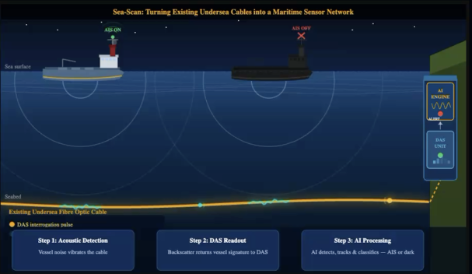
With Ireland’s EU Presidency placing a focus on security and resilience, Sea-Scan is bringing Trinity research into conversations on the protection of critical infrastructure and Europe’s maritime security.
In a LinkedIn post, Marco Ruffini shares the project’s journey and how the research is contributing to discussions with European and national security communities.
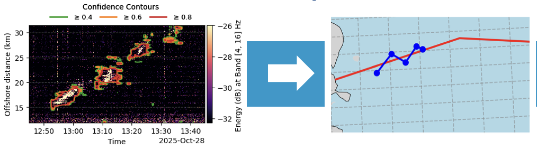
Sea-Scan is supported by the Department of Defence Ireland and the Irish Defence Forces through the Research Ireland Defence Innovation Challenge.