The Trinity Long Room Hub has launched a new initiative, giving early career researchers the opportunity to develop filming and editing skills and learn how to communicate their research to public audiences through video.
The workshop series builds on the Hub’s successful Early Career Research Poster Workshop series, which has been running since 2019. The poster workshops equip early career researchers with the skills to communicate their research to a public audience through a single image, while the new video series expands this approach into a dynamic, multimedia format.
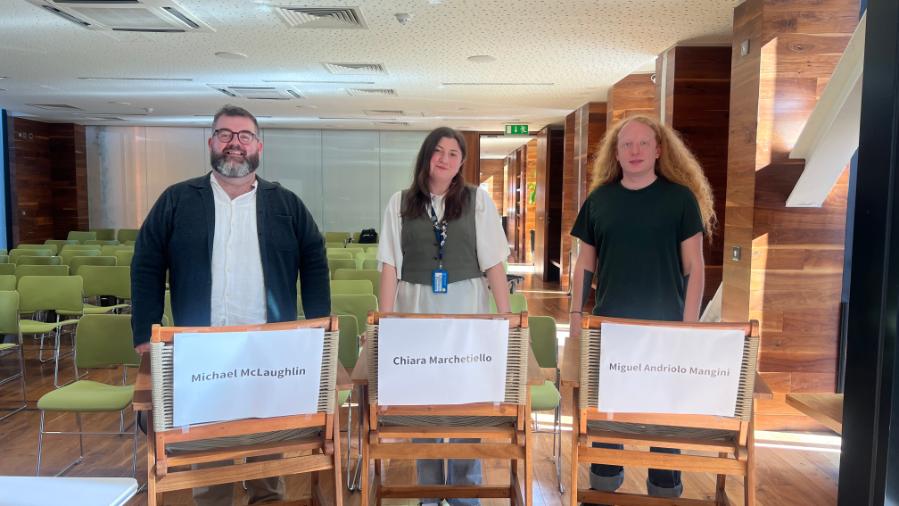
Three researchers who had previously completed the poster workshop took part in this six-month programme: Michael McLaughlin (Department of Music), whose project explores access, ambition and excellence in community choirs; Miguel Andriolo (Department of Classics), whose research examines the enduring relevance of an ancient Vergilian farming poem; and Chiara Marchetiello (School of Linguistic, Speech and Communication Sciences), whose project explores the importance of gestures in Southern Italy. The researchers premiered their completed videos at the Trinity Arts and Humanities Research Festival, marking the culmination of the six-month workshop.
The workshop series comprised six sessions, each designed to guide participants through the video development process, from developing an engaging video concept and identifying a clear narrative to filming, editing, and refining their final videos.
The series was enhanced by guest speakers who brought specialist expertise and industry experience to the workshops. Karen McCourt, Digital Research Storyteller for Trinity College Dublin, led a session on identifying and developing the ‘hook’ that draws an audience into a research story. Award-winning filmmaker and film professor, Sharon (Sharri) Hefner, shared her expertise on visual storytelling, with a particular focus on framing, composition and the effective use of b-roll.
Read on to learn more about the researchers, their videos, and their research projects.
Vergilius - Miguel Andriolo
The short film Vergilius is an output of my reading of the Georgics, a poem about farming written by the Roman poet Virgil in the 1st century BCE. I am a PhD student in the Department of Classics, and my thesis, which I am in the last year of writing, is on that very poem. The thoughts and feelings represented in Vergilius are some of those I have found in this poem and its mysterious depiction of an ancient farmer's existence in all its glory and horror, and everything in between. The video also carries other literary allusions.
I am very honoured to participate in this video-making project. The task was initially daunting, as I cannot film or edit, but we got there in the end, having had much fun. This project, conceived by Christina, was an ingenious idea for expanding the reach of topics and thoughts that usually are born and die within a specialised field of academic studies. Of course, the Georgics were not written for academics, so everyone is welcome to give them a go. My video is nothing more than an invitation for someone to open that book and share in a mystery that neither human can solve, nor can a robot be so bold as to pretend. It is only possible to contemplate, maybe learn.
Michael McLaughlin - More Than A Feeling: Considering Access, Ambition and the Pursuit of Excellence in a Community Choir
Who gets to sing - and who decides?
My PhD research at Trinity College Dublin explores the relationship between social inclusion and musical excellence in community choirs in Ireland.
Through questionnaires, ethnographic observation and interviews, my research asks whether choirs really must choose between being inclusive and being musically ambitious - or whether striving, improving and achieving together can strengthen the communities that choirs create.
At the centre of my research is the emerging idea of “excellence as communal capital”: the more singers invest in their shared musical development, the more they improve - and the more they improve together, the more they invest in each other and their community.
My film features Cairdeas Community Choir at Trinity College Dublin, an open-access choir where inclusion and musical ambition meet.
With thanks to Cairdeas Community Choir, Christina Hamilton, Trinity Long Room Hub, Trinity College Dublin Disability Service, the Department of Music at Trinity College Dublin, Dr Nicole Grimes, and PhD supervisor Dr Orla Flanagan.
Research supported by the Home Hewson Scholarship and Taylor Bequest Award.
And if somebody once told you that you couldn’t sing… perhaps it’s time to try again.
Chiara Marchetiello- Gesture, gesture on the spot: Are you grammar or are you not?
At the moment, one common assumption shared by many scholars who looked at gesture, from linguistics to psychology and anthropology -- but also communication studies, cognitive science, drama studies --, is that human communication is fundamentally multimodal. We do not communicate through words alone, but through speech, hand movements, facial expressions, as well as other body movements and other visual and auditory cues. Yet an important question remains: what exactly is the role of non-verbal communication in language and grammar?
My research is part of a bigger research project entitled “GestuGram: Investigating Gestures in Southern Italy” led by Valentina Colasanti, which aims to investigate the formal syntactic properties of gesture by looking at the gesture-heavy languages spoken in Southern Italy. In particular, GestuGram hypothesises that some gestures can be considered simply as syntactic abstract features, similar to what happens with speech (Colasanti 2023a,b). The only difference lies in the modality of externalisation: whereas speech is externalised via the auditory-spoken modality, gesture is externalised via the visual-gestural modality.
Within this project, I decided to focus my PhD on the formal syntactic integration of gestures in different linguistic domains (e.g., negation, adjectival modification, epistemicity) by looking at them in Neapolitan and other local languages spoken in Campania, which have not been previously documented or have received very little attention. I ask how gestures contribute to the syntactic structure of spoken utterances, how they interact with spoken language, and – most importantly – whether they should be analysed as part of grammar rather than as an additional layer of communication.
The idea behind this short clip came from turning this research question into a story: if the gesture itself could speak, what would it say?
Throughout the clip, I appear to be the person speaking in Neapolitan, but as the story unfolds, it becomes clear (I hope) that the real protagonist is my hand. I decided to play with the boundary between speech and gesture to make a point: if, as previously literature has shown (Ebert & Ebert 2014; Schlenker 2018; Esipova 2019; Sailor & Colasanti 2020; Colasanti 2023a,b; Colasanti & Marchetiello 2026; i.a.), a gesture can have a meaning, can function as question, and can even replace spoken words, maybe it is not “just a gesture”, perhaps it is just a word.
I am forever grateful to Christina Hamilton, Karen McCourt, and Sharon Heffner for delivering such inspiring training and for making me feel supported throughout this time.
I also want to deeply thank Mario Altrui, who helped me direct and brainstorm this clip. I couldn’t have done it without him.
Many thanks to the other members of the workshop for their support and for the discussion we had during and after the training.
My PhD Programme is funded by Trinity’s Provost’s PhD Project Award, awarded to the research project Gestural Grammar: Investigating Gestures in Southern Italy (GestuGram) led by Prof Valentina Colasanti.