“The future is inescapably multilingual,” according to Professor Michael Cronin, 1776 Professor of French and Senior Researcher in the Trinity Centre for Literary and Cultural Translation. As Ireland prepares to take on the mantle of the EU Presidency, the nation needs to reflect and build upon on its pioneering role in modern language education to make languages central to social cohesion, psychological well-being and economic prosperity.
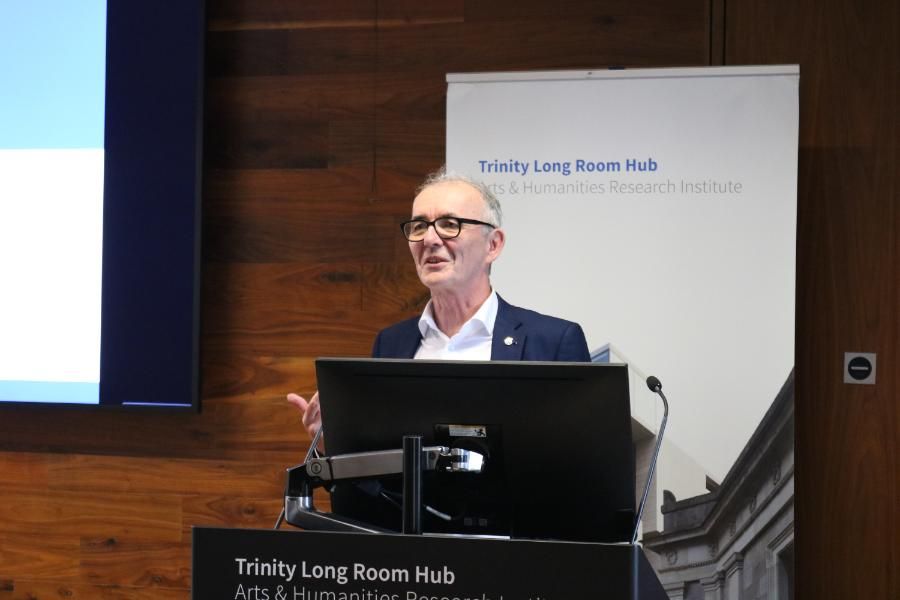
In his lecture, “A STEM Strategy for Modern Languages? Mapping Ireland’s Multilingual Future,” Cronin took the audience in the Neill Lecture Theatre on an expansive journey through the fields of politics, sociology, economics, cognitive science, and psychology, to demonstrate key areas where multilingualism is not only beneficial but crucial to Ireland’s future success in Europe. He then offered proposals for a robust priority status for language policies, akin to Ireland’s policy approach to STEM subjects.
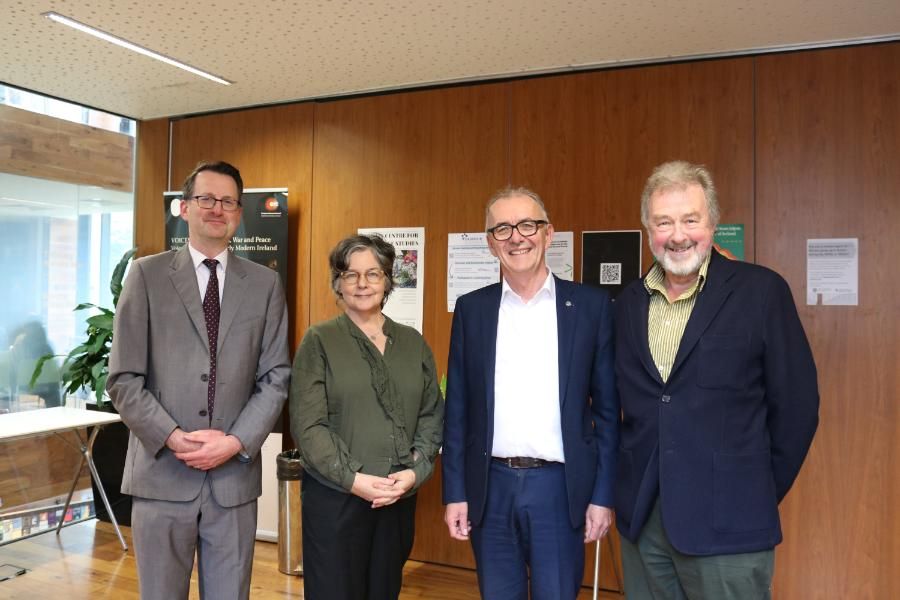
Introducing Cronin, Director of the Trinity Long Room Hub, Professor Patrick Geoghegan, highlighted that it was very appropriate that TCD’s French Chair would discuss Ireland’s multilingual future in 2026. It was 250 years ago that Trinity College Dublin established the first university chairs in Modern Languages in Ireland and Britain.
While looking to Ireland’s future, Cronin brought the audience to the island’s past. He cited a story from early Irish mythology, in which the precursor to Gaeilge was a language created from the best parts of each of the dispersed languages from the Tower of Babel. With this in mind, he invited the Ireland of today to take this same innovative and inclusive approach. “The multilingualism that we find as a constituent part of this Irish origin story is our most precious asset going into the future, but only if we know how to assess, develop and promote it,” he noted.
Cronin stressed that Ireland’s current over-reliance on the Anglosphere will work to our detriment. There has been a “catastrophic decline in foreign language learning in English-speaking countries,” which can be “attributed in part to the ready identification of English as the sole language of globalization, but also to a desire to maintain the benefits of connectedness without the pain of connection.”
Ireland must rise to this challenge of connection to ensure that language acquisition keeps pace with the country’s aims and aspirations in an interconnected world. He cited the closure of the national language institute, the Institiuid Teangalaiochta Éireann, in 2004 as a serious blow to Ireland’s ability to deliver a pioneering national language programme. Noting how there are numerous scientific institutes across the country, he observed that, “it would not make much sense for a STEM practitioner to believe that you could have a scientific or technological practice without rigorous collective research in an appropriate setting.”
Cronin discussed the difference between first order exchanges and second order exchanges in communication. First order exchanges are shallow, extremely limited interactions that require only a minimum exchange between languages. Second order exchanges are longer term, multidimensional and complex, requiring sustained and deep language exchanges. The Anglosphere, by necessity, depends upon first order exchanges with outside languages, but it is only with second order exchanges that long-lasting, deep connections and understandings can be maintained across cultures.
Second language acquisition is therefore key to combating racism, a way of maintaining business and industry partnerships, establishing a shared European identity, and a heightened awareness and understanding of the world around us. Cronin observed that, “in an uncertain global context and with the emergence of divisive populisms and the privileged narrow versions of national interest, the acquisition of a modern language becomes a way to substitute curiosity for condemnation, and partnership for paranoia.”
Five key takeaway points on Mapping Ireland’s Multilingual Future from the 2026 Annual Humanities Horizons Lecture:
- The solutions, perspectives, and insights needed to contend with major social problems, such as the Irish housing crisis, may be found outside the Anglosphere.
- Multilingual individuals experience slower rates of bio-behavioural ageing such as dementia: multilingualism is therefore a public health issue.
- Citizens Assemblies on plurilingualism as an opportunity for innovative and progressive policy making.
- Removing the second language requirement from third level education has proven disastrous elsewhere. Ireland must heed this warning.
- It is crucial “not to reduce language learning to instrumental outcomes. Language is an affair of the heart!