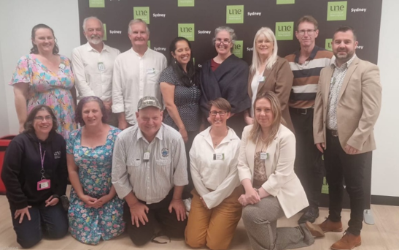
 Professor Éilish Burke and Dr Martin McMahon recently travelled to Australia on an invited visit to join the successful research team led by Professor Stuart Wark, investigating the health and wellbeing of older adults with intellectual disability in rural Australia. The visit celebrated the team’s AU$1.9 million grant award from Australia’s Medical Research Future Fund (MRFF) and provided an opportunity to advance the collaboration through scientific meetings, conference presentations and medical education. The funded project, Rural Compass: Navigating towards equitable healthcare for older people with intellectual disability, brings together Irish and Australian expertise to address health inequities in rural communities. Drawing on the model, survey and inclusive approach of IDS-TILDA, the partnership shares a commitment to healthcare that better understands and responds to people with intellectual disability’s needs as they age. For the Trinity Centre for Ageing and the Life Course in Intellectual Disability (TCAID), participation represents an opportunity to contribute Irish research experience to an international partnership focused on inclusion, ageing and health equity. The project will use the Intellectual Disability Supplement to The Irish Longitudinal Study on Ageing (IDS-TILDA) as a foundation for its research approach. IDS-TILDA examines the health and wellbeing of people with intellectual disability aged 40 and over in Ireland, generating evidence to inform health and social care policy. Building on this foundation, Rural Compass will focus on understanding and addressing health inequities in the rural Australian context. Its central ambition connects a stronger understanding of people’s needs and experiences with the evidence required to support more equitable healthcare. This focus is particularly important where rurality intersects with intellectual disability and ageing. Australian research has identified how workforce limitations and distance from specialist services can complicate access to healthcare for rural people with intellectual disability.
Dr Martin McMahon, Dr Hannah Ford, Prof. Stuart Wark & Prof Eilish Burke
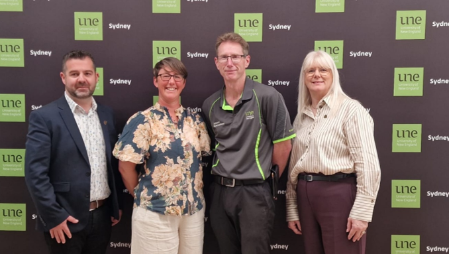 The recent visit also provided an opportunity to strengthen the collaboration through a series of scientific meetings with the research team. These discussions included a meeting in Armidale with Rural Compass principal investigator Professor Stuart Wark and colleagues. Professor Wark’s work at the University of New England’s School of Rural Medicine brings expertise in rural healthcare, intellectual disability and the practical implementation of research with service providers. Alongside the contribution of IDS-TILDA, this expertise provides a valuable basis for shared learning across different healthcare systems and community settings. The collaboration is about more than transferring a research model between countries. It offers an opportunity to consider how an established approach to ageing research can inform work that is responsive to the circumstances of rural Australian communities.
Bringing “Voices Less Heard” to the forefront
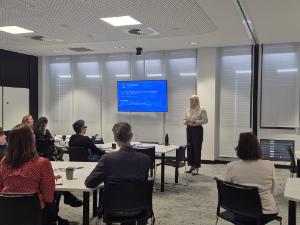 The visit also included keynote contributions to the Australasian Society for Intellectual Disability (ASID) conference, which explored the theme “Voices Less Heard”. The presentations brought together complementary perspectives on inclusive research and healthcare access. The IDS-TILDA contribution, presented by Prof. Burke, shared research findings with a particular emphasis on the inclusion of people with intellectual disability. Dr Martin McMahon presented his cancer research, highlighting concerns about late diagnosis and the importance of recognising and responding to health needs in a timely way. Together, these contributions reinforced a principle central to the partnership, that of research seeking to improve healthcare must make space for the experiences and perspectives of the people it concerns. Listening and inclusion are essential to understanding what equitable care should look like.
Connecting research, education and community impact
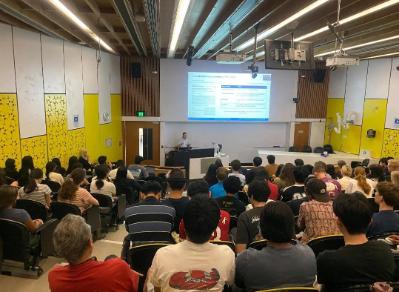 In Armidale, the visit extended into medical education through guest lectures for first- and second-year students in the School of Rural Medicine, Faculty of Medicine and Health, at the University of New England. Sessions on IDS-TILDA from Prof. Eilish Burke and Dr McMahon’s cancer research brought intellectual disability, ageing and healthcare equity into the education of future doctors emphasising the importance of communication and listening.
For older people with intellectual disability, their families and those who support them, the intended value of Rural Compass lies in research that can inform more responsive care. Its success should ultimately be understood not only through the evidence it generates, but through that evidence’s potential to support better recognition of health needs and more equitable access to care. TCAID celebrates this funding success and the collective work behind it. Rural Compass opens a new chapter in Irish-Australian collaboration, with a shared commitment to ensuring that older people with intellectual disability are heard, included and better served by healthcare.