
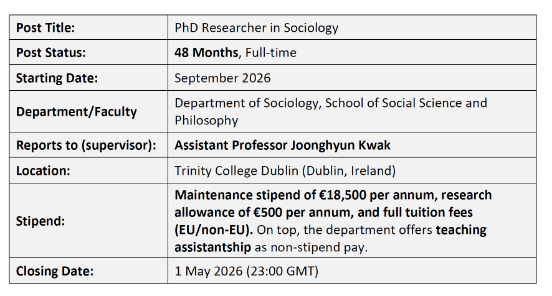
The Department of Sociology at Trinity College Dublin invites applications for one fully funded doctoral position in the PhD in Sociology programme for a period of 48 months. The successful candidate will have the opportunity to design and carry out an innovative PhD project titled ‘Meritocracy as Political Culture: A Comparative Analysis of Structures, Attitudes, and Meanings,’ which examines meritocracy as a dynamic political culture that responds to structural transformations and shapes political attitudes in systematic ways.
Meritocracy is widely regarded as a core principle of a fair society, based on the idea that individuals should be rewarded according to their talent and effort rather than their family background. In principle, this ideal promotes equality of opportunity and intergenerational mobility. However, a growing body of research highlights the paradoxical role of meritocratic beliefs in legitimising existing inequalities. As a dominant cultural framework, meritocratic ideals encourage individuals to interpret wealth and poverty as fair outcomes of ability and effort, thereby normalising unequal social structures and reinforcing liberal notions of individual responsibility.
Recent political developments in the United States and Europe suggest that the public legitimacy of meritocratic ideals may be increasingly fragile. Despite expanding access to education, the promise of upward mobility through individual effort appears less attainable for many. This widening gap between meritocratic ideals and lived experience may undermine trust in liberal institutions and contribute to political discontent, including resentment toward elites as well as hostility toward immigrants and minority groups. In this context, the project explores how meritocratic culture is formed, how it shapes exclusionary political attitudes, and why its political consequences vary across national contexts.
The PhD project will combine multiple methodological approaches. Cross-national macro-level data will be used to examine the structural conditions under which meritocratic culture emerges and intensifies, while cross-national survey data will analyse the relationship between meritocratic climate and individuals’ exclusionary attitudes, including anti-immigrant and anti-minority sentiments. In addition, the project will draw on qualitative interviews conducted in Ireland and South Korea to explore how individuals interpret the meaning of merit and meritocracy in different national contexts.