
The Postdoc Academy: Dr Gráinne Jameson on Trinity College Dublin’s Peer Support Network for Postdoctoral Fellows
Trinity’s postdoctoral researchers are a diverse and highly mobile group who contribute a considerable amount of knowledge and expertise to the university. They are frequently on short-term contracts, which means finding community and career support can be an extra challenge. This is where the Postdoc Academy becomes important, as it provides social supports for postdoctoral fellows, including networking sessions and career development opportunities.
The Chair of the Postdoc Academy, Dr Gráinne Jameson, is an immunologist specialising in tissue-resident Natural Killer (NK) cell biology, immunometabolism, and host defence in infectious diseases. Here she talks with #researchMATTERS about how her research career led her to the Postdoc Academy, and the importance of supporting postdoctoral researchers, both in terms of mentors and the wider community.
Establishing the Academy
The Postdoc Academy was established in 2024 as a way to strengthen connections and give a voice to the often scattered members of Trinity’s postdoctoral community. It was initiated by the then-Associate Dean of Research, Dr Immo Wanjes, and Research Strategy and Policy Manager Dr Jennifer Daly, who invited each school or institute to hold elections or otherwise select a postdoctoral representative to join the Academy’s steering group. The current Associate Dean of Research, Dr Joseph Roche, has continued this involvement. Every postdoctoral fellow in the college is automatically a member of the Academy, and the steering committee has the aim of improving the working life and community base of postdoctoral research fellows and teaching fellows in Trinity. 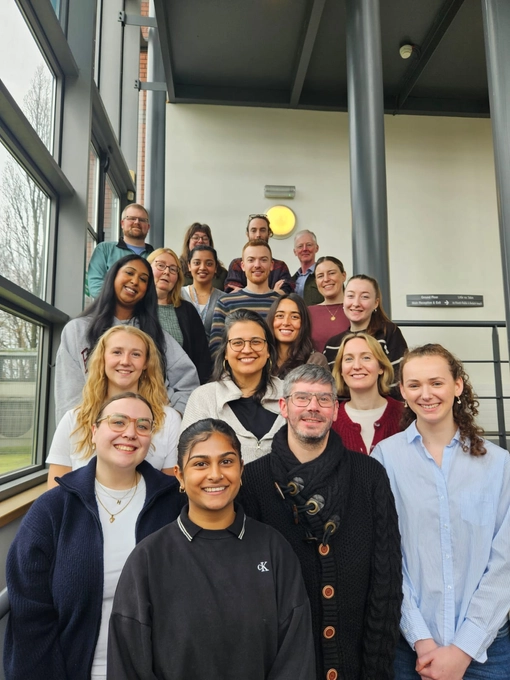
Jameson is currently chair of the Postdoc Academy’s steering group and has been a member of the Postdoc Academy since its inception. She was two and a half years into her postdoctoral work when the Academy was established. “I came in at a good point,” she says, “because I was still early in my postdoctoral career, but I had already made that transition from a student-led environment into a staff role. I wanted to bring postdocs together and to clearly communicate to the wider university what a postdoc is and who we are as a cohort.
A key reason for establishing the Postdoc Academy was because, as Jameson notes, they are a transient cohort. The estimates are that Trinity has around 400 postdoctoral researchers currently, but this number fluctuates because so many postdoctoral roles are funded by governmental funding agencies like the Heath Research Board or Research Ireland, as well as international grants. They’re not permanent posts funded by Trinity. Additionally, she notes, “the funding that’s available is very limited. And if we don’t have proper support systems within the university for postdocs, we risk losing them to other universities or to industry.”
NK Cells, Tuberculosis, and Immunometabolism
Jameson’s own research career is rooted in immunology. Her PhD focused on Natural Killer (NK) cells, which are a type of innate immune cells: “they’re one of your first lines of defence. They kill cells that pose a threat to the body, such as cancer cells.” Unlike adaptive immune cells such as T cells, NK cells can respond to and kill abnormal or infected cells without prior exposure.
During her PhD, Jameson worked with human liver transplants from St. Vincent’s Hospital. Unlike many other solid organ transplants, liver transplants can be successfully accepted with a lower level of donor–recipient matching, though the reasons for this are not fully understood. She noted; “There are a lot of NK cells in the liver, and I showed that they have a unique role in killing T cells, which are involved in transplant rejection. We provided evidence to support a role for the NK cells in mediating the acceptance of liver transplants.”
Jameson completed her PhD during the pandemic and then joined a COVID -19 research project, where much biomedical research was focused on at the time. As an immunologist rather than a virologist she found this challenging. But, she adds, “I brought my NK cell experience with me, and I started looking at the lung. I’m still working on the lung now, and I’ve moved into bacterial infectious diseases, which I really enjoy studying.”
Tuberculosis remains one of the world’s leading infectious killers, Jameson explains. “Just because it occurs mostly in lower-income countries, it’s often forgotten. But it is on the rise: paediatric tuberculosis has increased by 10 percent across mainland Europe.” And while Ireland remains a low-incidence country, the UK is on the brink of losing its low-risk status.
Indeed, Jameson’s work highlight why awareness and education are so important. Her team runs focus groups with people affected by tuberculosis in Ireland. She notes, “one of the patients spoke about how hard it is to have tuberculosis in Ireland. It has such a long history in our country, and they described being very isolated from their family, not allowed to see their nieces and nephews. At a certain point during treatment you are no longer contagious, so it is safe to be around others, but there is still a lot of stigma. Improving education around tuberculosis is really important.”
She’s now working on NK cells and other innate immune cells in people with tuberculosis. Previous vaccine approaches targeting adaptive T cells have had limited success, so Jameson’s research team (pictured here), led by Dr Sharee Basdeo in Trinity’s Translational Medicine institute (TTMI), is instead focusing on the innate immune system and immunometabolism. Immunometabolism refers to how immune cells generate and use energy to carry out their functions, much in the way we use food for energy. Understanding which fuels immune cells use to kill infected cells could open up new avenues for targeted therapies for bacterial infections such as tuberculosis.
Building a Postdoctoral Community
 It was Jameson’s own experiences that encouraged her to become Chair of the Postdoc Academy. During her PhD she was in a lab by herself, and she attended weekly meetings, where different labs from TTMI come together to host talks, followed by coffee. She highly values that supportive and transformative environment. “Without that I wouldn’t have finished my PhD. In my postdoc I moved into a much bigger lab, one with multiple PIs with all of their staff. I knew immediately how lucky I was, because I had come from being on my own most of the time.”
Jameson adds that she still found this transition hard due to the inherent uncertainty of postdoctoral life. “You’re on such short contracts, and in terms of financial and job stability it can be very challenging. I was really fortunate to receive strong mentorship in my second postdoc from my PI, Dr. Sharee Basdeo. That was a turning point in my career.”
Jameson is currently focused on writing funding applications with the aim of establishing her own research group. However, she describes the process as “quite disheartening” at times, given how competitive funding is and how frequently applications are unsuccessful. “You need to have the right mentorship to remind you that it’s not a reflection on you, but rather on the current system.”
Both her experience of community and individualised mentorship were key reasons why Jameson joined the Postdoc Academy. “People really struggle to find both of those things, so having the Academy as a place where all that information and support is brought together can be really helpful.”
Supporting Everyday Activity
The steering group is mandated to meet at least twice a year, but meet more often than that, to discuss and address postdoctoral issues, acting as a direct line of communication to the Associate Dean of Research and then the Dean of Research. They hold hybrid meetings to ensure accessibility for their representatives, many of whom are not located on the main campus. Most recently, the steering group met to update the Postdoc Academy's website with an FAQ section: “One of the big things that came up was postdocs coming from abroad. I’ve lived in Ireland my whole life so I’ve never had to deal with the struggles that they do – visas, opening up bank accounts, getting accommodation in Dublin. It’s really hard and it comes with the territory of the job, because when you progress to securing your own funding, there’s often an expectation that you’ve gone abroad for specialist training. So we have many postdocs coming into Trinity from overseas, and it’s simply more challenging for them.”
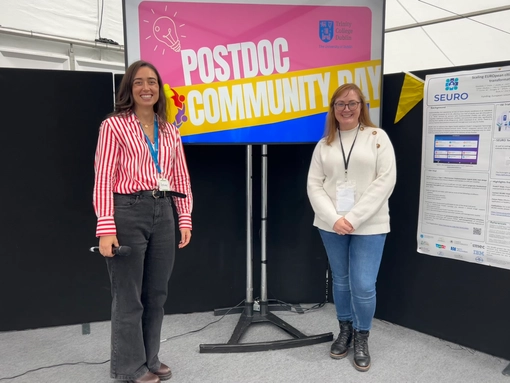
 The Postdoc Academy’s activity ensures that their busy and dispersed members get an opportunity to socialise and learn about each other’s research interests. In both 2024 and 2025 the Academy held Postdoc Community Days as part of TCD’s European Researchers’ Night events (see photos from the event, and Jameson pictured here with Dr Jennifer Daly). Throughout the day, Trinity’s support staff joined a relaxed coffee morning, where they answered any questions the postdoctoral fellows had. There was also a Speaker’s Corner, in which they were invited to informally present on their research. “We said just turn up on the day, no slides, and see can you talk about your research,” says Jameson. “It was so interesting to hear about the diversity of the projects. We’re running it again this year and we’re hoping to keep it going.”
What is very clear from talking with Jameson is the importance of supporting postdoctoral fellows in the way permanent staff are. “Postdocs are one of the most diverse cohorts in Trinity,” she adds, “across every school and institute there are postdocs with highly specialised training and innovative ideas. Without adequate support, we risk losing this talent from the system. With stronger support structures, more could remain in academia and be well positioned to secure future funding.”
- Article written by Dr Sarah Cullen
Dr. Gráinne Jameson
Gráinne Jameson is an immunologist, researcher, and science communicator passionate about understanding how the immune system responds to infectious disease. As a Research Fellow in Human & Translational Immunology Group, at the Trinity Translational Medicine Institute (TTMI), she investigates tissue-resident NK cells and immunometabolism in tuberculosis, with a focus on translating discoveries into new therapeutic approaches. She is also committed to mentorship, public engagement, and supporting researchers through her role as Chair of Trinity's Postdoctoral Academy.