
Between the Lines: Hannah Arendt’s Unwritten Chapter on Judging
Between the Lines asks researchers about the process of writing a book. Dr Samantha Fazekas reflects on the process behind writing Hannah Arendt’s Unwritten Chapter on Judging.
 When did you first come up with the idea for the book?
The book is an updated, published version of my Ph.D. thesis, which I completed at Trinity in 2023. Originally, I intended to write my Ph.D. thesis on Immanuel Kant’s moral philosophy. The first chapter I wrote was on Hannah Arendt’s criticism of Kant’s moral law. After my confirmation interview, my Ph.D. supervisor pointed out that the thesis seemed to be more about Arendt than about Kant.
Hannah Arendt was a German-Jewish political thinker, who studied philosophy until she fled Germany in 1933. In 1937, she lost German citizenship, was detained in an internment camp in France in 1940, and emigrated to the US in 1941. She was stateless for thirteen years until she received American citizenship in 1950. Her experience as a Jewish refugee, as a stateless person, living through the Holocaust, World War II, and the Eichmann trial, inspired her to leave philosophy behind and turn to politics.
Arendt’s political thought was deeply influenced by these political events. So, she emphasizes that the purpose of politics is to establish and maintain a political community that consists of a plurality of unique and different people. Arendt believes that everyone has the right to belong to the political community and to participate politically. For her, citizenship is the only guarantee for securing one’s place and ability to partake in politics. What’s interesting about Arendt’s conception of politics is that it can emerge anywhere. Because citizens create and shape the political community by speaking and interacting with each other. This also means that politics is a public space that citizens share by participating in it.
It wasn’t until later in life that she returned to philosophy, to the question of how we think, will, and judge. Arendt claims that she left philosophy behind because it’s antithetical to politics. The philosopher must retreat from politics in order to engage in the contemplative life, whereas the citizen leads an active life by throwing themselves into public affairs.
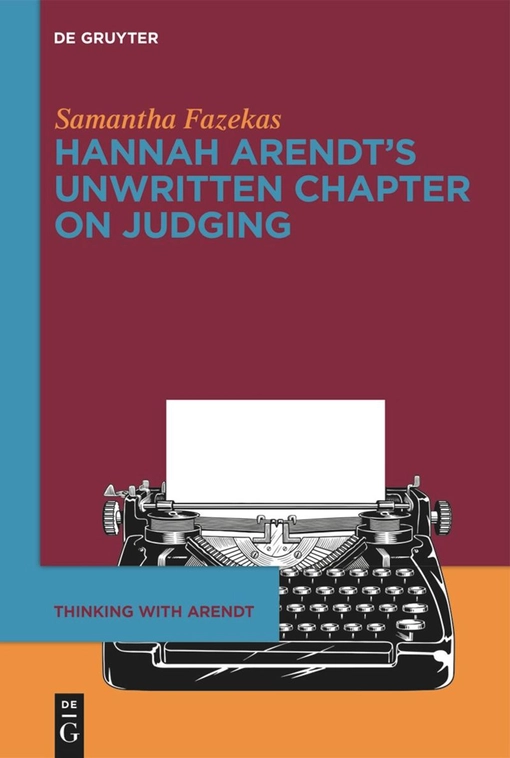
Even though I intended to write on Kant, Arendt is a figure who was always present for me. So, after my confirmation interview, I started re-reading some of her essays to try to figure out how I could develop a research project on her political thought that incorporated Kant. This led me to Arendt’s reflections on political judgment. It fascinated me that Arendt’s theory of political judgment was left unwritten. The last chapter of her last work, The Life of the Mind, was supposed to be about judgment. But only the title page of the chapter on judgment was left in her typewriter before her passing. Discovering this fact led me to question what her account of political judgment could have been.
Did you start out with the intention of writing a book about a particular topic, or did a book begin to make sense as you were researching?
To be honest, I never thought that I would turn the Ph.D. thesis into a book. When it came to the thesis, my intention to write on Arendt’s theory of political judgment was a coincidence. But when I did more research on the topic, I realized that I was neatly positioned to write about it. I had a background in Arendt’s political thought, Kant’s philosophy, and some of the other thinkers Arendt draws on to develop her conception of political judgment, for example, Plato, Socrates, and Aristotle. I felt like I stumbled upon a topic that interested me and that I coincidentally had the philosophical training to explore.
What are the book's main ideas?
My book develops a new reading of Hannah Arendt’s interpretation of Immanuel Kant’s aesthetic judgment. In Arendt’s Lectures on Kant’s Political Philosophy, she claims to unearth Kant’s unwritten political philosophy in his work on aesthetics. It’s a curious claim because Kant wrote a political philosophy that can be found in his other texts, but not in his aesthetics. So, I try to make sense of how Arendt thinks Kant’s aesthetic judgment can be applied to politics.
Even though Arendt’s chapter on judging remains unwritten, it’s clear that she intended to use Kant’s aesthetic judgment as a model for her conception of political judgment. Specifically, Arendt holds that there’s an analogy between how we judge aesthetically and politically, that is, how we distinguish “between beautiful and ugly, right and wrong.” What appeals to Arendt about aesthetic judgment is that people have to create their own rule by which to determine whether something, take a painting or a sculpture, is beautiful or ugly.
The analogy to political judgment is that people have to create their own rule by which to judge unprecedented political events. Precisely because unprecedented events shatter the reigning standards and norms, the existing categories of right and wrong, that people typically use to judge under normal circumstances. Arendt was interested in political judgment because she was grappling with the unprecedented political events of her time. Her hope is that judging, distinguishing between right and wrong ourselves, in these moments, as she says, “when the chips are down,” we will come to understand events that appear to defy our understanding.
This is precisely what Arendt believes political judgment achieves: it seeks to understand the unprecedented. When people judge politically, they establish their own rules by which they can categorize an event as right or wrong. Ideally, political judgment is supposed to provide a way for people to act when they can’t appeal to the existing categories of right and wrong. For Arendt, this would allow them to actively partake in politics and thereby continue to create and maintain the political community. Political judgment thus acts as a safeguard against the disappearance of the political world, which can occur, for example, through oppression, misinformation, political upheaval, or complacency.
So, what I try to do in my book is to justify and work out Arendt’s analogy between political judgment and Kant’s aesthetic judgment. This is a significant contribution to the secondary literature on this topic because many scholars don’t believe that Arendt is justified in maintaining this analogy. Some argue that it’s inconsistent with Kant’s thought, whereas others argue that it’s inconsistent with Arendt’s thought.
The main reason is that aesthetic judgment can’t lead into political action in the way Arendt envisions. Because aesthetic judgment is a reflective ability, which places it squarely within the contemplative life. This means that when we judge, we don’t assume the role of the citizen who is actively engaged in politics. Instead, we retreat from the political world like the philosopher does. So, the question is, how can a contemplative ability lead into political action?
In my book, I find a way to link judgment and action by remaining consistent with Kant’s and Arendt’s thought. Defending Arendt’s analogy between aesthetic and political judgment also provides insight into what Arendt’s account of political judgment could have been had she written her chapter on judgment.
What did writing a book allow you to do that wouldn’t have been possible in another medium eg. journal article?
The scope of the project was more feasible as a book than a journal article. The length of a book gave me the space to really contextualize aesthetic judgment in Arendt’s political thought. As I mentioned, the main issue with defending Arendt’s analogy between aesthetic and political judgment is that Kant and Arendt agree that judging is a reflective activity. According to Arendt’s thought, this would place judgment squarely within the private realm. Precisely because she sees judging and acting as mutually exclusive in the sense that they cannot take place at the same time.
Recall that the public realm is where citizens create and maintain politics by speaking and interacting with each other. In contrast, Arendt conceives of the private realm as the household where people retreat from politics in order to tend to the family and individual survival. As a result, she argues that the private and public realms are entirely discrete and opposed to each other. Meaning, judging and acting are entirely discrete and opposed to each other.
So, the clue to defending Arendt’s analogy between aesthetic and political judgment was to re-read Arendt’s distinction between the private and public realms. Writing a book allowed me to provide a complete and coherent re-interpretation of Arendt’s distinction between these two realms. What I showed is that there is another side of privacy that is not opposed to the public realm at all, but rather ensures its continuity and vitality. Following Arendt, I’ve termed this side of the private realm ‘the non-privative realm.’ Even though Arendt mentions this side of privacy briefly, it’s been almost entirely overlooked in the secondary literature.
My claim is that the non-privative realm offers persons refuge from politics and from the family. I’ve therefore characterized it as the place where people can judge, where they can see unprecedented political events from the outside, figure out how to categorize them, and subsequently how they can act in response. I took this to show that Arendt equally cares about a kind of private life – that is, the contemplative life – and about the public life of the citizen. What is more, I argue that the contemplative life, and judgment in particular, is not opposed to politics at all, but rather that is necessary to lead the kind of public life she envisions.
In fact, this leads me to the conclusion that the contemplative and active lives are not antithetical to each other, but rather that they are two sides of the same coin. Meaning, when people retreat from the political world, they assume to role of someone who observes public affairs, similarly to the philosopher, or in Arendt’s terminology, it’s the spectator. Once they judge and determine how they should act, then they assume the role of the citizen, who throws themselves into the world by speaking and interacting with others, thereby assuring the continuity and vitality of the political community.
Engaging in this exegetical work allowed me to justify Arendt’s reading of Kant’s aesthetic judgment in a way that remains consistent with their thought. If I had published chapters as individual journal articles, I fear that the significance of my interpretation for Arendt’s thought as a whole would have gotten lost. Namely, it seems that Kant’s aesthetic judgment actually gives Arendt the key to uniting the contemplative and active lives, which she intended to do via judgment.
How did you decide which publisher to place the book with?
I was lucky that I was put in touch with the publisher to publish my Ph.D. thesis as the first book of the series, Thinking with Arendt. The external examiner on my Ph.D. panel, Roger Berkowitz, who is one of the editors of this series, recommended it for publication. I was honored to be considered.
How long did it take to write?
It took me roughly three years to see the book to completion. As I mentioned, I started by writing a chapter that didn’t feature in the book, although certain parts of it did in different ways. So, it took me a while to re-think my project, familiarize myself with the primary and secondary literature, and situate myself within a particular debate concerning Arendt’s interpretation of Kant’s aesthetic judgment. I didn’t start writing properly until about one and a half years before submitting my Ph.D. thesis. Most of the work up until that point was research-based and preparatory. Then it took me a few months to turn the thesis into a book, which I did over the course of two months in the summer of 2024.
Did you ever experience any moments of writer’s block? What did you do to overcome this?
I definitely have! And continue to. What helps me is shifting gears instead of trying to force myself to write. I’ll either take a break from writing for a few hours, a day or two, or even more. Reading other books and articles can sometimes inspire me to write. Other times, I find that doing other activities, such as going for walks, doing yoga, cooking, baking, or gardening, actually helps me work through what I’m trying to say.
What advice would you give someone thinking about writing a book?
I would tell them that it always takes longer than you think! There’s a lot more work that takes place behind the scenes than the actual writing process. And the process of writing isn’t always steady – it waxes and wanes. I found that each chapter takes a different amount of time. Some can be written up in a month or two, whereas you might be grappling with others for six months or longer. Some days you might write one page or five pages. Other days you might just edit one sentence over and over again.
It also doesn’t necessarily make sense to start writing the introduction or the first chapter first. When I started writing up my Ph.D. thesis properly, I believe I started with the second chapter first, which I then divided into two chapters for the book. Then I wrote the first chapter, and the rest in order, but I wrote the introduction and the conclusion last.
I would also tell them that the book might never feel like it’s finished. There are definitely sections I wish I had more time to work on. And I’m currently working on a few articles that further and even amend some of my claims in the book. But that’s the beauty of thinking and writing – it never ends!
If you could go back in time and give yourself one piece of advice before you started writing, what would that be?
I would tell myself to be more patient with the writing process. Take moments of inspiration and moments of stagnation as they come. It takes time to think through problems, to come up with your own interpretations, to put them on paper, and to edit them. You might think you know where the argument is going in your head. But once you start writing, you might find that it takes you somewhere else. Instead of seeing these moments as deviations from the plan, I’d tell myself that they’re actually vital steppingstones towards the final product.
When did you first come up with the idea for the book?
The book is an updated, published version of my Ph.D. thesis, which I completed at Trinity in 2023. Originally, I intended to write my Ph.D. thesis on Immanuel Kant’s moral philosophy. The first chapter I wrote was on Hannah Arendt’s criticism of Kant’s moral law. After my confirmation interview, my Ph.D. supervisor pointed out that the thesis seemed to be more about Arendt than about Kant.
Hannah Arendt was a German-Jewish political thinker, who studied philosophy until she fled Germany in 1933. In 1937, she lost German citizenship, was detained in an internment camp in France in 1940, and emigrated to the US in 1941. She was stateless for thirteen years until she received American citizenship in 1950. Her experience as a Jewish refugee, as a stateless person, living through the Holocaust, World War II, and the Eichmann trial, inspired her to leave philosophy behind and turn to politics.
Arendt’s political thought was deeply influenced by these political events. So, she emphasizes that the purpose of politics is to establish and maintain a political community that consists of a plurality of unique and different people. Arendt believes that everyone has the right to belong to the political community and to participate politically. For her, citizenship is the only guarantee for securing one’s place and ability to partake in politics. What’s interesting about Arendt’s conception of politics is that it can emerge anywhere. Because citizens create and shape the political community by speaking and interacting with each other. This also means that politics is a public space that citizens share by participating in it.
It wasn’t until later in life that she returned to philosophy, to the question of how we think, will, and judge. Arendt claims that she left philosophy behind because it’s antithetical to politics. The philosopher must retreat from politics in order to engage in the contemplative life, whereas the citizen leads an active life by throwing themselves into public affairs.
Even though I intended to write on Kant, Arendt is a figure who was always present for me. So, after my confirmation interview, I started re-reading some of her essays to try to figure out how I could develop a research project on her political thought that incorporated Kant. This led me to Arendt’s reflections on political judgment. It fascinated me that Arendt’s theory of political judgment was left unwritten. The last chapter of her last work, The Life of the Mind, was supposed to be about judgment. But only the title page of the chapter on judgment was left in her typewriter before her passing. Discovering this fact led me to question what her account of political judgment could have been.
Did you start out with the intention of writing a book about a particular topic, or did a book begin to make sense as you were researching?
To be honest, I never thought that I would turn the Ph.D. thesis into a book. When it came to the thesis, my intention to write on Arendt’s theory of political judgment was a coincidence. But when I did more research on the topic, I realized that I was neatly positioned to write about it. I had a background in Arendt’s political thought, Kant’s philosophy, and some of the other thinkers Arendt draws on to develop her conception of political judgment, for example, Plato, Socrates, and Aristotle. I felt like I stumbled upon a topic that interested me and that I coincidentally had the philosophical training to explore.
What are the book's main ideas?
My book develops a new reading of Hannah Arendt’s interpretation of Immanuel Kant’s aesthetic judgment. In Arendt’s Lectures on Kant’s Political Philosophy, she claims to unearth Kant’s unwritten political philosophy in his work on aesthetics. It’s a curious claim because Kant wrote a political philosophy that can be found in his other texts, but not in his aesthetics. So, I try to make sense of how Arendt thinks Kant’s aesthetic judgment can be applied to politics.
Even though Arendt’s chapter on judging remains unwritten, it’s clear that she intended to use Kant’s aesthetic judgment as a model for her conception of political judgment. Specifically, Arendt holds that there’s an analogy between how we judge aesthetically and politically, that is, how we distinguish “between beautiful and ugly, right and wrong.” What appeals to Arendt about aesthetic judgment is that people have to create their own rule by which to determine whether something, take a painting or a sculpture, is beautiful or ugly.
The analogy to political judgment is that people have to create their own rule by which to judge unprecedented political events. Precisely because unprecedented events shatter the reigning standards and norms, the existing categories of right and wrong, that people typically use to judge under normal circumstances. Arendt was interested in political judgment because she was grappling with the unprecedented political events of her time. Her hope is that judging, distinguishing between right and wrong ourselves, in these moments, as she says, “when the chips are down,” we will come to understand events that appear to defy our understanding.
This is precisely what Arendt believes political judgment achieves: it seeks to understand the unprecedented. When people judge politically, they establish their own rules by which they can categorize an event as right or wrong. Ideally, political judgment is supposed to provide a way for people to act when they can’t appeal to the existing categories of right and wrong. For Arendt, this would allow them to actively partake in politics and thereby continue to create and maintain the political community. Political judgment thus acts as a safeguard against the disappearance of the political world, which can occur, for example, through oppression, misinformation, political upheaval, or complacency.
So, what I try to do in my book is to justify and work out Arendt’s analogy between political judgment and Kant’s aesthetic judgment. This is a significant contribution to the secondary literature on this topic because many scholars don’t believe that Arendt is justified in maintaining this analogy. Some argue that it’s inconsistent with Kant’s thought, whereas others argue that it’s inconsistent with Arendt’s thought.
The main reason is that aesthetic judgment can’t lead into political action in the way Arendt envisions. Because aesthetic judgment is a reflective ability, which places it squarely within the contemplative life. This means that when we judge, we don’t assume the role of the citizen who is actively engaged in politics. Instead, we retreat from the political world like the philosopher does. So, the question is, how can a contemplative ability lead into political action?
In my book, I find a way to link judgment and action by remaining consistent with Kant’s and Arendt’s thought. Defending Arendt’s analogy between aesthetic and political judgment also provides insight into what Arendt’s account of political judgment could have been had she written her chapter on judgment.
What did writing a book allow you to do that wouldn’t have been possible in another medium eg. journal article?
The scope of the project was more feasible as a book than a journal article. The length of a book gave me the space to really contextualize aesthetic judgment in Arendt’s political thought. As I mentioned, the main issue with defending Arendt’s analogy between aesthetic and political judgment is that Kant and Arendt agree that judging is a reflective activity. According to Arendt’s thought, this would place judgment squarely within the private realm. Precisely because she sees judging and acting as mutually exclusive in the sense that they cannot take place at the same time.
Recall that the public realm is where citizens create and maintain politics by speaking and interacting with each other. In contrast, Arendt conceives of the private realm as the household where people retreat from politics in order to tend to the family and individual survival. As a result, she argues that the private and public realms are entirely discrete and opposed to each other. Meaning, judging and acting are entirely discrete and opposed to each other.
So, the clue to defending Arendt’s analogy between aesthetic and political judgment was to re-read Arendt’s distinction between the private and public realms. Writing a book allowed me to provide a complete and coherent re-interpretation of Arendt’s distinction between these two realms. What I showed is that there is another side of privacy that is not opposed to the public realm at all, but rather ensures its continuity and vitality. Following Arendt, I’ve termed this side of the private realm ‘the non-privative realm.’ Even though Arendt mentions this side of privacy briefly, it’s been almost entirely overlooked in the secondary literature.
My claim is that the non-privative realm offers persons refuge from politics and from the family. I’ve therefore characterized it as the place where people can judge, where they can see unprecedented political events from the outside, figure out how to categorize them, and subsequently how they can act in response. I took this to show that Arendt equally cares about a kind of private life – that is, the contemplative life – and about the public life of the citizen. What is more, I argue that the contemplative life, and judgment in particular, is not opposed to politics at all, but rather that is necessary to lead the kind of public life she envisions.
In fact, this leads me to the conclusion that the contemplative and active lives are not antithetical to each other, but rather that they are two sides of the same coin. Meaning, when people retreat from the political world, they assume to role of someone who observes public affairs, similarly to the philosopher, or in Arendt’s terminology, it’s the spectator. Once they judge and determine how they should act, then they assume the role of the citizen, who throws themselves into the world by speaking and interacting with others, thereby assuring the continuity and vitality of the political community.
Engaging in this exegetical work allowed me to justify Arendt’s reading of Kant’s aesthetic judgment in a way that remains consistent with their thought. If I had published chapters as individual journal articles, I fear that the significance of my interpretation for Arendt’s thought as a whole would have gotten lost. Namely, it seems that Kant’s aesthetic judgment actually gives Arendt the key to uniting the contemplative and active lives, which she intended to do via judgment.
How did you decide which publisher to place the book with?
I was lucky that I was put in touch with the publisher to publish my Ph.D. thesis as the first book of the series, Thinking with Arendt. The external examiner on my Ph.D. panel, Roger Berkowitz, who is one of the editors of this series, recommended it for publication. I was honored to be considered.
How long did it take to write?
It took me roughly three years to see the book to completion. As I mentioned, I started by writing a chapter that didn’t feature in the book, although certain parts of it did in different ways. So, it took me a while to re-think my project, familiarize myself with the primary and secondary literature, and situate myself within a particular debate concerning Arendt’s interpretation of Kant’s aesthetic judgment. I didn’t start writing properly until about one and a half years before submitting my Ph.D. thesis. Most of the work up until that point was research-based and preparatory. Then it took me a few months to turn the thesis into a book, which I did over the course of two months in the summer of 2024.
Did you ever experience any moments of writer’s block? What did you do to overcome this?
I definitely have! And continue to. What helps me is shifting gears instead of trying to force myself to write. I’ll either take a break from writing for a few hours, a day or two, or even more. Reading other books and articles can sometimes inspire me to write. Other times, I find that doing other activities, such as going for walks, doing yoga, cooking, baking, or gardening, actually helps me work through what I’m trying to say.
What advice would you give someone thinking about writing a book?
I would tell them that it always takes longer than you think! There’s a lot more work that takes place behind the scenes than the actual writing process. And the process of writing isn’t always steady – it waxes and wanes. I found that each chapter takes a different amount of time. Some can be written up in a month or two, whereas you might be grappling with others for six months or longer. Some days you might write one page or five pages. Other days you might just edit one sentence over and over again.
It also doesn’t necessarily make sense to start writing the introduction or the first chapter first. When I started writing up my Ph.D. thesis properly, I believe I started with the second chapter first, which I then divided into two chapters for the book. Then I wrote the first chapter, and the rest in order, but I wrote the introduction and the conclusion last.
I would also tell them that the book might never feel like it’s finished. There are definitely sections I wish I had more time to work on. And I’m currently working on a few articles that further and even amend some of my claims in the book. But that’s the beauty of thinking and writing – it never ends!
If you could go back in time and give yourself one piece of advice before you started writing, what would that be?
I would tell myself to be more patient with the writing process. Take moments of inspiration and moments of stagnation as they come. It takes time to think through problems, to come up with your own interpretations, to put them on paper, and to edit them. You might think you know where the argument is going in your head. But once you start writing, you might find that it takes you somewhere else. Instead of seeing these moments as deviations from the plan, I’d tell myself that they’re actually vital steppingstones towards the final product.
- Interviewed conducted by Dr Sarah Cullen

Dr. Samantha Fazekas
Dr. Samantha Fazekas completed her Ph.D. in philosophy at Trinity College Dublin in 2023 before which she was hired as Teaching Fellow in Political Philosophy at TCD. She will commence a stay as Visiting Researcher at the Philipps-Universität Marburg, Germany this fall. Her research areas are in continental philosophy, particularly in the history of philosophy, political and moral philosophy, Kantian and post-Kantian philosophy.