
Beyond Demolition: Investigating Sustainable Alternatives for the Repair and Remediation of Ireland's Defective Concrete Block Housing Crisis
Dr Madhavi Latha Kasulanati is a Postdoctoral Research Fellow in the School of Civil, Structural and Environmental Engineering at Trinity College Dublin. She spoke with us about her experimental work on one of Ireland’s most serious and costly housing problems - and what science can do to help solve it.
Across counties Donegal, Mayo, Clare, and Limerick, thousands of homes are slowly falling apart. Walls are cracking, bowing, and crumbling, yet the families living in them had no warning this would happen. The cause is the concrete blocks used to build these houses, mainly during the 1980s and 1990s, which contained minerals with percentages exceeding the standard limitations, that have caused severe structural damage over time. The problem, now known as the Defective Concrete Block (DCB) crisis, is estimated to affect more than 7,500 homes at a state cost projected to exceed €3 billion.
Home Should Feel Safe
 When Dr Kasulanati first arrived at Trinity, she built a cardboard model of an Irish house to explain her work to colleagues during the Postdoc Academy event held during September 2025: “I wanted to show how the cracks, forming the major part of the visible symptoms, are affecting the home owners. These cracks appearing on the walls of defective homes across Ireland do more than compromise their visual appearance, they fracture the sense of safety and dignity within.”
For families, who invested years of hard work and deep trust into building their homes, the visible deterioration is not merely a structural concern but a source of daily psychological distress, as each crack serves as a constant reminder that the home they worked so hard for is slowly failing them. “Home is a place where you have to feel secure and safe, and at the end of the day, you want to feel comfortable there.” She is clear-eyed about the scale ahead: “The crisis cannot be solved in a short stretch. It is huge. You need so much experimentation, documented analysis, and many conclusions.” For the thousands of families still waiting, that commitment, grounded in rigorous science is exactly what is needed.
Dr Madhavi Latha Kasulanati’s Background and Experience
Dr Kasulanati’s background in recycled concrete, durability studies, and life cycle assessment at the National Institute of Technology Warangal, India, where she pursued her PhD, made her well placed to work on this problem. She has joined as Research Fellow at Trinity College Dublin’s School of Civil, Structural and Environmental Engineering, now part of a joint project between Trinity College Dublin and the University of Galway, funded through Construct Innovate and supported by the National Standards Authority of Ireland (NSAI) and the Housing Agency of Ireland. She is currently working on alternative methods of remediation of buildings damaged by defective concrete blocks, where she is trying to understand exactly how these blocks are failing, classify homes by level of damage, and identify cost-effective alternatives to full demolition.
What Is Causing the Damage?
For years, a mineral called muscovite mica was blamed as the main culprit of the deterioration, particularly in Donegal. This formed the basis of Ireland’s 2018 national assessment standard, which outlined a protocol to assess and categorise the damage in properties where the concrete blocks are suspected of containing excessive amounts of free or unbound muscovite mica or potentially deleterious quantities of pyrite. However, a landmark 2023 study published in Cement and Concrete Research challenged this interpretation. Leemann et al. (2023), involving researchers from Switzerland and Ireland, demonstrated that the deterioration of defective concrete blocks in Donegal was primarily associated with the oxidation of pyrrhotite, a highly reactive iron sulphide mineral, which triggered a process called Internal Sulphate Attack (ISA). In other words, pyrrhotite present in the concrete, when activated by oxygen and water, caused the concrete to expand and crack from within.
The revised standard published by NSAI in 2026 finally incorporated this updated science, indicating the critical effect of oxides of sulphur in defective concrete block crisis. Dr Kasulanati’s own analysis of the data from the defective houses adds a further critical finding. Analysis of data provided by the Housing Agency for 227 affected homes showed that houses containing a combination of pyrrhotite and mica exhibited the fastest rates of deterioration, suggesting a potential association between the presence of both minerals and increased deterioration severity. It is therefore not pyrite or pyrrhotite or mica alone, it is the combination of pyrrhotite and mica that was causing the maximum damage. Dr Kasulanati’s research is demonstrated in her field work too: she tells us that, “I have seen images where concrete walls can be crumbled with your hand, due to continuous oxidation and Internal Sulphate Attack.”
How the Research Works
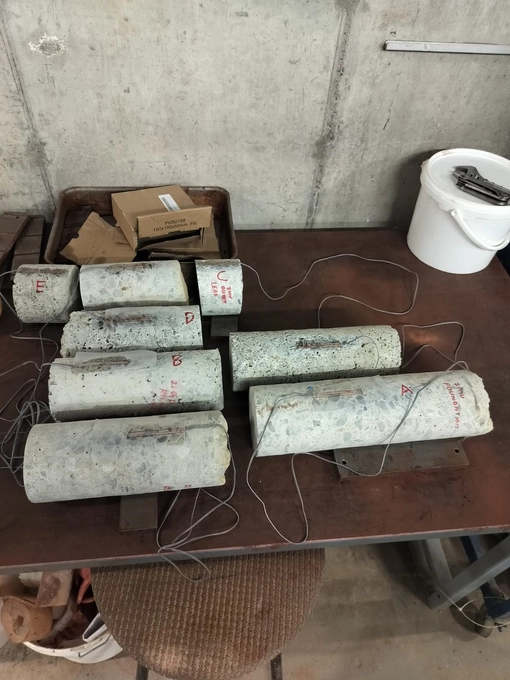 With core samples facilitated by the Geological Survey of Ireland (GSI), Prof. Rui Teixeira, principal investigator of the project, and Dr Kasulanati, obtained specimens taken from different structural elements, including the outer and inner leaves, rising walls, and foundations, from four of the affected houses, for experimentation. Small electrical sensors, called strain gauges, were attached to each sample to detect even small changes in its dimensions as the material deteriorated. The eight samples were then placed in a controlled climate chamber (called a Memmert HPP Constant Climate Chamber), where the researchers recreated the cold and humid conditions typical of Ireland, including a low temperature of 10°C and high relative humidity of 80%. A data logger, a device that automatically records measurements over time, recorded changes in the samples every 15 minutes, allowing the researchers to track their response throughout the experiment.
A consistent pattern has emerged across the structural elements: the above-ground walls and outer layers of the cavity walls showed much greater expansion than the foundations of the same property, even when all contained the same mineral composition. The greater exposure of these parts of the building to oxygen and moisture can accelerate the chemical reactions responsible for internal sulphate attack, causing greater expansion and deterioration. This confirms that greater moisture exposure drives faster and more severe ISA, and has direct implications for which parts of a home can be partially repaired versus fully replaced.
Figure 1 (left): Concrete core samples with strain gauges bonded to the surface.
Figure 2 (right): Samples instrumented and loaded inside the Memmert climate chamber at TCD.
Finding Better Solutions
Dr Kasulanati’s team meets regularly with the NSAI and the Housing Agency to ensure findings feed into national standards and future repair guidance. Currently, the only government-supported repair option is full demolition and rebuild under the Enhanced Defective Concrete Blocks Grant Scheme, with a cap of €462,000 per home. The total scheme cost is estimated at €2.2 billion, with projections as high as €3.6 billion. The research is working towards a classification framework, placing homes into one of four damage categories, thus enabling more targeted repair. For homes in earlier stages, it may be possible to remove and replace only the outer layer of a wall while leaving the inner structure intact. “We want to see more sustainable options so we can reduce the cost of repair and remediation,” she says. “If in some houses we can demolish only the outer leaf of the wall and leave the inside intact, that changes everything.”
- Article written by Sarah Cullen and Dr Kasulanati Madhavi Latha

Dr Kasulanati Madhavi Latha
Dr Kasulanati Madhavi Latha is a Postdoctoral Research Fellow in the School of Civil, Structural and Environmental Engineering at Trinity College Dublin. She is part of a research project, “A Study to Evaluate Alternative Methods of Remediation of Buildings Damaged by Defective Concrete Blocks”, funded through Construct Innovate and supported by the Department of Housing, Local Government and Heritage (DHLGH) and the National Standards Authority of Ireland (NSAI), in collaboration with the University of Galway and the Housing Agency.