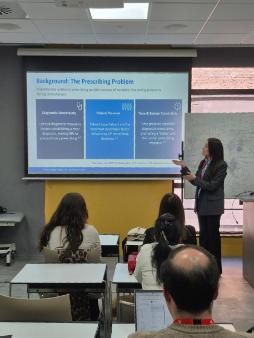
Congratulations to Dr Isil Coklar-Okutkan for her presentation at the Psychology, Health and Medicine Conference, held at Royal College of Surgeons in Ireland (RCSI) last week. Dr Coklar-Okutkan spoke about interventions to tackle antibiotic resistance and outlined early findings from interviews with patients and carers as part of the PREDICTORS Project (Point-of-caRE DiagnostICs for respiraTOry tRact infectionS), a Health Research Board (HRB)-funded programme.
Antimicrobial resistance is a significant global health challenge, and unnecessary prescribing is a key driver. In Ireland, antibiotic prescribing rates are slightly above the EU average, with respiratory tract infections among the most common reasons people receive a prescription. Most of these infections are caused by viruses, meaning antibiotics will not help. Without a test, it is genuinely difficult for a general practitioner (GP) or community pharmacist (CP) to be certain whether an infection is bacterial or viral, so antibiotics are sometimes prescribed as a precaution.
The project, led by Professor Cristín Ryan at the School of Pharmacy and Pharmaceutical Sciences, aims to target antibiotic resistance by developing a practical intervention to support general practitioners and community pharmacists in using rapid CRP (C-reactive protein) point-of-care tests when managing respiratory infections. These quick, finger-prick blood tests are carried out during a patient’s appointment and can help clinicians decide within minutes whether an antibiotic is genuinely needed.
Fifteen patients and carers with experience of respiratory infections took part in in-depth interviews. Most were in favour of CRP testing and were comfortable with both GPs and CPs carrying it out. They valued the diagnostic certainty it offered and felt greater confidence in prescribing decisions when backed by a test result. Participants also recognised broader benefits, including reduced pressure on healthcare services and support for preserving antibiotics for when they are truly needed.
Cost and accessibility were raised as the main practical concerns, with most participants feeling that testing should be state-funded. These patient findings will be brought together with interviews from GPs and CPs to inform the intervention being developed.
By placing patient perspectives at the centre of the research, the team is helping to ensure that any intervention developed will be both clinically sound and acceptable to the people it is designed to help. If successful, the project could contribute to meaningful changes in how respiratory infections are managed across primary care in Ireland, and inform policy on antibiotic stewardship more broadly.
Read the full protocol: https://doi.org/10.12688/hrbopenres.13962.2
The project can be followed here: https://lnkd.in/dbQ8wDcc