“This new world order didn’t start last year”, former European Commissioner Mairéad McGuinness said in her opening comments at the Trinity Long Room Hub’s recent ‘Behind the Headlines’ discussion on Venezuela, Greenland, and the New World Order?
Introducing the discussion, which included experts from history, law, environmental humanities and the world of EU politics, Professor Patrick Geoghegan, Director of the Trinity Long Room Hub, alluded to the fast-moving nature of events of the past two months.
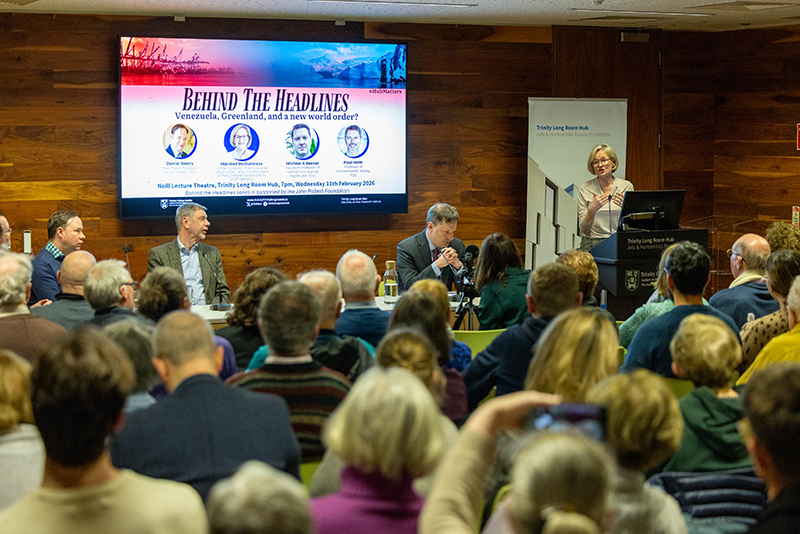
Mairéad McGuinness was EU Commissioner for Financial Stability, Financial Services and Capital Markets Union from 2020-24 and is currently the Vice-President of the European People’s Party. McGuinness told the audience that Covid and Brexit both represented significant shocks, and the pandemic was “the first jolt for the European economy and European system” that “made us think about supply chains”.
In a short talk which referenced security and defence, “provocative headlines” and coarsening language, McGuinness said that we need to remember how much Europe does for its citizens. She argued that the EU has shown itself capable of responding to crises, but to speak with a more unified voice it requires “more effort by member states and their leaders.”
Picking up on the now “forgotten” headline of Venezuela, Michael A. Becker, Assistant Professor of International Human Rights Law at Trinity College Dublin said that “part and parcel of dealing with the Trump administration” is that every week we have a new crisis to deal with.
At a previous event in January, Dr. Becker spoke with a retired US Marine Corps lawyer about the events leading up to Maduro’s arrest on ‘Murder on the High Seas? The Implications of US Attacks on Alleged Drug Traffickers’.
Dr. Becker argued that “the U.S. is running Venezuela from afar”. He said while we can have a conversation about the faults of international law and what international law should be, as it stands “violations attendant to that operation were so blatant.” In his talk he also referenced the dynamics of the long-running territorial dispute between Venezuela and Guyana - its neighbouring state - around the oil rich Essequibo region. He said the International Court of Justice (ICJ) in The Hague is currently presiding over this case, with hearings due in May 2026. The person, he said, who represented Venezuela in previous phases of the case was Delcy Rodríguez, the current interim President of Venezuela.
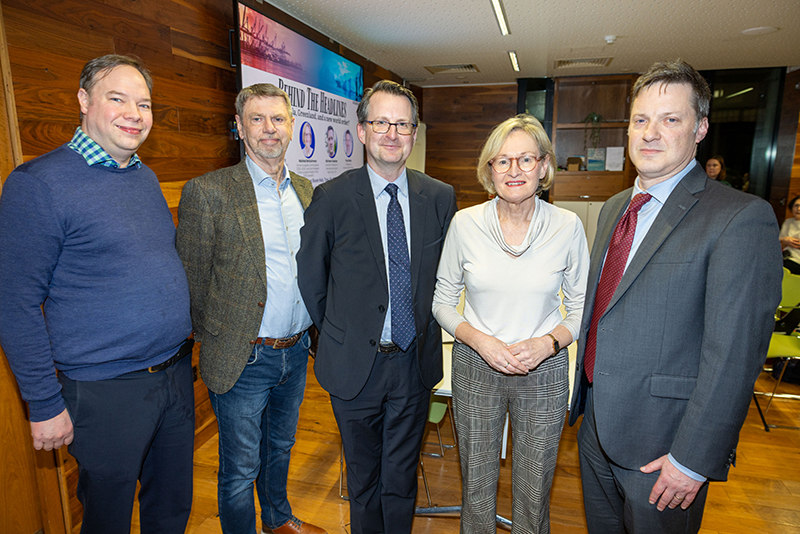
Daniel Geary, Poul Holm, Patrick Geoghegan, Mairéad McGuinness and Michael A. Becker
From the overthrow of Allende in Chile to the Panama war, Professor Daniel Geary highlighted “so many cases of the US intervening in Latin America in what people would say are clear violations of international law.” However, the Mark Pigott Professor in U.S. History at Trinity College Dublin highlighted the “brazenness” of the current administration, and a “lack of even attempting to justify themselves in terms of international law.” He added that when it comes to Latin America, the U.S approach has always been to make exceptions “when it wanted to”.
Moving from Venezuela to Greenland, Professor of Environmental History and Danish citizen Poul Holm said that while Greenland still holds strong aspirations for independence, what has transpired in the last year has brought Denmark and Greenland closer together.
In the past, he noted, that Denmark has been “arrogant” towards Greenlanders with a perception that Greenland was “too small to be an independent state”. “We have seen ourselves as gentle colonisers”, Professor Holm said of the Danish perspective, while now understanding that “a coloniser is a coloniser”.
He noted that a large proportion of Greenland's 57,000 citizens are ethnic Danes, and there is a lot of inter-marriage between the two nations. Confronted with the harsh decision to either go with the U.S. or remain tied to Denmark, he said all Greenland parties are now aligned that Greenland should remain with Denmark.
Listen to the full conversation here: