William Tyndale’s New Testament was printed in 1526 and we mark the 500th anniversary of this landmark moment in the course of the English Reformation and the development of the English language this year. This New Testament was the first to be printed in English and the first English translation to be made using the original Greek text.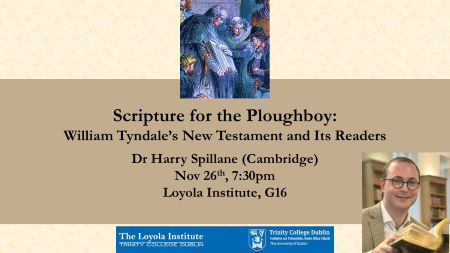
Tyndale proudly declared that his translation was for the ploughboy who would find comfort in the ‘plain text’. Yet, Tyndale also produced a series of prefaces and prologues, reading aids and marginal notes, that were designed to help guide his readers through their encounters with the Bible in English. In this lecture we will explore how Tyndale’s New Testament was packaged to be saleable and usable for everyone from the prince to the ploughboy. We will also ask what Tyndale’s reading aids might reveal about the anxiety reformers had about vernacular Bibles being read by the laity without guidance.
Ultimately, when Tyndale prayed moments before his execution for ‘God to Open the King of England’s eyes’ and allow everyone to legally possess an English Bible, what did he imagine his readers would do with their copies?
Lecture given by Dr Harry Spillane, a historian of the English Reformation with a particular interest in the history of the Bible, printing and the book. He is currently the Anthony Whiting Scholar at Emmanuel College and Bye-Fellow in History at Queens' College, Cambridge. He has previously been the Munby Fellow in Bibliography at Cambridge University Library and a research fellow at the Bodleian Library, Oxford. He has recently published his first book, 'Selling the Word of God: The Early Commercial History of the English Bible' (Bodleian Publishing, 2026 - £25.00).