
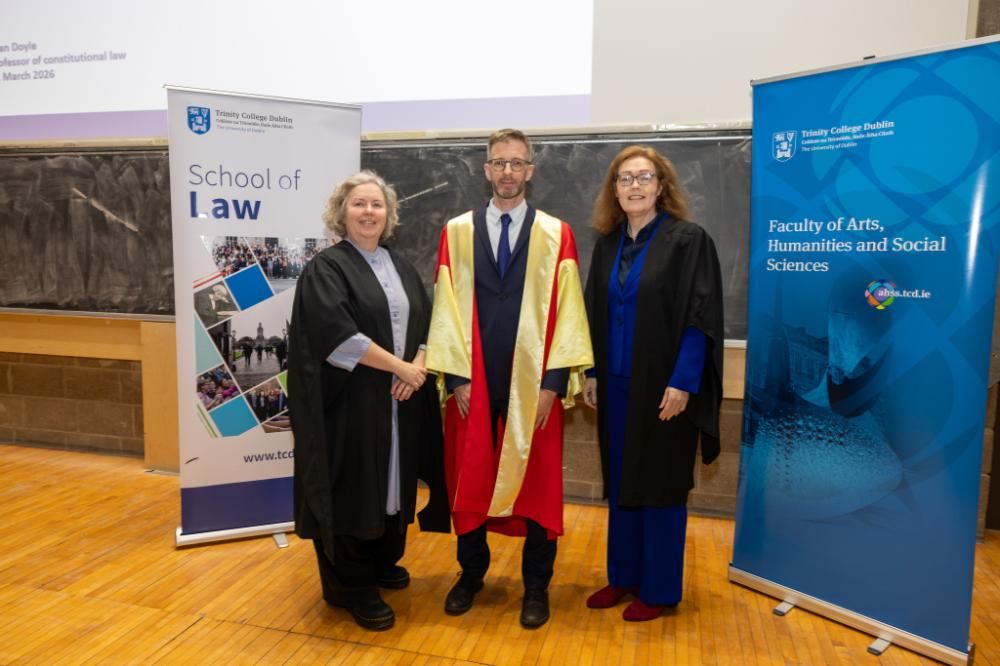
 Picture : Provost Linda Doyle, Professor Oran Doyle, the Dean of AHSS Professor Carmel O'Sullivan
The lecture’s focus point was to understand the power judges have in a democracy today and to see how they can sometimes overturn decisions made by elected officials. It appears that this problem occurs because judges are influenced by their interpretation of the law. Thus, Professor Doyle's point of interest was to understand how the people who are writing the constitution as well as judges try to find a solution to handle this problem.
Over the last decade, the role of the Irish Supreme Court has shifted, and the judges now agree the constitutional text must be read in its appropriate context. However, the question remains: what should be the context? While many judges fear that the use of "constitutionalist values" gives them too much power, some would argue that this approach is necessary to understand the true purpose of the Constitution.
Professor Doyle explained that the Constitution must be interpreted with these values in mind. He also added that, to keep judicial power in check, it is important for judges to enable democratic governance. A partial solution could be to see how other countries interpret similarly worded provisions.
He concluded his lecture on the importance to continue a dialogue, explaining: "It is a small contribution today to have opened up space in the debate to consider a slightly different approach."
About Professor Oran Doyle Professor
 Oran Doyle is the Head of the School of Law and Professor of Constitutional Law at Trinity College Dublin. A recognised expert in comparative constitutional law, his research focuses on territory, constitutional amendment, and the legal implications of Irish unification.
He has served as a constitutional law advisor to the Citizens' Assembly, was the founder and director of the COVID-19 Law and Human Rights Observatory, and acted as the Principal Investigator for the Irish Research Council-funded NSLMap project, which examined legal convergence across the Irish border. His research and expertise are frequently cited in Supreme Court judgements, reflecting his significant impact on the development of Irish law.