/filters:format(webp)/filters:quality(100)/prod01/channel_3/media/tcd/legacies/images/inisbofin-banner.jpg)
The July 2023 return from Trinity of the skeletal remains of 13 people to the island of Inishbofin featured among five case studies in the first report and guidance from the Government’s Advisory Committee on the Restitution and Repatriation of Cultural Heritage.
The report noted that the case “highlights the value of transparent processes, rigorous historical research, and meaningful engagement with descendant communities in addressing institutional legacies and ethical responsibility”.
It added: “The Inishbofin case broke new ground by setting a precedent for returning stolen remains to an Irish descendant community.”
The successful transfer of the human remains followed extensive engagement with the island community, whose advocacy and co-operation were crucial.
Trinity historians played a key role in the process, with Dr Ciaran O’Neill , Dr Patrick Walsh and Dr Mobeen Hussain (who was also then of the School of Histories and Humanities) working as part of the Trinity Legacies Review Working Group (TLRWG) to oversee the research, analysis and public consultation on the future of the remains.
This was the first case to be considered by the TLRWG, whose role is to collate and document evidence on legacy issues arising within the University.
The Board of the University approved the return of the remains in February 2023. In July, with the support of Old Anatomy Museum curator Evi Numen and chief technical officers Siobhan Ward and Philomena McAteer, the Inishbofin remains were signed over to a representative of the island community. An official release was signed by the Old Anatomy Museum, and witnessed by a Garda from Pearse Street Garda Station, Dublin. 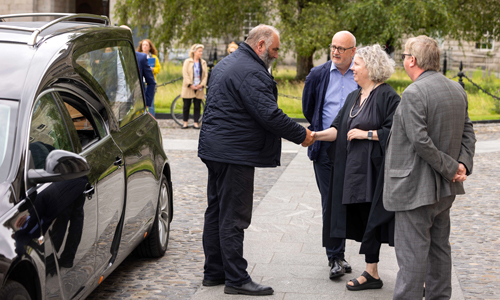
A ceremony took place in Trinity’s Chapel to mark their departure from Trinity and the University was also represented at the funeral ceremony on Inishbofin by Senior Dean Eoin O’Sullivan, Chair of the Legacies Review Working Group and by Dr Ciaran O’Neill.
The remains had made their way to Trinity after ethnologist Alfred Cort Haddon and student Andrew Francis Dixon (subsequently Trinity’s Professor of Anatomy), took partial skeletal remains of 13 people from St Colman’s monastery in Inishbofin, in July 1890. As is clearly documented in Haddon’s diary of the time, they did not seek the community’s consent.
The remains were stored in Trinity’s Old Anatomy Museum amid a contemporary interest in fields including craniometry (measurement of the cranium) and anthropometry (scientific measurement of individuals).
While considering the possible return, Trinity invited evidence-based submissions from the public on the future of the human remains from Inishbofin. It received 13 submissions, including a submission from most of the Inishbofin islanders.
The evidence documents compiled on the topic and the submissions received from the public and college community may be found below.
Evidential Review
Submissions
- Submission by Old Anatomy Museum
- Inishbofin Submission by SCA
- Inishbofin Submission by Pegi Vail
- Inishbofin Submission by Paul Gilmore
- Inishbofin Submission by Maedhbh Ní Dhubhshláine
- Inishbofin Submission by Inishbofin Islanders
- Inishbofin Submission by Inishbofin Development Company
- Inishbofin Submission by Edward Liebow
- Inishbofin Submission by EASA
- Inishbofin Submission for Dr Justin O'Brien
- Inishbofin Submission by CLIC Project
- Inishbofin Submission by Ciaran Walsh
- Inishbofin Submission by Christine Morris