
The Light of the Word: Exploring Stained Glass and the Bible - Took place on Thursday 14 May to Saturday 16 May 2025
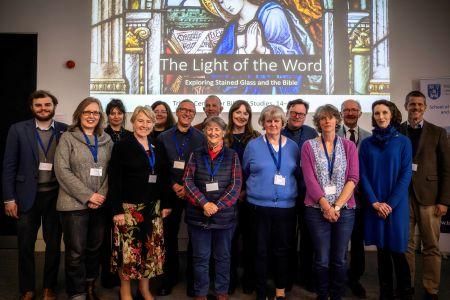
Image of Contributors (see below for details and references)
Session 1 - Back to the Bible 13:30–15:00 Chair: Stephen Huws ‘He took his sword’: Edward Burne-Jones’ David and Goliath (Christ Church, Oxford, 1872), the Dilessi Affair and Goliath’s Scabbard
David Shepherd
On the 11th of April 1870, a young Englishman, Frederick Vyner, the son of Lady Mary Vyner, was kidnapped by Greek brigands for ransom. When the rescue mission went wrong and young Frederick was killed, his Oxford college, Christ Church commissioned a memorial window to be designed by Edward Burne-Jones which included figures of Samuel, David, John the Evangelist and Timothy, all of them like Vyner, in the flower of their youth. In the predella below each, Burne-Jones included a biblical scene in which they feature and for David, Burne-Jones depicted the latter’s famous triumph over Goliath in single combat, recounted in 1 Samuel 17. This study considers how the refraction of the biblical tradition in Burne-Jones’ window was influenced by the circumstances of the commission but also by his awareness of earlier depictions of the scene by Raphael (ca. 1519) and/or Marcantonio Raimondi (ca. 1490-1534). However, this study also gives consideration to the way in which Burne-Jones’ depiction of David beheading Goliath invites reflection on various peculiarities of David’s felling of the giant from Gath in 1 Samuel 17, which have largely escaped the attention of biblical scholarship.
The Book of Revelation, as depicted in the seven stained glass windows of Irish artist Richard King (1907-74) in the chapel of Nazareth House, Malahide Road, Dublin, 1969-70
Ruth Sheehy
Richard King’s late stained glass windows from 1960-73 in Ireland and overseas reflect the artist’s own biblical and theological interests and provide a visual interpretation of this subject matter. His works from 1965-73, demonstrate the influence of the theology of Vatican II (1962-65), emphasising the Christ-event and the Paschal Mystery. The seven stained glass windows in Nazareth House (1969-70) were inspired by the Book of Revelation, which was a biblical subject of particular interest to King. These seven windows reflect both the salience of this number in Revelation and indicate the perfection of Christ, as the Alpha and Omega. The Paschal Mystery, celebrated in the Eucharist, is epitomised by the windows of the Cross and Resurrection and their Paschal and Apocalyptic Lambs. The Holy Spirit window evokes transcendence, divine radiance and the relationship between heaven and earth. The Mary window signifies her role in the incarnation and salvation as ‘a woman clothed with the sun’ from Revelation. The antique visual language of Early Christianity, reflected in the symbolism of these windows, shows a return to the authentic sources. Early Christian motifs, depicted in a modernist, abstract style, and with a restricted symbolical colour range and contrasts of light and darkness, are both evocative and stimulating. The compelling large window of Christ as the Fish from Early Christianity, focuses particularly on his Passion and Resurrection, as prefigured by Jonah and the whale from the Old Testament.
Session 2 – Image and Word
Chair: David Shepherd
Enriching the image: layered biblical narratives in stained glass
Martin Crampin
The biblical imagery of nineteenth- and twentieth-century stained glass is sometimes supplemented with biblical quotes from different parts of the Bible to convey layered theological ideas. This is perhaps most commonly seen in the use of Old Testament prophecy to accompany the imagery of the Gospel narratives, but may also be seen in the referencing of texts drawn from New Testament letters. In this way, texts found in lesser known corners of the Bible – from the minor prophets and denser passages in the letters ascribed to Paul – were combined with depictions of other biblical stories and themes that suggest a theological sophistication on the part of the patrons, designers and makers of stained glass. In addition to illustrating this phenomenon, this paper will also underline the necessity of including biblical references in comprehensive cataloguing of stained glass to facilitate this kind of comparative research.
Grand Biblical Narrative in Irish Gothic Revival Stained Glass
Stephen Huws
Although little stained glass survives in Ireland from before the mid-nineteenth century, the medium was embraced with remarkable ambition once it began to be widely adopted. This paper examines four major stained-glass programmes produced between 1862 and the end of the nineteenth century, a formative period in which Irish ecclesiastical patrons engaged intensively with the ideals of the Gothic Revival. Focusing on two Church of Ireland and two Catholic sites, including complete glazing schemes and complex multi-subject windows, the paper analyses how expansive biblical narratives were constructed across glass cycles rather than within isolated scenes. Drawing on examples from Christ Church Cathedral, Dublin (the restoration scheme by GE Street), St Patrick’s Cathedral, Dublin (the south transept window by William Wailes), and the complete glazing scheme by Lobin of Tours for Sligo Cathedral, this study explores how episodes from both the Hebrew Bible and New Testament are selected, ordered, and juxtaposed to articulate coherent visions of Christian history. Particular attention is paid to the interaction of image and text within these windows, examining how scriptural citations, captions, and typological pairings function hermeneutically. Through close comparison of Catholic and Protestant commissions, the paper argues that stained glass served as a powerful medium for expressing theological priorities and biblical interpretation in nineteenth-century Ireland. In doing so, it situates Irish Gothic Revival stained glass within broader debates on biblical reception, material theology, and the role of visual culture in shaping religious understanding.
Session 3 - Medieval
Martin Crampin
‘The Mind of Teachers’: Visual Exegesis and Late Medieval Glass
Karl Kinsella
In his popular twelfth-century liturgical commentary, Honorius Augustodunensis described the glass set within churches as mens doctorum (“The mind of teachers”) illuminated by the rays of sunlight passing through them. He wrote his De gemma animae a few short years before Abbot Suger commissioned and discussed the glass for the royally endowed abbey church of Saint Denis. The eastern end of the renovated church marks the first substantially Gothic structure, but also represents among the earliest systematic use of glass to tell stories. This paper examines examples of extant stained glass from the twelfth century in the context of the developing commentary tradition around architecture and visual exegesis. In addition to Honorius’s work, the school of Saint Victor down the road from St. Denis, established a consistent practice of visual exegesis, where images accompanied commentary texts and supported the arguments. We see a similar approach in the use of stained glass, where scenes from the Bible are subject to commentary traditions rather than simple story telling. For example, Saint Denis’s Tree of Jesse draws on recent manuscript practices in typological exegesis relating the Old to the New Testament. The content raises the question of audiences and whether the images in the east end of the church were intended for the monks of Saint Denis or the canons of Notre Dame, or whether they supported the laity’s engagement with allegorical readings of the Bible.
Unbridled Passions: The Origin of the Continental Glass in the East Window of Dublin Castle’s Chapel Royal
Susanna Wyse Jackson
Until now, it has been widely understood that the central section of the east window of Dublin Castle’s Chapel Royal comprises ‘fifteenth-century Continental glass’ of indeterminate origin. The four panels of this register contain scenes from the Passion of Christ. The scenes depicted are unexpected given their relative insignificance within the context of the narrative sequence as a whole, which suggests that the scenes derived from a larger series of panels, the full extent and location of which is unknown. Taking this iconographical conundrum as its point of departure, this paper seeks to challenge prevailing estimates by confidently dating the Continental glass to the 1520s–30s, rather than the fifteenth century, and by confirming its place of origin as Rouen, France. Furthermore, through stylistic, material, and documentary analysis, it has been possible to demonstrate that the dislocation and sale of the glass following the Treaty of Amiens (1802) led to the dispersal of the individual components of this complex French Passion cycle to a number of high-profile sites in Ireland and the UK, among them Dublin Castle, Ely Cathedral and, potentially, York Minster. By revealing the narrative and geographical extent of the dislocated Passion cycle, and in doing so, shedding light on this well-loved but poorly understood window, this paper tells the untold story of the journey of this remarkable glass from France, through the hands of the antiquarian salesman, to Ireland. This research therefore constitutes a new contribution to our understanding of this specific window, and underlines the importance of attending to both the impact of Continental political developments on the nineteenth-century trade in stained glass, as well as the visual manifestation of British imperialism within the material culture of Ireland’s capital.
Session 4 - Artists and their Iconographies
Chair: Susanna Wyse Jackson
Illuminating the Good Shepherd: Catherine O’Brien’s Interpretation of Biblical Imagery in Stained Glass.
Brigid Barron
Catherine O’Brien (1881–1964) was a distinguished stained glass and opus sectile mosaic artist, a devout member of the Church of Ireland and noted for her prolific contribution to ecclesiastical stained glass in Church of Ireland churches throughout Ireland and abroad. O’Brien’s stained glass occupies a distinctive position within Irish ecclesiastical art, demonstrating her deep respect for liturgical tradition through her sensitive handling of light, colour and form, where she transforms architectural space into a site of contemplation. Recent collation of a catalogue raisonné of O’Brien’s oeuvre builds on information gleaned from the Gazetteer of Irish Stained Glass, providing a resource for scholars and the critical analysis of O’Brien’s windows and comparison with that of her contemporaries. This paper takes up the biblical subject most frequently depicted by O’Brien—the Good Shepherd—focusing on her singular visual interpretation of the relevant biblical texts in Luke, John, and Psalm 23 in light of recent work on the depiction of the Good Shepherd in the work of Hubert McGoldrick and other artists associated with An Túr Gloine.
NOT Grave Saints: rigid in glass - How Karl Parsons illustrates the Bible in his stained glass
Sarah Lear
‘Grave saints: rigid in glass’ wrote Welsh poet R.S.Thomas describing many churches where stern and sombre depictions fill windows. Solemn, gaunt and severe, their entombed disapproval oozes imagery of a God who, at worst, frowns on or, at best, expects much of His creations. Those saints - biblical or otherwise - would turn in their graves to see the colourful, vibrant, dynamic imagery of Arts and Crafts stained glass artist Karl Parsons. Instead of grave saints, Karl presents theological constructs offering a popular, inclusive view of God - of comfort, colour, beauty and hope. My research demonstrates this with exemplary case studies drawn from across the British Isles which illustrate how his windows really were part of how ordinary churchgoers ‘lived religion.’ In this paper, I will discuss Parsons’ interpretation of the Bible and showcase the myriad details which enliven and banish the scary saints. In St Mary’s, Tenby, Wales, Parsons envisioned a personalised First World War memorial, creating art riffing on the theme of resurrection as a substitute gravestone. For St Martin of Tours, Epsom, the usually formal iconography of enthroned Virgin and child becomes a feminised sinuous dance-like composition interwoven with Benedicite canticle imagery. In St Mary’s, Whitekirk, Scotland, two saints conceal a mermaid and cryptic saying. Finally, for the second in his trilogy of stunning Christ in Majesty artworks, at Saintfield Church, Ireland, Karl produced a masterpiece incorporating twirling angels, devout green Saints plus an entire Nativity scene with presiding seraph. These iconographies will dispel Thomas’s gloomy notion and bring Karl’s alternative visual theology to life.
Session 5 - Illuminating Biblical Women
Chair: Chloë Reddaway Ways of Seeing the Bible Through Stained Glass
Holly Morse
Stained glass within sacred architecture offers a distinctive medium through which biblical texts are encountered not only intellectually but experientially and corporeally. Churches and cathedrals that incorporate stained glass effectively curate their own visual retellings of the Bible, producing narratives that rarely adhere to canonical ordering or textual boundaries. Stories from the Hebrew Bible and the New Testament are frequently interwoven, occasionally supplemented by apocryphal material, and structured according to liturgical rhythms, salvation history, and typological interpretation. In this way, biblical narratives are continually retold, generating new meanings and affective resonances through their visual arrangement. Building on David Shepherd’s demonstration of the value of narratological approaches and visual exegesis for the interpretation of biblical stained glass, particularly in relation to the work of Edward Burne-Jones, this paper broadens the methodological framework by introducing curatorial theory, participatory hermeneutics, and affect theory. It addresses two central concerns. First, it examines the interpretive transformations that biblical texts undergo when translated into stained glass, with particular attention to the visual construction and theological implications of representations of Eve. Second, it reflects on the ways that stained glass, especially when encountered in situ within ecclesial spaces, cultivates a particular way of seeing biblical narratives (Berger 1972). These modes of seeing encourage viewers to not only focus on close reading of isolated texts but to also encounter biblical stories beyond their original narratological contexts, allowing them to be reassembled into new constellations of meaning. Through this process, stained glass fosters fresh associations, analogies, and interpretive possibilities, generating new meanings and affective resonances for the Bible.
Through a Glass, Clearly: The Penitent Medium and Cazalet’s Mirfield Magdalenes
Siobhan Jolley
Mark Cazalet’s 2015 engraved glass screens for Mirfield Abbey’s Reconciliation Chapel radically depart from both traditional stained glass and confessional architecture. Fabricated in conjunction with Daedalian, light passes through the engraved and sandblasted surface, creating shifting patterns of opacity and transparency. An accomplished biblical interpreter across multiple media, Cazalet draws upon the rich reception of the biblical Mary Magdalene to create this penitential space. One screen, a triptych, traces the Magdalene’s composite Western identity as penitent sinner: washing Christ’s feet, grieving at the tomb, encountering the risen “gardener”. In the other, the Eastern Myrrh-bearer walks barefoot through a formal garden toward angelic witnesses (who gesture toward the resurrection altar). This paper makes two linked arguments about these screens. Firstly, it proposes that Cazalet treats Mary Magdalene’s multifaceted reception not as historical fragmentation requiring scholarly correction, but as a resource for reconciliation. Secondly, the glass itself is operant in this biblical interpretation; transparency and permeability are not neutral properties but performative qualities. What appears first as irony (centring a woman’s sin in male monastic space) is read here as theology, with the medium and the message combining to form a framework for repentance. Through close formal analysis and attention to biblical reception history, the paper demonstrates how Cazalet uses light, engraved surface, and spatial positioning to generate a material theology where the penitential medium becomes inseparable from the penitent witness. The Magdalene’s witness, etched in clear glass, offers transformation through openness rather than the enclosure.
Chair: Siobhan Jolley
Promise of the rainbow: Evie Hone in the 1940s
Joseph McBrinn
Evie Hone first read St. Augustine’s Confessions during the crisis of the First World War. Written at the end of the fourth century, St. Augustine’s remarkable autobiographical text includes meditations not just on the divine meaning of love but also on the human “origins of evil” that struck a particular chord with Hone, who like many of her contemporaries was trying to make sense out of the horrors of industrialised warfare. Augustine’s use of biblical text as a means of self-reflection, however, would profoundly shape Hone’s particular approach to the Bible as a source for both her abstract art and stained glass. In addition, her reading of Augustine was central to the importance she would place on the metaphysical as well as the theological conceptualisation of light and colour and especially on auratic symbols such as aureoles, halos, mandorlas, nimbuses, prisms and rainbows. This paper looks at the development and meaning of such symbols in Hone’s non-representational painting of the inter-war years and how it laid the foundations for her major stained glass of the 1940s on which her reputation as one of the greatest religious artists in post-war Europe was built.
‘Praise the Lord from the earth’ (Ps. 148:7): Thomas Denny’s Ecclesiastical Glass
Chloë Reddaway
The contemporary stained-glass artist, Thomas Denny, has produced work for 55 churches and cathedrals over the past four decades, making an exceptional contribution to the experience of light, colour, and space in ecclesiastical buildings. This paper draws on current research for a catalogue of and commentary on Denny’s windows which situates them within a theology of ecclesiastical stained glass as revelatory and spiritually formative, and within a line of British ‘visionary’ artists. A distinctive characteristic of many Denny windows is their exploration of the natural world through texts drawn from the Psalms, Wisdom literature, and Isaiah. These texts are not standard sources for stained glass windows but in Denny’s windows they become a lens through which to view the ‘book of nature’ (in line with patristic and medieval theologians including Maximus the Confessor and Hugh of St Victor, and their longer influence on the theological, and poetic, imagination), revealing a sanctity in landscape and creation at large. Unusually, Denny elevates the natural world to the place of protagonist in his windows, conveying the mystery and doxology of his Biblical sources through close readings - close visualisations - of particular places and their divinely expressive flora, fauna, and geology. As his figures travel through valleys, pass through waters, and climb holy mountains, they join a continuous stream of praise and worship issuing from the earth itself, whose ‘hills are clothed with gladness’ (Ps. 65:12), and present a visionary, sacramental, and redemptive, perception of the world as it is and as it should be.
Session 7 - The Typologies of Stained Glass
Chair: Holly Morse
‘Children of Rome’: Extending Biblical Typology in Killarney Cathedral’s Stained Glass Windows
Finola Finlay
This paper examines how a set of fourteen stained glass windows in Killarney Cathedral extends biblical typology beyond its traditional framework. While typology conventionally reads Old Testament events as prefiguring New Testament fulfilment (OT→NT), these fourteen windows create a new typological pattern: New Testament scenes prefiguring Irish hagiographic events (NT→IH). The Nativity anticipates Patrick’s fire at Tara; Christ’s baptism foreshadows Patrick baptising an Irish king; Christ’s condemnation presages Oliver Plunkett’s. Designed at Earley Studios by John Bishop Earley, and installed in 1911, evidence suggests the windows were the brainchild of Bishop John Mangan, who completed the building of the cathedral in this period. They were erected during a time of intense interest in Irish hagiography fuelled by many new translations. Nationalistic fervour coupled with ultramontane zeal supplies the lens through which our understanding of these windows must be refracted and that lens also helps us to appreciate how the Bishop appropriated biblical hermeneutics. In a radical interpretation, they claim that Irish sacred history was embedded in God’s eternal plan—that when Christ gave Peter the keys, he anticipated Ireland as 'Children of Rome.' This redeployment of scriptural interpretation suggests that biblical typology itself could be extended, adapted, and indeed weaponised to assert Ireland’s divinely ordained place in salvation history.
Refracted Fulfilment: A Theological Reading of the Stained Glass Programme in St Michael’s Church of Ireland, Limerick
Jessie Rogers
The stained glass programme in St Michael’s Church of Ireland, Limerick, reflects both theological intention and historical contingency. Its four nave stained glass windows articulate a structured typological reading of the Old Testament, pairing prophetic, priestly and royal figures (Elijah/Elisha; Isaiah/Jeremiah; David/Solomon and Aaron/Melchizedek). Within the spatial and liturgical logic of ecclesial architecture, such a sequence would ordinarily culminate in an explicitly Christological image in the chancel window. Instead, that expectation is interrupted by the presence of a five-lancet parable window which was relocated from St Mary’s Cathedral, introduced for pragmatic rather than theological reasons. When the windows are read together as a received visual programme, the anticipated depiction of Christ gives way to a clustered field of Gospel parables concerned with mercy, judgment, reversal, delay, and discernment. This paper argues that the resulting configuration, with its juxtaposition of typological iconography and parables, is theologically evocative. Christological presence is not abolished but mediated through parables. The teller of parables disappears into the parabolic logic itself. As light passes through this reconfigured programme, the Word is received, not as settled meaning, but as an invitation to creative interpretation. Drawing on biblical scholarship on parable and figural interpretation, the paper proposes that this stained glass programme functions as visual exegesis, in which theological meaning emerges through interruption and refraction. The relationship between anticipation and fulfillment in the biblical canon is encountered not as representational closure but as an interpretive event shaped by light, colour, and spatial sequencing.
Session 8 - The Bible, Irish Studios and the Wider World
Chair: David Shepherd
‘Don’t Forget the Shamrock’: Biblical Stained Glass at St Andrew Memorial, London, Ontario
Paul Donnelly
Through the 1950s and ‘60s hundreds of stained-glass windows were ordered from the Dublin studio of Harry Clarke Stained Glass Ltd. for more than twenty locations in North America. The orders mainly came from Irish American pastors working in parishes across the United States and Canada who wanted to include Irish stained glass in the decoration of their religious buildings. While the majority of the work was for Catholic churches on the West Coast, a series of commissions between 1957 and 1960 for an Anglican church in London, Ontario, is significant as it resulted in an integrated program of thirty-eight windows, the subjects for which are drawn from The Great Litany, biblical narratives described in the Old Testament, and the Life and Ministry of Jesus Christ. This paper focuses on the working relationship between the rector, Canon Alford Abraham, and the studios in terms of the selection and design of subjects. It also describes how the commission came about, some of the difficulties that arose over the course of the project, the resulting program of stained glass, and its reception. In addition to the religious importance of the windows, other aspects of the commission will be referenced, including the significance of ordering Irish stained glass for a Canadian church and how the approach to this work by Clarke Studios compared with other commissions at home and in the United States in that period.
New Testament Imagery in Devotional Representational Stained Glass in Catholic Ireland
Michael Earley
The period of sudden expansion and popularisation of devotional representation in Irish Catholic stained glass falls between the 1860s and the 1960s. The chief catalyst was the appointment of Cardinal Paul Cullen by Pope Pius IX to Ireland in 1849 which ushered in an era where the focus was on popular devotional piety coupled with a strongly authoritarian Rome following Tridentine principles. Stained glass became an obvious method by which approved imagery could be presented before the devout viewer, including a dazzling portrayal of saints and Bible stories in the decoration of sacral spaces. Examples illustrate that whereas the Irish market initially favoured Victorian stained glass such as that produced by Hardman in Birmingham, Earley & Powells in Dublin, and Joshua Clarke of Dublin, Catholic clergy increasingly preferred the more European representational imagery typified by Mayers of Munich. The Catholic hierarchy also favoured devotional imagery inspired by reproductions of paintings by artists such as Raphael and Murillo as seen in prints, prayer books, and prayer and mass cards but also the tableaux of Biblical scenes as seen in the art of the Nazarenes including Julius Schnorr’s ‘Bible in Pictures’. Stained glass artists realised that the Catholic clergy expected them to portray the Gospel stories in a literal and traditional manner with representational figures which would make Biblical instruction more accessible for believers by presenting ‘saints as familiar friends and sacred stories as actual and applicable’.
Contributors
Brigid Baron is currently completing a book on the life and times of stained-glass artist Catherine O’Brien based on MA research for an MA in Public History & Cultural Heritage from the University of Limerick (UL). She holds a Diploma in Genealogy from University College Cork and a Certificate in History of Family from UL. Professionally, Brigid worked as a Public Health Nurse until she co-founded a government funded charity called Caring for Carers Ireland. This organisation led to the formation of a Europe wide organisation called Eurocarers. Brigid became the organisation’s first elected chairperson. She has served on several statutory and voluntary boards including the Nursing and Midwifery Board of Ireland and the board of Ennis Information Age Town. She is a Fellow of the Faculty of Nursing and Midwifery, Royal College of Surgeons, Ireland.
Martin Crampin is an artist, photographer and designer based at the University of Wales Centre for Advanced Welsh and Celtic Studies in Aberystwyth. His main areas of research focus on ecclesiastical art, the visual culture of Medievalism and the Celtic Revival in Wales, and he has contributed to a series of innovative research projects including ‘Visual Culture of Wales’, ‘Imaging the Bible in Wales’, ‘The Cult of Saints in Wales’ and ‘Ports, Past and Present’. Publications include Stained Glass from Welsh Churches (2014), Depicting St David (2020) and Welsh Saints from Welsh Churches (2023). He has been the main author and producer of several online databases, mainly concerning ecclesiastical art in Wales, notably the ‘Stained Glass in Wales’ catalogue, which was launched in 2011 and continues to grow, with over 8500 images of nearly 3500 windows across Wales. Similar new resources for England and Scotland are planned for 2026.
Paul Donnelly was awarded a PhD (2023) by Trinity College Dublin (TCD) for his research on the stained glass work of the Irish artist Harry Clarke (1889 – 1931), and how the studio he founded built on his artistic legacy in the forty years following his death. Paul’s doctoral research focused on the stained glass made by Harry Clarke Studios for American clients in the mid-twentieth century, and on how cultural, religious and economic developments both in Ireland and the U.S. impacted the company’s production. On completion of his PhD, Paul accepted the position of Visiting Research Fellow in the School of Histories and Humanities at TCD, continuing his research into the work of Clarke and his studio. Paul’s publications include contributions to Harry Clarke and Artistic Visions of the New Irish State (2019), Gazetteer of Irish Stained Glass (2021) and Éire-Ireland, vol.60 (2025).
Michael Earley was awarded a PhD in December 2023 for his thesis on ‘the devotionalism and traditionalism in stained glass in twentieth century Ireland: Earley & Co. 1903-1953’ which he researched through the department of visual culture, NCAD. Since then, he has lectured on Irish stained glass and has published in local journals and in Glass Ireland on windows by Earley Studios. He is presently preparing a monograph on the studios. His primary degree was Medicine from UCD in 1973 (MB, BAO, BCh) and he qualified as a fellow of the Royal College of Surgeons in 1977 (FRCS Eng.). He obtained a specialist fellowship in plastic, reconstructive and aesthetic surgery in 1985 (FRCS plast.), completed a thesis on the arterial anatomy of the thumb for which he was awarded Master of Surgery by NUI in 1986 (MCh) and retired from his surgical career in 2017.
Finola Finlay completed a BA and MA at University College Cork, and undertook further doctoral-level research in British Columbia, Canada. She trained as an archaeologist and historian, excavating at Newgrange with Prof O'Kelly, and researching prehistoric Irish rock art. In Northern Canada she excavated fur trade forts and researched the history of the early fur trade. She spent most of her working life in higher education executive positions in Canada. Back in Ireland since 2012, she has written, with her late husband Robert Harris, the arts and culture blog Roaringwater Journal and contributed many articles to historical journals. She studies and photographs stained glass, is a contributor to the Gazetteer of Irish Stained Glass, has contributed a chapter to Glory Azure and Gold: the Stained Glass of Thomas Denny. She is working on a book about the life and work of stained glass artists, George Stephen Walsh and his son, George Walsh.
Stephen Huws completed his PhD at Trinity College Dublin in 2025, funded by the Provost’s Award and supervised by Professor David Shepherd. His doctoral research examined the reception of biblical narratives involving the Virgin Mary from the Lucan corpus in the stained glass of Dublin, combining art-historical analysis with biblical reception theory. His wider research interests include nineteenth- and twentieth-century stained glass, and the relationship between text, image, and theology in ecclesiastical art. Stephen’s research builds on earlier work undertaken during his MA in Medieval Studies at the University of York, where he examined medievalism in Pre-Raphaelite stained glass. He has presented papers at international conferences in both biblical studies and art history and has led specialist tours for the National Gallery of Ireland and the Stained Glass Museum, Ely. His publications include articles and reviews in the Journal of Stained Glass, Vidimus, The British Art Journal, and The Burlington Magazine.
Siobhán Jolley, FHEA, is a specialist in the reception of the Bible in visual art and popular culture. She is Lecturer in Christian Studies at the University of Manchester, having previously been the Howard and Roberta Ahmanson Research Fellow in Art and Religion at the National Gallery and Visiting Lecturer in Christianity and the Arts at King’s College, London. An expert in the portrayal of Mary Magdalene, her broader research interests include the work of female artists, the reception of biblical women and the New Testament, and feminist approaches. She also works as a curator and art consultant and teaches and writes regularly for major museums.
Karl Kinsella is a lecturer in medieval art and architecture in the University of Aberdeen’s Art History Department. He was Shuffrey Junior Research Fellow in Architectural History at Lincoln College in Oxford until 2021, and currently holds a Leverhulme Research Fellowship for a project on the Latin Language of Architecture. He has published widely, most recently God’s Own Language: Architectural Drawing in the Twelfth Century (2023), a monograph with MIT Press on early architectural drawings in twelfth-century exegetical literature.
Sarah Lear is a PhD student researching the stained glass iconographies of Karl Parsons (1884-1934), under the supervision of Professor Sarah Brown, University of York. She has shared her research at the New Illuminations symposium (Trinity College, Dublin, 2023), Heart of Glass (Dusseldorf, 2022) and at PhD conferences in York (2023, 2025) and has contributed to the Visit Stained Glass website. Her MA (King’s College, London) under the supervision of Dr. Jennifer Sliwka focused on a series of fifteen windows offering scenes from the Life of the Virgin by Harry Clarke (1924) at Ashdown Park, Sussex in the novitiate chapel of the Sisters of Notre Dame de Namur.
Joseph McBrinn was educated and has worked in Ireland, Scotland and France. He holds an MA and PhD in art history and is currently Reader in art history at Belfast School of Art, Ulster University, Belfast, Northern Ireland. He previously taught at the National College of Art and Design in Dublin. He is an art historian but writes about a broad range of contemporary art, modern craft and design history. He has published on the history of stained glass in The Journal of Stained Glass (BSMGP), Glass Ireland (GSoI) and The Journal of Modern Craft (Taylor & Francis). He is currently working on a biography of the pioneering Irish modernist and stained glass designer Evie Hone.
Holly Morse is Senior Lecturer in Bible, Gender and Culture at the University of Manchester. Her work to date has focused on the reception of Eve in Genesis 2-4 and representations of gender-based violence in the Hebrew Bible. She is author of Encountering Eve’s Afterlives: A New Reception Critical Approach to Genesis 2-4 (Oxford: Oxford University Press, 2020) and various publications on the reception of the Hebrew Bible, focusing particularly on visual arts, popular cultures, and gender. She is also co-founder of the Bible, Gender and Church Research Centre with Dr Kirsi Cobb and co-led the AHRC-funded research network Abusing God: Reading the Bible in the #MeToo Age.
Chloë Reddaway is the McDonald Agape Research Fellow in Theology and the Visual Arts, and Deputy Director of the Centre for Arts and the Sacred at King’s College London. She works in visual theology and Christian art, with a particular interest in artworks as sites of revelation and agents of spiritual formation and transformation. She has worked at the University of Cambridge, National Gallery, London, Duke Initiatives in Theology and the Arts, and on the Visual Commentary on Scripture at KCL. Publications include Transformations in Persons and Paint: Visual Theology, Historical Images and the Modern Viewer (Brepols, 2016), Strangeness and Recognition: Mystery and Familiarity in Renaissance Images of Christ (Brepols, 2019), and Theology, Modernity, and the Visual Arts (co-edited with Ben Quash). Public engagement work includes The Audacity of Christian Art (National Gallery, London 2017). Chloë is currently writing a monograph on Thomas Denny’s stained glass and co-editing a reader in hermeneutics in theology and the visual arts.
Jessie Rogers is Director of the Centre for Mission and Ministries and Lecturer in Sacred Scripture at St Patrick’s Pontifical University, Maynooth, where she previously served as Dean of Theology. She holds a PhD from Stellenbosch University, with research focused on biblical wisdom literature, and has published on Scripture, theology, and reception history. Her work includes studies on the cultural and artistic reception of the Bible, notably on biblical themes in Irish stained glass, as well as on parables, wisdom, and interpretive openness in Scripture. She is co-editor of Missed Treasures of the Holy Spirit: Distinctive New Testament Pneumatologies (2024) and a founding member of Tarsus Scripture School. Her current research interests include visual exegesis, parable as a mode of theological meaning, and the reception of Scripture within lived and ecclesial contexts.
Ruth Sheehy is an art historian and the Slide and Photographic Librarian emerita in the Department of the History of Art and Architecture, Trinity College Dublin. She has expertise in modern Irish stained glass and religious art of the twentieth century. Sheehy received her MLitt from the School of Art History and Cultural Policy in 2007 for her thesis on The Religious Art of Richard King in Ireland: 1933-73, which was the basis for The Life and Work of Richard King: Religion, Nationalism and Modernism (Peter Lang, 2020). Sheehy has published articles on Richard King in Doctrine & Life and given talks on King’s stained glass windows and on the religious dimension of his art in other media such as illustration, paintings in oils and other work in vitreous and non-vitreous enamels.
David J. Shepherd is Professor in Hebrew Bible in the School of Religion, Theology, and Peace Studies, Trinity College Dublin and founding director of the Trinity Centre for Biblical Studies. In addition to his work on the Hebrew Bible and its ancient translation, he has published widely on the reception of the Bible in the visual and performing arts of the late 19th and early 20th century and has received grant funding from Trinity College Dublin, the Irish Research Council and the Templeton Religion Trust for research on religious iconography in Irish stained glass. Recent research contributions include presentations on the iconography of Moses, Job, Samuel and the Good Shepherd at meetings of the American Academy of Religion/Society of Biblical Literature in San Antonio (2023), Amsterdam and San Diego (2024) and Boston (2025). His current monograph project is the first book-length study of biblical iconography in the stained glass of Edward Burne-Jones.
Susanna Wyse Jackson is a stained glass conservator from Dublin. After completing her BA in Ancient and Medieval History and Culture at Trinity College Dublin, she received her MA in Stained Glass Conservation and Heritage Management from the University of York. Following graduation, she joined the York Glaziers Trust where she has been employed as a stained glass conservator for the past three years. In this role, Susanna has conserved windows ranging in date from the 13th to the 20th century. She is a Pathway Member of ICON and is actively working towards professional accreditation. She has presented and published on a variety of topics including Irish medieval stained glass; the conservation of heat-damaged glass of York Minster; the depiction of women in the stained glass of late medieval York; and Irish stained glass artist Catherine O’Brien. Her current research interests include conservation cold paints and the stained glass of William Peckitt of York.