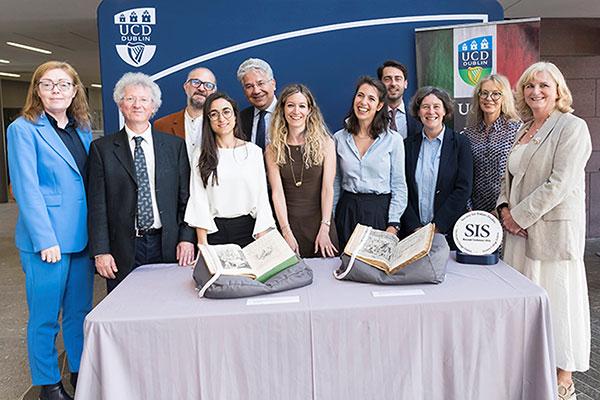
Image: Delegates attending the biennial conference of the Society for Italian Studies, including on the left, Professor Carmel O’Sullivan, Dean of TCD’s Faculty of Arts, Humanities and Social Sciences; in the centre, Ambassador of Italy to Ireland Nicola Faganello; on the right, Professor Ruth Glynn, Chair of the Society of Italian Studies and Professor Regina Uí Chollatáin, Dean of UCD’s College of Arts and Humanities; and in the centre, from left to right, the conference organising committee, Professor Paolo Acquaviva (UCD), Dr Igor Candido (TCD), Dr Serena Laiena (UCD), Dr Serena Vandi (TCD), Dr Mara Josi (UCD), Dr Marco Bellardi (UCD), Professor Clodagh Brook (TCD). Credit: Vincent Hoban.
Trinity College Dublin (TCD) and University College Dublin (UCD) joined forces to celebrate Ireland's pioneering role in Italian Studies as the first country in the world to establish university chairs in modern European languages. Together the universities hosted more than 300 international scholars for the biennial conference of the Society for Italian Studies.
At the gathering, UCD showcased its rich tradition in language education since the founding of the University. One of UCD’s best known graduates James Joyce, the author of Ulysses, graduated from the University in 1902 with a degree in modern languages, including Italian, a language that would leave a lasting imprint on his literary life and work.
UCD President Professor Orla Feely said “Today at UCD, the institution where James Joyce in 1902 graduated in modern languages (including Italian), we celebrate this mutual enrichment between cultures ... Openness to the outside world and mutual dialogue is what makes cultures vibrant. At a time when international collaboration, multilingualism and cultural understanding are increasingly central to Ireland’s economic and diplomatic future, this conference highlights the enduring role universities play in connecting Ireland to Europe and the wider world.”
The history of Italian Studies at Trinity College Dublin began in 1776 when the university appointed professors in French, German, Spanish and Italian, becoming the first university in the world to introduce the study of modern continental languages.
Professor Carmel O’Sullivan, Dean of the TCD Faculty of Arts, Humanities and Social Sciences, and speaking for the university’s Provost said “Italian has a deeply rooted tradition at Trinity, with many important milestones like the presence of Samuel Beckett who graduated in Italian and French in 1927. The establishment of these chairs tells us something important: that the case for studying other languages and cultures at the highest level is not a recent or fragile idea. It is, in this country, two hundred and fifty years old. The Provost behind that decision, Trinity’s John Hely Hutchinson, believed that a university education worthy of the name had to equip graduates not merely with knowledge of their own tradition, but with genuine access to others.”
The Heads of the Departments of Italian at TCD (Professor Clodagh Brook) and UCD (Professor Paolo Acquaviva), in their opening remarks, pointed to “an extraordinary fact that links our two departments: that two of the greatest modernist writers of the 20th century – James Joyce and Samuel Beckett did degrees in Italian”.
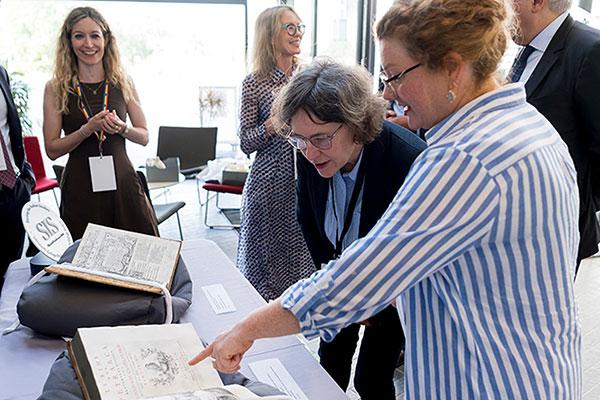
Image: UCD Library Head of Special Collections Lorraine McLoughlin shows delegates a rare 1756 edition of Le Rime del Petrarca, by Francesco Petrarch as well as a 1617 edition of Torquato Tasso’s epic poem La Gerusalemme Liberata. Credit: Vincent Hoban.
Professor Ruth Glynn, Chair of the Society for Italian Studies, added that the conference highlights the enduring value of cultural exchange and international collaboration and said “Italian is traditionally a language, and a culture, that brings people together. The spirit of partnership that has made this conference possible is here to demonstrate it.”
The Italian Ambassador to Ireland, Nicola Faganello, highlighted “the value of the Italian language and culture as tools for dialogue and mutual understanding, also noting that the event coincided with the start of Ireland’s EU presidency - a symbol of a shared commitment by Ireland, Italy, and the European Union to cooperation and cultural exchange”. His Excellency the Ambassador, on the eve of the conference, also generously hosted representatives of UCD and TCD, the keynote speakers, the Chair and other members of the Society for Italian Studies, together with a delegation of scholars in his residence for an opening reception.
 The conference of the Society for Italian Studies explored topics spanning eight centuries of Italian culture, from Dante, Boccaccio and the Renaissance to contemporary issues including migration, ecology, technology and Italian-Irish literary exchanges. Hosted jointly by UCD and TCD, the gathering commemorated the 250th anniversary of the world's first university chair in Italian being established.
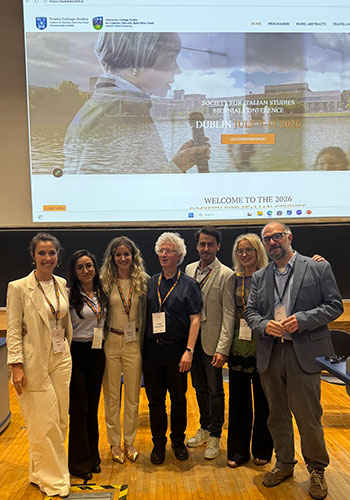
Image: The Conference organising committee from left to right: Dr Mara Josi (UCD), Dr Serena Laiena (UCD), Dr Serena Vandi (TCD), Professor Paolo Acquaviva (UCD), Dr Marco Bellardi (UCD), Professor Clodagh Brook (TCD), Dr Igor Candido (TCD).
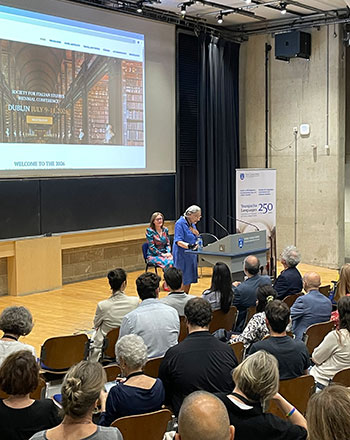 In welcoming delegates at TCD, together with Professor Carmel O’Sullivan, Professor Emerita Corinna Salvadori Lonergan traced a history of Italian Studies at TCD, since the establishment of the first chair. Professor Salvadori Lonergan also hosted a tour of Trinity College, together with Professor Edward Joseph McParland, for a large group of conference delegates. The event, Ireland’s largest ever symposium dedicated to Italian Studies, reflected a long-standing partnership between the Italian Studies departments at UCD and TCD.
Image: Professor Carmel O’Sullivan (seated) and Professor Corinna Salvadori Lonergan welcoming delegates at TCD, on the third day of the conference.
Please see also further news on this celebration and event on the School of Languages, Literatures and Cultural Studies website here. This event formed part of the TCD School of Languages, Literatures and Cultural Studies Languages 25 at Trinity (1776-2026) programme.