Congratulations to Grace Foley, PhD student, on being awarded the A.J. Leventhal Scholarship in 2026. Grace reports here on her funded research trip to the Department of Modern Languages, Literatures and Cultures (LILEC), and its Experimental Laboratory, at the University of Bologna, Italy.
A.J. Leventhal Scholarship Recipient Grace Foley Visits the University of Bologna. A two-week scholarship visit to Europe’s oldest university brings fresh perspectives on language, media and academic life.
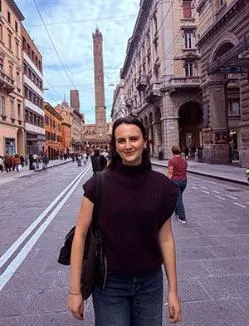 Crossing a road in Rome can feel like a conquest. Bologna moves to a different pace, beneath its historic porticoes (62 kilometres of them to be exact) students converse in lively streets and the city itself seems to not only form part of the university campus but to be the campus itself.
That blend of scholarship and city life framed my two-week visit to the University of Bologna as recipient of the A. J. Leventhal Scholarship. At an institution whose origins are dated back to 1088, I pursued my interests in Applied Linguistics and Communication Sciences while gaining a closer view of academic life in Italy.
Image: Grace Foley in Bologna.
Ideas behind ancient walls
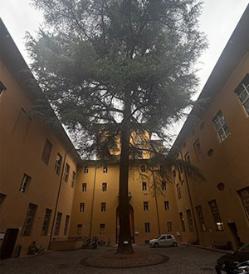
My visit began with a tour of the Department of Modern Languages, Literatures and Cultures led by Professor Elena Lamberti, Full Professor and Deputy Chair of the Department of Modern Languages, Literatures and Cultures. In a university shaped by more than nine centuries of intellectual life, our conversations looked firmly to the future. History was visible at every turn, from statues and paintings to winding staircases and windows opening onto striking views. At the heart of the Department of Modern Languages, Literatures and Cultures, a towering tree brings a touch of nature to the building.
 Professor Lamberti offered candid guidance on the opportunities and challenges of pursuing an academic career after a PhD. We discussed the contemporary media landscape, developments in communication research and possible directions for my doctoral work.
The visit also brought opportunities to meet Associate Professor Claudia Borghetti, Associate Professor Caterina Mauri and Professor Marianna Marcella Bolognesi, whose different perspectives broadened those conversations.
One of the most rewarding parts of the visit took place in LILEC’s Experimental Laboratory, established through the MIUR Departments of Excellence Initiative. Working with researchers Ludovica Pannitto and Carmelo Caruso introduced me to digital tools and technologies being used in innovative language research.
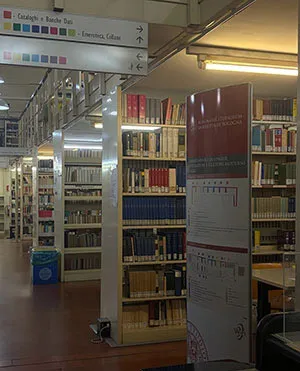
Image: The Department of Languages, Literatures and Cultures Library at the University of Bologna
Following the traces of Umberto Eco
Bologna also offered a chance to encounter the intellectual legacy of Umberto Eco, whose work on semiotics, language and communication has long inspired my research. At the historic Biblioteca Salaborsa, I visited the Piazza Coperta Umberto Eco, a space dedicated to his memory.
 Standing in the city where Eco taught and conducted research gave that influence a physical setting. It was a reminder that ideas do not exist only on the page, they are shaped by institutions, conversations, places and people!
The scholarship was academic at its core, but Bologna’s cultural life was never far away. Its food, architecture and public spaces offered another way to understand the region. By the end of the two weeks, the visit had become both a research opportunity and a measure of personal growth. I had formed valuable relationships with international scholars, strengthened my confidence as a doctoral researcher, I am especially grateful to Professor Lamberti for her generosity, encouragement and continued support.
Image: The Department of Modern Languages, Literatures and Cultures building in the University of Bologna
A scholarship with a legacy
Walking through the university’s historic buildings also prompted reflection on A. J. Leventhal, in whose memory the scholarship was established, and on his connection with European languages, literature and intellectual life. Conducting research in Bologna gave that legacy resonance.
The opportunity was made possible by the private donors and the T.C.D. Trust, whose support enables postgraduate students at Trinity College Dublin to extend their studies internationally. For me, Bologna has left more than memories of an extraordinary city, it has made a lasting contribution to my doctoral research, academic development and hopes for a future career in academia.
My research focuses on how the Irish language is portrayed in media discourse, examining representation and cultural belonging in particular. My research intersects with Professor Lamberti's work though a shared interest in how media narratives shape public perceptions about language and attitudes towards cultural memory, identity and belonging. Professor Lamberti is one of Europe's foremost McLuhan scholars. Professor Lamberti's volume "Marshall McLuhan’s Mosaic. Probing the Literary Origins of Media Studies (2012)" received the MEA Award 2016 - Award for Outstanding Book in the Field of Media Ecology.
Overall, the research visit was instrumental in establishing valuable academic relationships and translating my methodological framework into a practical research plan. It strengthened my understanding of data management in linguistics research and provided a clear workflow for the data-collection phase, which will begin in the third year of my doctoral studies. The visit therefore made a direct contribution not only to the feasibility, coherence, and methodological rigour of my project, but also to my longer-term professional development.
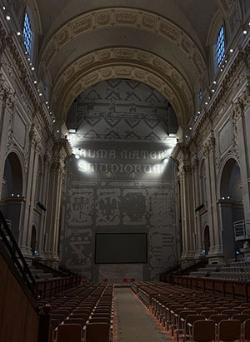
Image: The Alma Mater Studiorum at the University of Bologna
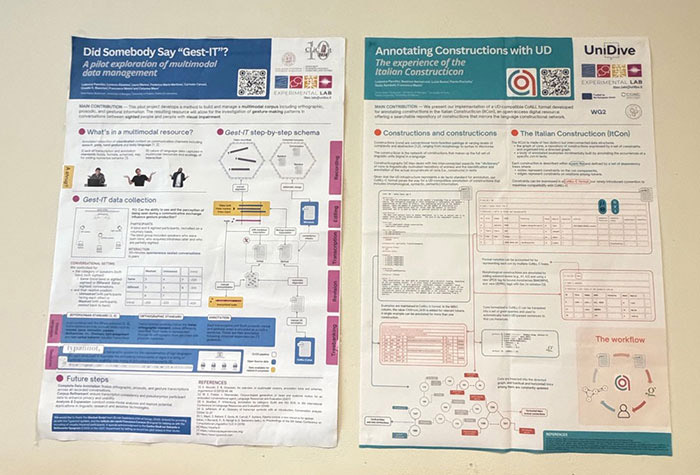
Image: Posters in The Experimental Laboratory in the University of Bologna
A.J. Leventhal Scholarship
The A.J. Leventhal Scholarship, funded by private donation and by the T.C.D. Trust, was created to enable graduates of Irish universities who are pursuing postgraduate studies in Trinity College, Dublin in modern languages or modern literature to further their studies in Europe. It is an annual scholarship, and applications are invited from registered postgraduate students in the Faculty of Arts, Humanities and Social Sciences who are pursuing research in modern languages or modern literature. Final year undergraduate students who expect to graduate this year and to register for a research degree in modern languages or modern literature may also apply. Further details are available from the Faculty Office by emailing artshss@tcd.ie.
All images courtesy of Grace Foley.