Congratulations to Arushi Sharma, PhD student in Law, and Jack Traynor, PhD student in History, who were both finalists in this year’s 3MT competition.
Trinity College Dublin recently held its annual Three Minute Thesis (3MT) competition. The competition is for PhD students and aims to cultivate their academic, presentation, and research communication skills. Students compete by aiming to explain their research in three minutes, in language appropriate for a non-specialist audience. The competition is a joint endeavour by the Dean of Students, the Dean of Graduate Studies and the Dean of Research. Further information is available on the 3MT competition website here.
Arushi and Jack share their experiences at the competition here.
Arushi Sharma, PhD student in the School of Law and an Early Career Researcher in the Trinity Long Room Hub.
Thesis title: ‘Fortifying Financial Frontiers: Safeguarding Data in Banking and Finance’.
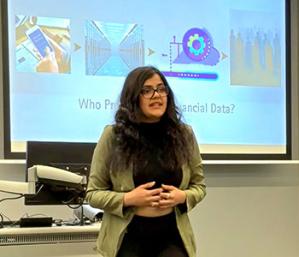 I recently took part in the Three Minute Thesis competition at Trinity College Dublin, where PhD researchers are asked to present their work in just three minutes to a general audience. It’s a fairly intense format: one slide, a strict time limit, and the challenge of making your research understandable to people outside your field. The competition runs internally within Trinity, with participants progressing through heats to a final round, and the winner going on to represent the university at the wider Coimbra Group competition.
The final took place on Wednesday, 25th March, from 6 PM onwards at the Bank of Ireland Theatre in the Trinity Business School, followed by a reception and a speech by the Associate Dean of Research.
My research focuses on data protection law, particularly in the context of financial systems and the growing role of artificial intelligence. Trying to distil that into three minutes forced me to step away from how I usually write and think about my work. It made me focus more on what actually matters in the research, what the problem is, why it matters, and how it connects to the real world.
One of the biggest things I took away from the experience was how easy it is, as researchers, to become deeply absorbed in our own work and lose sight of how to communicate it beyond our immediate academic circle. The process really pushed me to think about clarity, not just simplifying ideas, but making them meaningful and accessible without losing their depth.
It also made me realise that my research doesn’t sit in isolation. Engaging with other participants and their work highlighted how much overlap there is across disciplines, and how much stronger research can become when we allow for those connections. It encouraged me to think more openly about how my work might contribute to, and benefit from, conversations beyond law, particularly in areas where technology, behaviour, and policy intersect.
I was really pleased to make it to the final. Overall, it was a valuable experience both in terms of presentation skills, and how I think about my research and its place within a wider academic and societal context.
Jack Traynor, PhD student in History, School of Histories and Humanities.
Thesis title: ‘National Revolutionaries Across Borders: Transnational Encounters and Ideological Transfer between the IRA and the German nationalist fringe, 1919-39’.
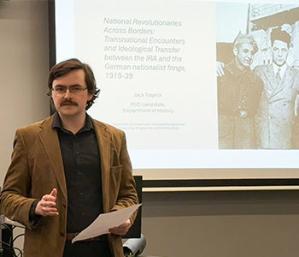 The three-minute thesis competition is a unique opportunity to present PhD research to a non-specialist audience within a very short timeframe. It requires participants to get to the central themes of their research and answer the question of why it matters. This can be challenging, but it’s a worthwhile exercise. It helped me to think about my own research and how it can best be presented, particularly to an audience outside my own academic specialism (twentieth century history).
Although officially a competition, everyone at the event was laid-back which made for a pleasant environment. We were all there to present our research findings and to learn about the interesting work being done by our peers in Trinity, particularly in areas we would not usually experience. In my own case, most of my peers are also working on history PhDs - so it was brilliant to meet people from fields like science and medicine and to hear about their research.
I was grateful to progress to the final of the competition. The feedback received from the panel was particularly useful. If I could give advice to future participants, it would be to try to avoid speaking from notes - this requires greater preparation, but it makes for a more engaging presentation. Fine-tuning a presentation encompassing your entire research to just three minutes can prove surprisingly difficult. I would recommend anyone considering applying for next year’s three-minute thesis to go for it, as it’s a great opportunity to reflect on your key research questions and to develop as a public speaker.
Congratulations and thanks to both students for sharing their experience and insights, which will help and inspire fellow students to participate in future years.