
Virpi Timonen, Professor of Social Research and Theory, will deliver her Inaugural Lecture titled ‘On Growing Old in the 21st Century’.
Date: Wednesday 07 October 2026
Time: 18.15 - 19.15
Location: Robert Emmet Theatre, Arts Building, Trinity College Dublin.
Admission is free and open to the public.
Please click here or on the image below to register for a ticket and for further information.
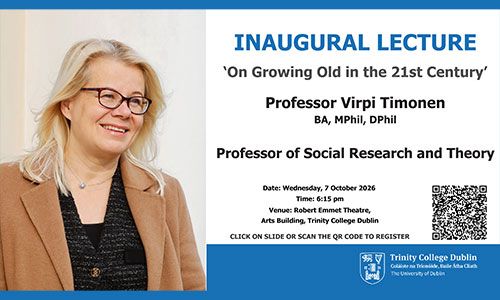
Please join us for the Inaugural Lecture of Professor Virpi Timonen.
Abstract
This lecture examines the demographic, social, and institutional transformations underlying population ageing in high-income societies, and considers their implications for how growing old should be understood and governed. Contemporary populations are living substantially longer than previous generations, with mortality at younger ages dramatically reduced and life expectancy at older ages significantly extended. Members of younger cohorts in aged societies can expect to live into their second century, an unprecedented prospect.
Drawing on Professor Timonen’s works, the lecture develops three interconnected arguments.
First, ageing is deeply relational: resilience and wellbeing in later life are not personal achievements but are produced through social relationships. Care – inherently relational and essential human activity – remains an inadequately collectivised social risk, disproportionately absorbed by families and by poorly remunerated workers.
Second, social institutions have not adapted to the reality of extended lifespans. Normative assumptions about education, employment, retirement, and the sequencing of the life course remain oriented to historically shorter lives, generating avoidable strain, particularly for mothers and grandmothers navigating reproduction, career-building, and caregiving.
Third, longer lives create both an opportunity and an obligation to reconsider individual and collective relationships to time, generativity, and intergenerational responsibility – extending this responsibility beyond the human lifespan to broader ecological and future-oriented considerations. Building on her research on ageing families, care, and social policies, Professor Timonen’s lecture marshals the case against individualised prescriptions for "successful ageing" and instead calls for a reorientation of policy and social imagination toward the collective, relational, intergenerational, and more-than-human dimensions of long lives.
Biography of Professor Virpi Timonen
Virpi Timonen completed her DPhil in Politics at the University of Oxford (Magdalen College) in 2001. Her research spans social policies in ageing societies, sociology of intergenerational relationships, and research methods. Her investigations of intergenerational relations and grandparenting have provided new insights into how older adults contribute to the maintenance of family and societal solidarity but also disrupt established roles. Professor Timonen has theorised how successful and active ageing are socially constructed through policymaking; her theory of Model Ageing takes a critical stance on paradigms that currently dominate policy making for older adults. Her contributions to research on qualitative research methods are highly cited and have made Grounded Theory more accessible for researchers across disciplines and substantive fields. Among recent publications, her 2025 book Social Policy: The Quest for Freedom, Equality and Justice (Cambridge: Polity) sets out the core ideational constituents of present and future welfare societies.
Professor Timonen’s current research, funded by an Advanced Grant from the European Research Council (ERC), is generating new insights into material and environmental legacy-making among co-existing generations. An open access book published in 2026 by Cambridge University Press, titled Small Worlds: Theorising Material and Environmental Legacies, presents her original concept of legacy-making: future-oriented ideation and actions pertaining to the material and environmental effects that humans leave behind. Recent and forthcoming work interrogates environmental relationalities – how humans understand ‘the environment’ – and interconnections between how we think about and act in relation to our material possessions and environmental effects in the era of climate turbulence.
Further information on this inaugural lecture is available by emailing the Faculty Office, Faculty of Arts, Humanities and Social Sciences at artshss@tcd.ie