Date: Thursday 05 February 2026
Time: 16.00 to 17.30
Location: Boydell Recital Room, House 5, Top Floor, Trinity College Dublin.
Admission is free and all are welcome.
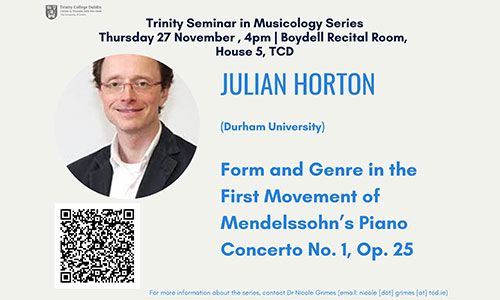
'Form and Genre in the First Movement of Mendelssohn’s Piano Concerto No. 1, Op. 25'. A talk by Julian Horton (Durham University, UK).
'Mendelssohn', so Donald Francis Tovey tells us, 'may truthfully be said to have destroyed the classical concerto form' (1936, p. 178). Tovey’s comment responds to Mendelssohn’s replacement, in all three of his mature concertos, of the classical concerto first-movement form, which embeds a sonata form within an alternation of tutti and solo sections, with a unitary sonata form more common in symphonic or chamber music. My talk explores this innovation in the first movement of the Piano Concerto No. 1 in G minor, Op. 25 (1831). This movement’s radicalism is not limited to its formal scheme. The material discloses significant ambiguities, which problematise attempts to define the succession of themes; and at significant junctures, Mendelssohn blurs formal boundaries by dislocating thematic events from their underlying harmonic, tonal and contrapuntal frameworks. I conclude by offering thoughts on my analysis’s relevance of the theory of musical form – the so-called 'New Formenlehre' – and especially its recent 'Romantic' turn, which has sparked fresh interest in Mendelssohn’s instrumental music.
Biography
Julian Horton is Professor of Music Theory and Analysis at Durham University. He was educated at Trinity College, Cambridge, receiving his doctorate in 1998, and also held a Junior Research Fellowship at Trinity between 1996 and 2000. He taught analysis at King’s College London between 2000 and 2001, and held a lectureship at UCD between 2001 and 2013. His research concerns the theory, analysis and reception of nineteenth-century instrumental music. He has published widely on the analysis of Romantic sonata form, theories of tonality, the symphony, the concerto and the music of Bruckner, Brahms, Schubert, Mendelssohn and Schumann. He has served twice as president of the Society for Music Analysis and was a founding member of the Society for Musicology in Ireland, of which he has since been elected a Corresponding Member.
Please sse also this video biography: https://www.youtube.com/watch?v=0tQ-z8yV-bU
For further information on this event please email Dr Nicole Grimes, Department of Music, School of Creative Arts, at nicole.grimes@tcd.ie